4RHD image
Deposition Date 2014-10-01
Release Date 2015-07-08
Last Version Date 2024-02-28
Entry Detail
PDB ID:
4RHD
Keywords:
Title:
DNA Duplex with Novel ZP Base Pair
Biological Source:
Source Organism(s):
Method Details:
Experimental Method:
Resolution:
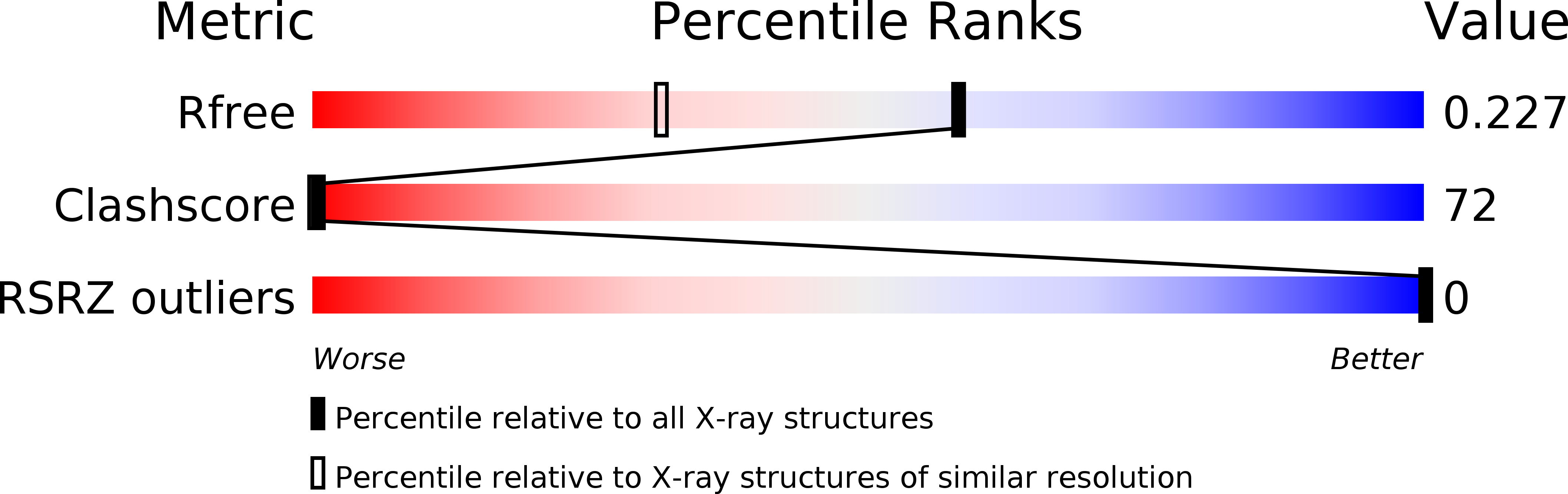
1.70 Å
R-Value Free:
0.22
R-Value Work:
0.22
R-Value Observed:
0.22
Space Group:
P 3
Macromolecular Entities
Polymer Type:polydeoxyribonucleotide
Molecule:DNA 9mer novel Z nucleobase
Chain IDs:A, C, E, G
Chain Length:9
Number of Molecules:4
Biological Source:synthetic construct
Polymer Type:polydeoxyribonucleotide
Molecule:DNA 9mer novel P nucleobase
Chain IDs:B, D, F, H
Chain Length:9
Number of Molecules:4
Biological Source:synthetic construct
Modified Residue
Compound ID Chain ID Parent Comp ID Details 2D Image
T5S A DT ?
Ligand Molecules
Primary Citation
Evolution of functional six-nucleotide DNA.
J.Am.Chem.Soc. 137 6734 6737 (2015)
PMID: 25966323 DOI: 10.1021/jacs.5b02251

Abstact

Axiomatically, the density of information stored in DNA, with just four nucleotides (GACT), is higher than in a binary code, but less than it might be if synthetic biologists succeed in adding independently replicating nucleotides to genetic systems. Such addition could also add functional groups not found in natural DNA, but useful for molecular performance. Here, we consider two new nucleotides (Z and P, 6-amino-5-nitro-3-(1'-β-D-2'-deoxyribo-furanosyl)-2(1H)-pyridone and 2-amino-8-(1'-β-D-2'-deoxyribofuranosyl)-imidazo[1,2-a]-1,3,5-triazin-4(8H)-one). These are designed to pair via complete Watson-Crick geometry. These were added to a library of oligonucleotides used in a laboratory in vitro evolution (LIVE) experiment; the GACTZP library was challenged to deliver molecules that bind selectively to liver cancer cells, but not to untransformed liver cells. Unlike in classical in vitro selection, low levels of mutation allow this system to evolve to create binding molecules not necessarily present in the original library. Over a dozen binding species were recovered. The best had Z and/or P in their sequences. Several had multiple, nearby, and adjacent Zs and Ps. Only the weaker binders contained no Z or P at all. This suggests that this system explored much of the sequence space available to this genetic system and that GACTZP libraries are richer reservoirs of functionality than standard libraries.

Legend

Protein

Chemical

Disease

Primary Citation of related structures
Feedback Form
Name
Email
Institute
Feedback