4RAF image
Deposition Date 2014-09-10
Release Date 2015-08-26
Last Version Date 2023-11-08
Entry Detail
PDB ID:
4RAF
Title:
Crystal structure of PP2Ca-D38A
Biological Source:
Source Organism:
Homo sapiens (Taxon ID: 9606)
Host Organism:
Method Details:
Experimental Method:
Resolution:
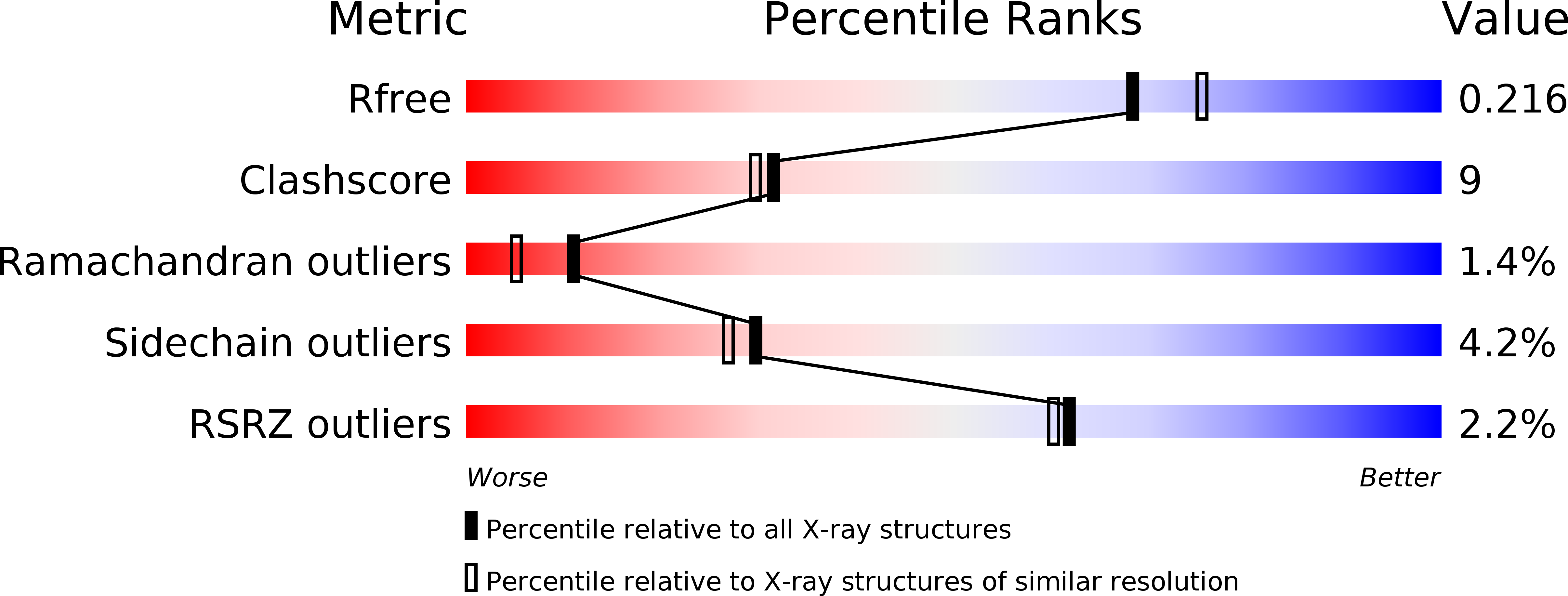
2.00 Å
R-Value Free:
0.22
R-Value Work:
0.19
R-Value Observed:
0.19
Space Group:
P 31 2 1
Macromolecular Entities
Structures with similar UniProt ID
Protein Blast
Polymer Type:polypeptide(L)
Molecule:Protein phosphatase 1A
Gene (Uniprot):PPM1A
Mutagens:D38A
Chain IDs:A
Chain Length:367
Number of Molecules:1
Biological Source:Homo sapiens
Ligand Molecules
Primary Citation
The catalytic role of the M2 metal ion in PP2C alpha
Sci Rep 5 8560 8560 (2015)
PMID: 25708299 DOI: 10.1038/srep08560

Abstact

PP2C family phosphatases (the type 2C family of protein phosphatases; or metal-dependent phosphatase, PPM) constitute an important class of signaling enzymes that regulate many fundamental life activities. All PP2C family members have a conserved binuclear metal ion active center that is essential for their catalysis. However, the catalytic role of each metal ion during catalysis remains elusive. In this study, we discovered that mutations in the structurally buried D38 residue of PP2Cα (PPM1A) redefined the water-mediated hydrogen network in the active site and selectively disrupted M2 metal ion binding. Using the D38A and D38K mutations of PP2Cα as specific tools in combination with enzymology analysis, our results demonstrated that the M2 metal ion determines the rate-limiting step of substrate hydrolysis, participates in dianion substrate binding and stabilizes the leaving group after P-O bond cleavage. The newly characterized catalytic role of the M2 metal ion in this family not only provides insight into how the binuclear metal centers of the PP2C phosphatases are organized for efficient catalysis but also helps increase our understanding of the function and substrate specificity of PP2C family members.

Legend

Protein

Chemical

Disease

Primary Citation of related structures
Feedback Form
Name
Email
Institute
Feedback