4QZA image
Deposition Date 2014-07-27
Release Date 2015-06-10
Last Version Date 2023-09-20
Entry Detail
PDB ID:
4QZA
Keywords:
Title:
Mouse Tdt in complex with a DSB substrate, C-C base pair
Biological Source:
Source Organism:
Mus musculus (Taxon ID: 10090)
Host Organism:
Method Details:
Experimental Method:
Resolution:
2.15 Å
R-Value Free:
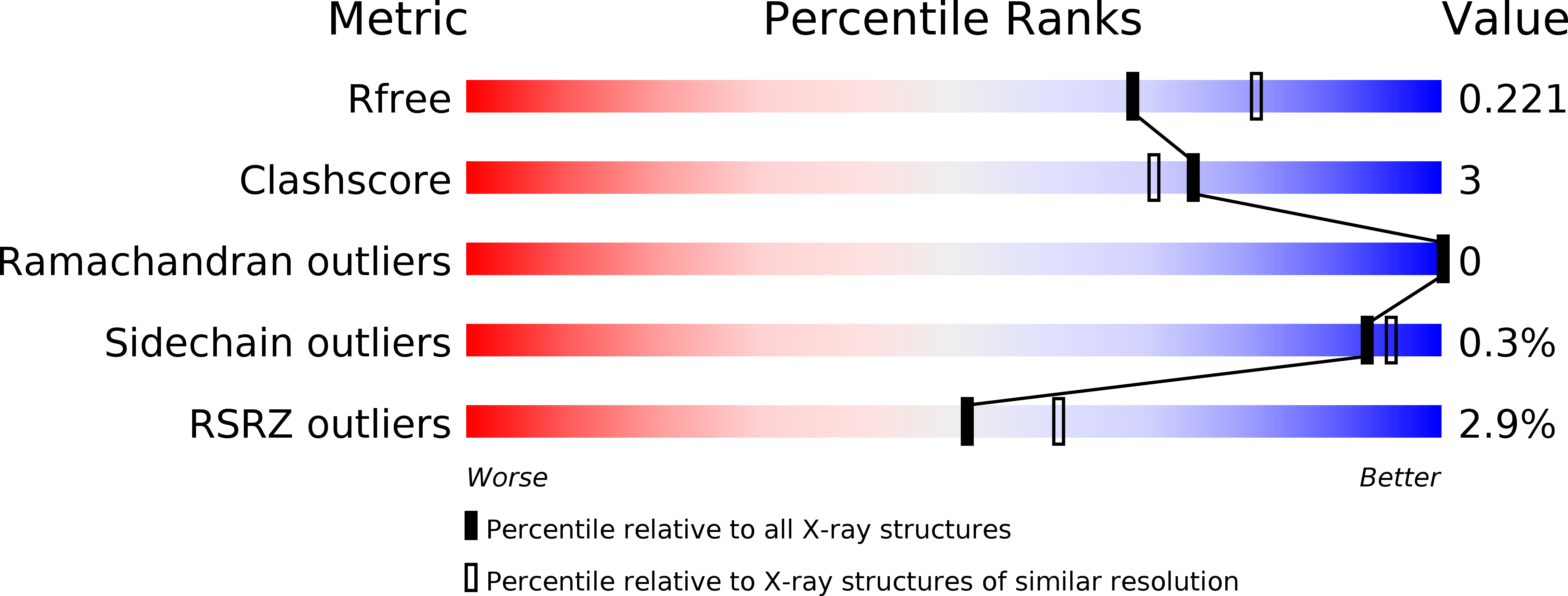
0.21
R-Value Work:
0.18
R-Value Observed:
0.19
Space Group:
C 1 2 1
Macromolecular Entities
Structures with similar UniProt ID
Protein Blast
Polymer Type:polypeptide(L)
Molecule:DNA nucleotidylexotransferase
Gene (Uniprot):Dntt
Chain IDs:A
Chain Length:400
Number of Molecules:1
Biological Source:Mus musculus
Primary Citation
Structural basis for a novel mechanism of DNA bridging and alignment in eukaryotic DSB DNA repair.
Embo J. 34 1126 1142 (2015)
PMID: 25762590 DOI: 10.15252/embj.201489643

Abstact

Eukaryotic DNA polymerase mu of the PolX family can promote the association of the two 3'-protruding ends of a DNA double-strand break (DSB) being repaired (DNA synapsis) even in the absence of the core non-homologous end-joining (NHEJ) machinery. Here, we show that terminal deoxynucleotidyltransferase (TdT), a closely related PolX involved in V(D)J recombination, has the same property. We solved its crystal structure with an annealed DNA synapsis containing one micro-homology (MH) base pair and one nascent base pair. This structure reveals how the N-terminal domain and Loop 1 of Tdt cooperate for bridging the two DNA ends, providing a templating base in trans and limiting the MH search region to only two base pairs. A network of ordered water molecules is proposed to assist the incorporation of any nucleotide independently of the in trans templating base. These data are consistent with a recent model that explains the statistics of sequences synthesized in vivo by Tdt based solely on this dinucleotide step. Site-directed mutagenesis and functional tests suggest that this structural model is also valid for Pol mu during NHEJ.

Legend

Protein

Chemical

Disease

Primary Citation of related structures
Feedback Form
Name
Email
Institute
Feedback