4QRY image
Deposition Date 2014-07-02
Release Date 2015-06-17
Last Version Date 2024-11-20
Entry Detail
PDB ID:
4QRY
Title:
the ground state and the N intermediate of pharaonis halorhodopsin in complex with bromide ion
Biological Source:
Source Organism(s):
Method Details:
Experimental Method:
Resolution:
2.20 Å
R-Value Free:
0.24
R-Value Work:
0.21
R-Value Observed:
0.21
Space Group:
C 1 2 1
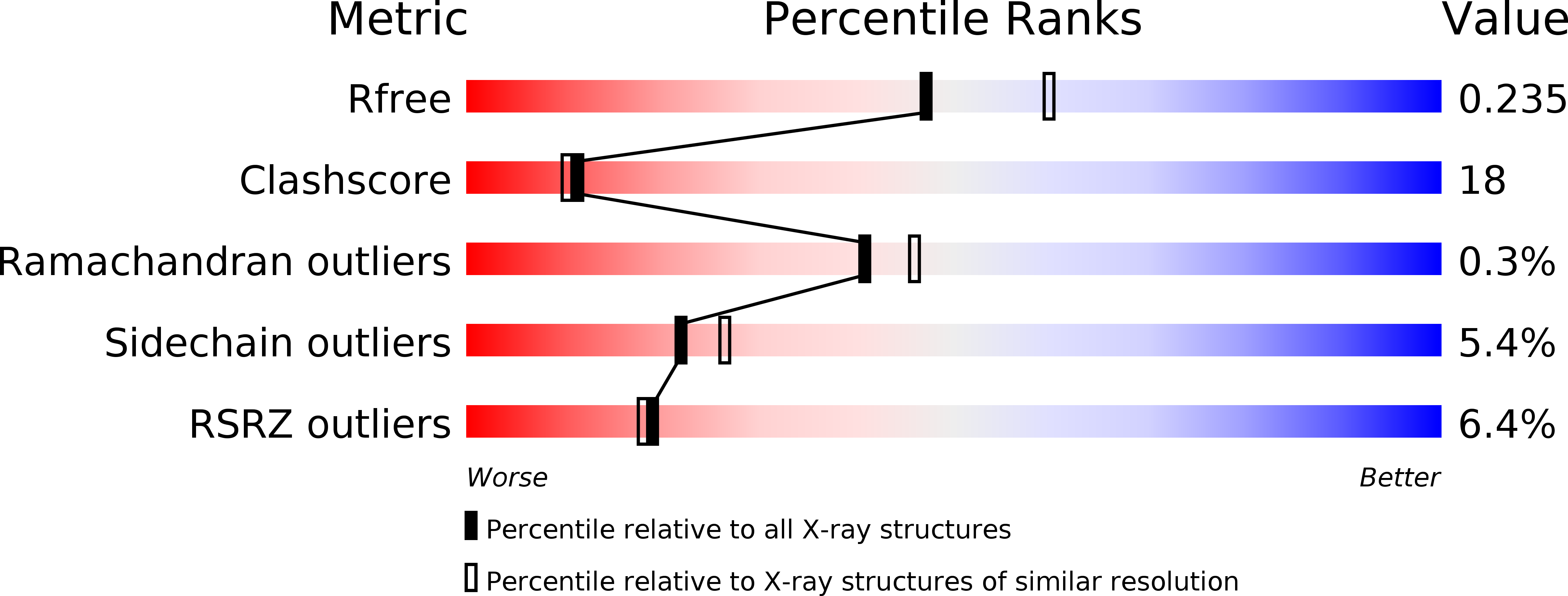
Macromolecular Entities
Polymer Type:polypeptide(L)
Molecule:Halorhodopsin
Chain IDs:A, B, C, D (auth: E), E (auth: F), F (auth: G)
Chain Length:291
Number of Molecules:6
Biological Source:Natronomonas pharaonis
Primary Citation
Crystal Structures of the L1, L2, N, and O States of pharaonis Halorhodopsin
Biophys.J. 108 2680 2690 (2015)
PMID: 26039169 DOI: 10.1016/j.bpj.2015.04.027

Abstact

Halorhodopsin from Natronomonas pharaonis (pHR) functions as a light-driven halide ion pump. In the presence of halide ions, the photochemical reaction of pHR is described by the scheme: K→ L1 → L2 → N → O → pHR' → pHR. Here, we report light-induced structural changes of the pHR-bromide complex observed in the C2 crystal. In the L1-to-L2 transition, the bromide ion that initially exists in the extracellular vicinity of retinal moves across the retinal Schiff base. Upon the formation of the N state with a bromide ion bound to the cytoplasmic vicinity of the retinal Schiff base, the cytoplasmic half of helix F moves outward to create a water channel in the cytoplasmic interhelical space, whereas the extracellular half of helix C moves inward. During the transition from N to an N-like reaction state with retinal assuming the 13-cis/15-syn configuration, the translocated bromide ion is released into the cytoplasmic medium. Subsequently, helix F relaxes into its original conformation, generating the O state. Anion uptake from the extracellular side occurs when helix C relaxes into its original conformation. These structural data provide insight into the structural basis of unidirectional anion transport.

Legend

Protein

Chemical

Disease

Primary Citation of related structures
Feedback Form
Name
Email
Institute
Feedback