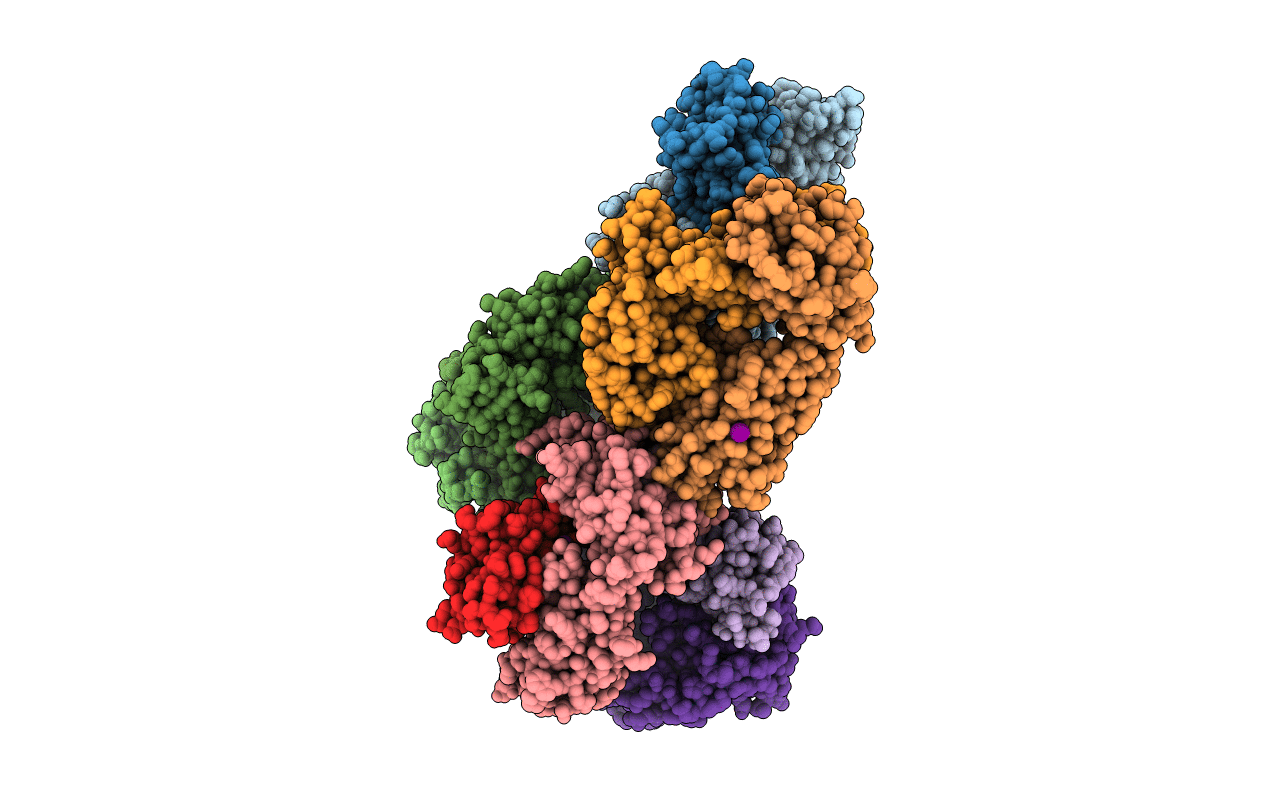
4QRP image
Deposition Date 2014-07-02
Release Date 2014-11-12
Last Version Date 2024-11-06
Entry Detail
PDB ID:
4QRP
Keywords:
Title:
Crystal Structure of HLA B*0801 in complex with HSKKKCDEL and DD31 TCR
Biological Source:
Source Organism:
Homo sapiens (Taxon ID: 9606)
Hepatitis C virus (Taxon ID: 11103)
Host Organism:
Method Details:
Experimental Method:
Resolution:
2.90 Å
R-Value Free:
0.24
R-Value Work:
0.20
R-Value Observed:
0.20
Space Group:
P 1 21 1

Macromolecular Entities
Structures with similar UniProt ID
Protein Blast
Polymer Type:polypeptide(L)
Molecule:HLA class I histocompatibility antigen, B-8 alpha chain
Chain IDs:A, F
Chain Length:276
Number of Molecules:2
Biological Source:Homo sapiens
Structures with similar UniProt ID
Protein Blast
Polymer Type:polypeptide(L)
Molecule:Beta-2-microglobulin
Gene (Uniprot):B2M
Chain IDs:B, G
Chain Length:100
Number of Molecules:2
Biological Source:Homo sapiens
Structures with similar UniProt ID
Protein Blast
Polymer Type:polypeptide(L)
Molecule:NS3-4A protein
Chain IDs:C, H
Chain Length:9
Number of Molecules:2
Biological Source:Hepatitis C virus
Polymer Type:polypeptide(L)
Molecule:DD31 TCR alpha chain
Chain IDs:D, J, K
Chain Length:206
Number of Molecules:3
Biological Source:Homo sapiens
Polymer Type:polypeptide(L)
Molecule:DD31 TCR beta chain
Chain IDs:E, I, L
Chain Length:245
Number of Molecules:3
Biological Source:Homo sapiens
Primary Citation
An Extensive Antigenic Footprint Underpins Immunodominant TCR Adaptability against a Hypervariable Viral Determinant.
J.Immunol. 193 5402 5413 (2014)
PMID: 25355921 DOI: 10.4049/jimmunol.1401357

Abstact

Mutations in T cell epitopes are implicated in hepatitis C virus (HCV) persistence and can impinge on vaccine development. We recently demonstrated a narrow bias in the human TCR repertoire targeted at an immunodominant, but highly mutable, HLA-B*0801-restricted epitope ((1395)HSKKKCDEL(1403) [HSK]). To investigate if the narrow TCR repertoire facilitates CTL escape, structural and biophysical studies were undertaken, alongside comprehensive functional analysis of T cells targeted at the natural variants of HLA-B*0801-HSK in different HCV genotypes and quasispecies. Interestingly, within the TCR-HLA-B*0801-HSK complex, the TCR contacts all available surface-exposed residues of the HSK determinant. This broad epitope coverage facilitates cross-genotypic reactivity and recognition of common mutations reported in HCV quasispecies, albeit to a varying degree. Certain mutations did abrogate T cell reactivity; however, natural variants comprising these mutations are reportedly rare and transient in nature, presumably due to fitness costs. Overall, despite a narrow bias, the TCR accommodated frequent mutations by acting like a blanket over the hypervariable epitope, thereby providing effective viral immunity. Our findings simultaneously advance the understanding of anti-HCV immunity and indicate the potential for cross-genotype HCV vaccines.

Legend

Protein

Chemical

Disease

Primary Citation of related structures
Feedback Form
Name
Email
Institute
Feedback