4Q76 image
Deposition Date 2014-04-24
Release Date 2014-09-10
Last Version Date 2023-12-06
Entry Detail
PDB ID:
4Q76
Keywords:
Title:
Crystal structure of Nfs2 C384S mutant, the plastidial cysteine desulfurase from Arabidopsis thaliana
Biological Source:
Source Organism:
Host Organism:
Method Details:
Experimental Method:
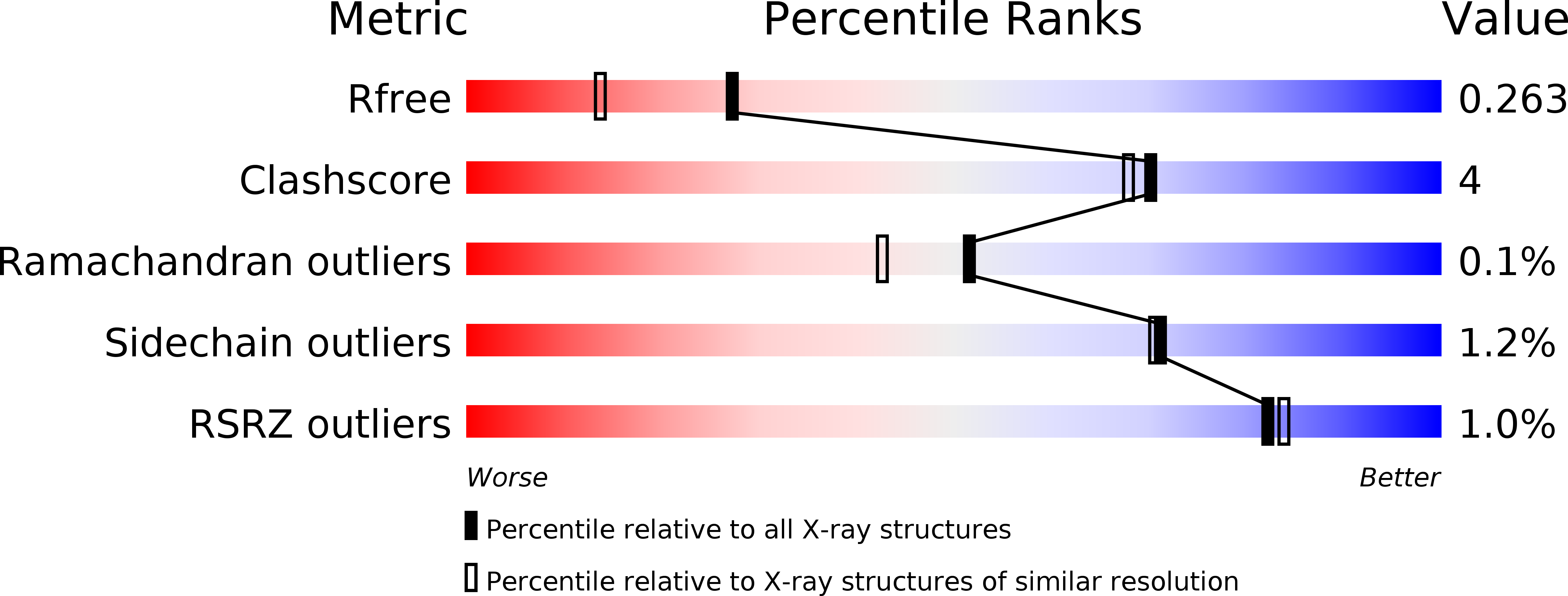
Resolution:
1.90 Å
R-Value Free:
0.26
R-Value Work:
0.23
R-Value Observed:
0.23
Space Group:
P 1 21 1
Macromolecular Entities
Structures with similar UniProt ID
Protein Blast
Polymer Type:polypeptide(L)
Molecule:Cysteine desulfurase 2, chloroplastic
Gene (Uniprot):NFS2
Chain IDs:A, B
Chain Length:429
Number of Molecules:2
Biological Source:Arabidopsis thaliana
Modified Residue
Compound ID Chain ID Parent Comp ID Details 2D Image
LLP A LYS ?
Primary Citation
X-ray structures of Nfs2, the plastidial cysteine desulfurase from Arabidopsis thaliana.
Acta Crystallogr F Struct Biol Commun 70 1180 1185 (2014)
PMID: 25195888 DOI: 10.1107/S2053230X14017026

Abstact

The chloroplastic Arabidopsis thaliana Nfs2 (AtNfs2) is a group II pyridoxal 5'-phosphate-dependent cysteine desulfurase that is involved in the initial steps of iron-sulfur cluster biogenesis. The group II cysteine desulfurases require the presence of sulfurtransferases such as SufE proteins for optimal activity. Compared with group I cysteine desulfurases, proteins of this group contains a smaller extended lobe harbouring the catalytic cysteine and have a β-hairpin constraining the active site. Here, two crystal structures of AtNfs2 are reported: a wild-type form with the catalytic cysteine in a persulfide-intermediate state and a C384S variant mimicking the resting state of the enzyme. In both structures the well conserved Lys241 covalently binds pyridoxal 5'-phosphate, forming an internal aldimine. Based on available homologous bacterial complexes, a model of a complex between AtNfs2 and the SufE domain of its biological partner AtSufE1 is proposed, revealing the nature of the binding sites.

Legend

Protein

Chemical

Disease

Primary Citation of related structures
Feedback Form
Name
Email
Institute
Feedback