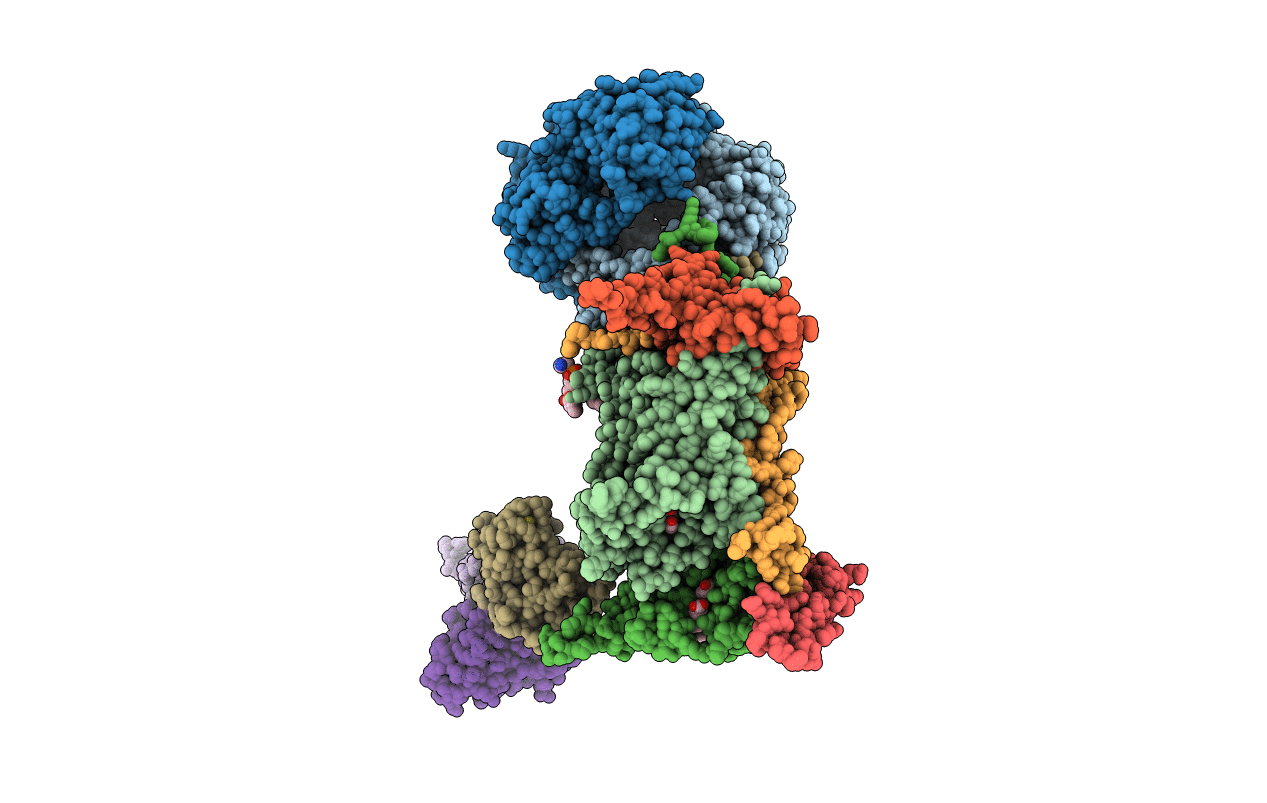
4PD4 image
Deposition Date 2014-04-17
Release Date 2014-06-11
Last Version Date 2024-11-20
Entry Detail
PDB ID:
4PD4
Title:
Structural analysis of atovaquone-inhibited cytochrome bc1 complex reveals the molecular basis of antimalarial drug action
Biological Source:
Expression System(s):
Method Details:
Experimental Method:
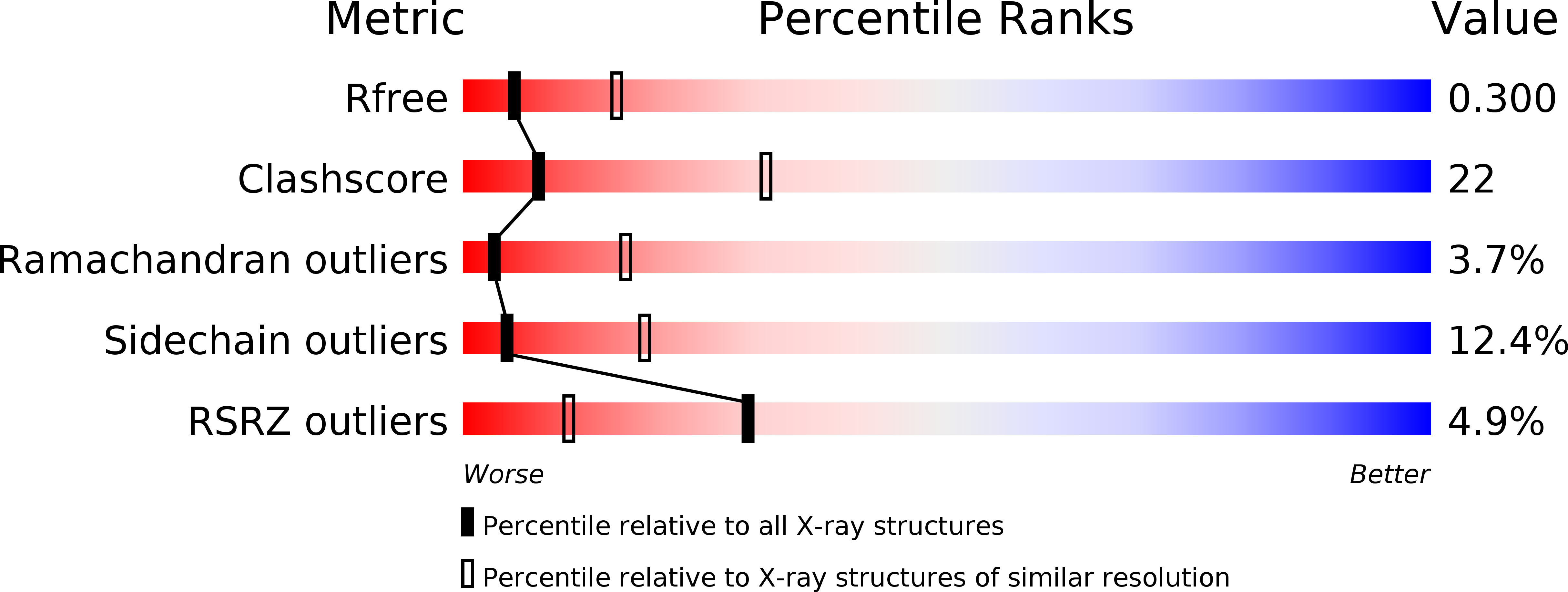
Resolution:
3.04 Å
R-Value Free:
0.29
R-Value Work:
0.26
R-Value Observed:
0.26
Space Group:
C 1 2 1
Macromolecular Entities
Structures with similar UniProt ID
Protein Blast
Polymer Type:polypeptide(L)
Molecule:Cytochrome b-c1 complex subunit 1, mitochondrial
Gene (Uniprot):COR1
Chain IDs:A
Chain Length:431
Number of Molecules:1
Biological Source:Saccharomyces cerevisiae (strain ATCC 204508 / S288c)
Structures with similar UniProt ID
Protein Blast
Polymer Type:polypeptide(L)
Molecule:Cytochrome b-c1 complex subunit 2, mitochondrial
Gene (Uniprot):QCR2
Chain IDs:B
Chain Length:352
Number of Molecules:1
Biological Source:Saccharomyces cerevisiae (strain ATCC 204508 / S288c)
Structures with similar UniProt ID
Protein Blast
Polymer Type:polypeptide(L)
Molecule:Cytochrome b
Gene (Uniprot):COB
Chain IDs:C
Chain Length:385
Number of Molecules:1
Biological Source:Saccharomyces cerevisiae (strain ATCC 204508 / S288c)
Structures with similar UniProt ID
Protein Blast
Polymer Type:polypeptide(L)
Molecule:Cytochrome c1, heme protein, mitochondrial
Gene (Uniprot):CYT1
Chain IDs:D
Chain Length:248
Number of Molecules:1
Biological Source:Saccharomyces cerevisiae (strain ATCC 204508 / S288c)
Structures with similar UniProt ID
Protein Blast
Polymer Type:polypeptide(L)
Molecule:Cytochrome b-c1 complex subunit Rieske, mitochondrial
Gene (Uniprot):RIP1
Chain IDs:E
Chain Length:185
Number of Molecules:1
Biological Source:Saccharomyces cerevisiae (strain ATCC 204508 / S288c)
Structures with similar UniProt ID
Protein Blast
Polymer Type:polypeptide(L)
Molecule:Cytochrome b-c1 complex subunit 6
Gene (Uniprot):QCR6
Chain IDs:F
Chain Length:74
Number of Molecules:1
Biological Source:Saccharomyces cerevisiae (strain ATCC 204508 / S288c)
Structures with similar UniProt ID
Protein Blast
Polymer Type:polypeptide(L)
Molecule:Cytochrome b-c1 complex subunit 7
Gene (Uniprot):QCR7
Chain IDs:G
Chain Length:126
Number of Molecules:1
Biological Source:Saccharomyces cerevisiae (strain ATCC 204508 / S288c)
Structures with similar UniProt ID
Protein Blast
Polymer Type:polypeptide(L)
Molecule:Cytochrome b-c1 complex subunit 8
Gene (Uniprot):QCR8
Chain IDs:H
Chain Length:93
Number of Molecules:1
Biological Source:Saccharomyces cerevisiae (strain ATCC 204508 / S288c)
Structures with similar UniProt ID
Protein Blast
Polymer Type:polypeptide(L)
Molecule:Cytochrome b-c1 complex subunit 9
Gene (Uniprot):QCR9
Chain IDs:I
Chain Length:57
Number of Molecules:1
Biological Source:Saccharomyces cerevisiae (strain ATCC 204508 / S288c)
Structures with similar UniProt ID
Protein Blast
Polymer Type:polypeptide(L)
Molecule:Igh protein
Chain IDs:J
Chain Length:127
Number of Molecules:1
Biological Source:Mus musculus
Structures with similar UniProt ID
Protein Blast
Polymer Type:polypeptide(L)
Molecule:Ig kappa chain V-V region HP 124E1
Chain IDs:K
Chain Length:107
Number of Molecules:1
Biological Source:Mus musculus
Primary Citation
Structural analysis of atovaquone-inhibited cytochrome bc1 complex reveals the molecular basis of antimalarial drug action.
Nat Commun 5 4029 4029 (2014)
PMID: 24893593 DOI: 10.1038/ncomms5029

Abstact

Atovaquone, a substituted hydroxynaphthoquinone, is a potent antimalarial drug that acts by inhibiting the parasite's mitochondrial cytochrome bc1 complex (cyt bc1). Mutations in cyt bc1 confer atovaquone resistance. Here we describe the X-ray structure of mitochondrial cyt bc1 from Saccharomyces cerevisiae with atovaquone bound in the catalytic Qo site, at 3.0-Å resolution. A polarized H-bond to His181 of the Rieske protein in cyt bc1 traps the ionized hydroxyl group of the drug. Side chains of highly conserved cytochrome b residues establish multiple non-polar interactions with the napththoquinone group, whereas less-conserved residues are in contact with atovaquone's cyclohexyl-chlorophenyl tail. Our structural analysis reveals the molecular basis of atovaquone's broad target spectrum, species-specific efficacies and acquired resistances, and may aid drug development to control the spread of resistant parasites.

Legend

Protein

Chemical

Disease

Primary Citation of related structures
Feedback Form
Name
Email
Institute
Feedback