4OMF image
Deposition Date 2014-01-27
Release Date 2014-06-11
Last Version Date 2025-02-12
Entry Detail
PDB ID:
4OMF
Keywords:
Title:
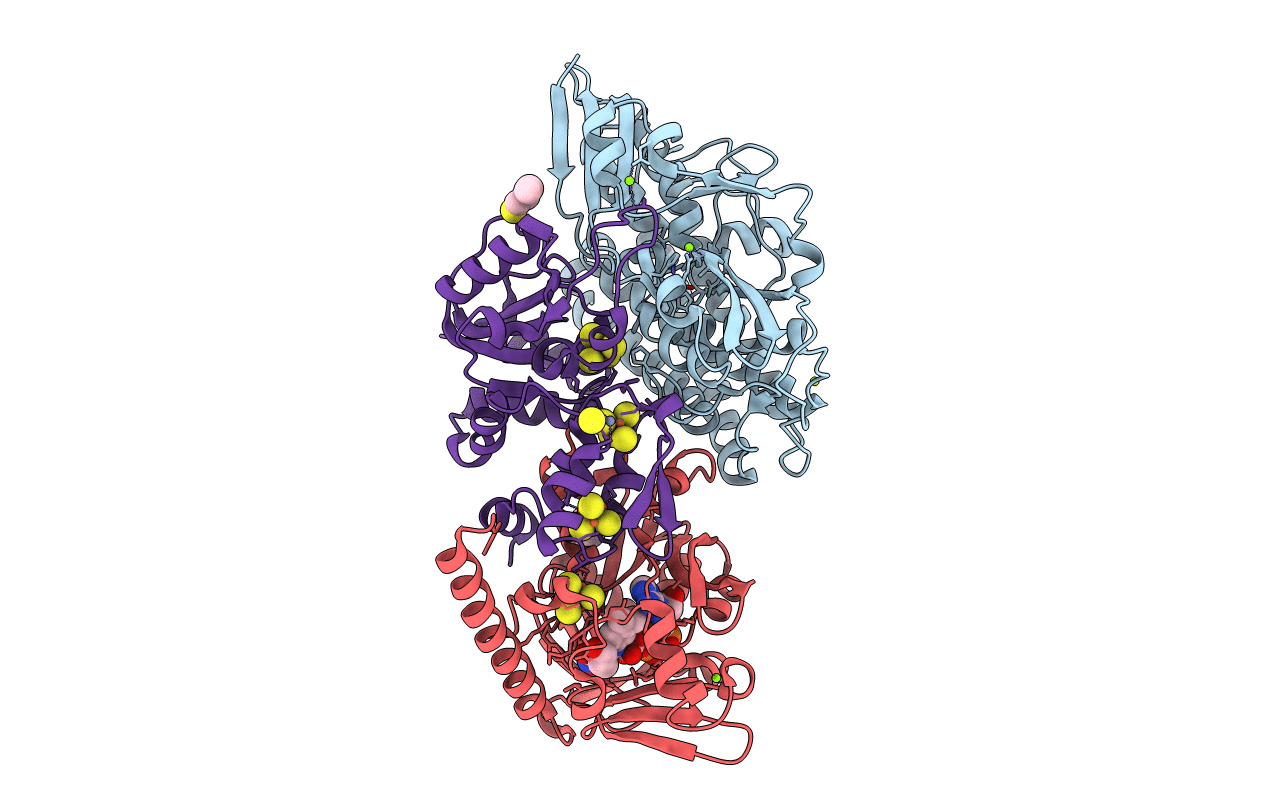
The F420-reducing [NiFe]-hydrogenase complex from Methanothermobacter marburgensis, the first X-ray structure of a group 3 family member
Biological Source:
Source Organism:
Method Details:
Experimental Method:
Resolution:
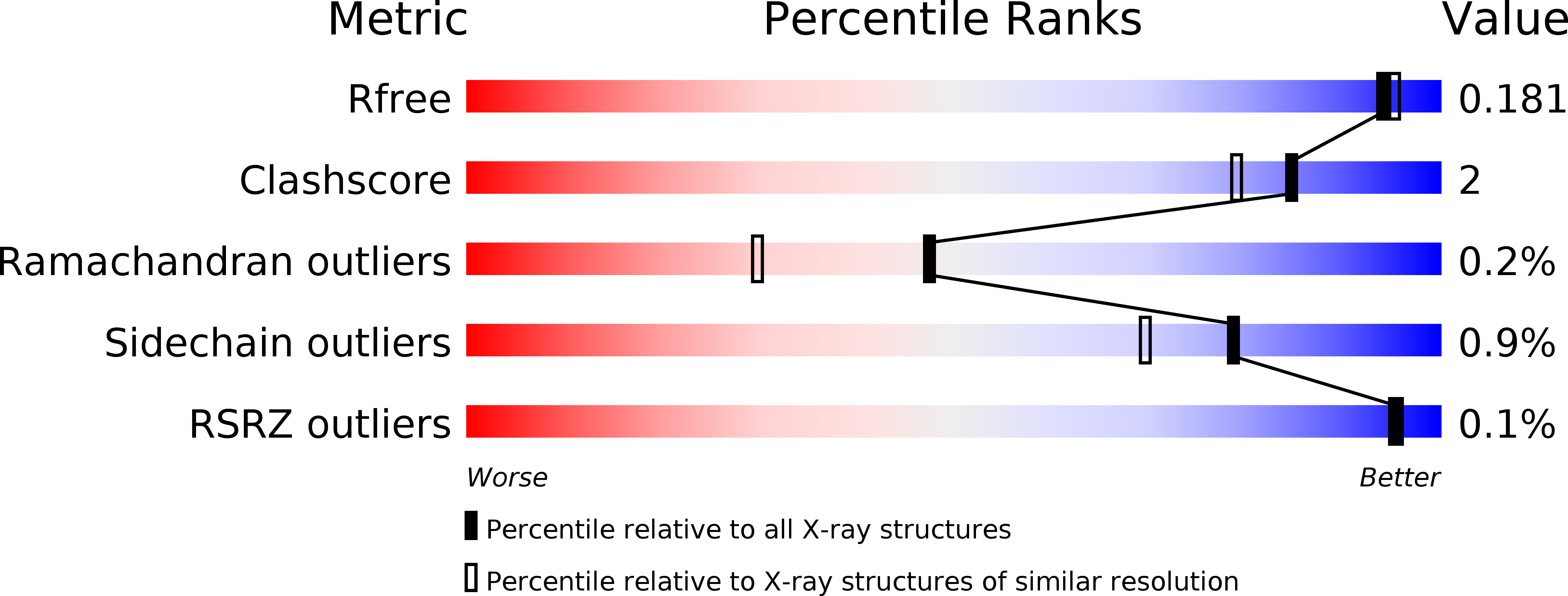
1.71 Å
R-Value Free:
0.18
R-Value Work:
0.15
R-Value Observed:
0.15
Space Group:
F 2 3
Macromolecular Entities
Structures with similar UniProt ID
Protein Blast
Polymer Type:polypeptide(L)
Molecule:F420-reducing hydrogenase, subunit alpha
Gene (Uniprot):frhA
Chain IDs:B (auth: A)
Chain Length:405
Number of Molecules:1
Biological Source:Methanothermobacter marburgensis
Structures with similar UniProt ID
Protein Blast
Polymer Type:polypeptide(L)
Molecule:F420-reducing hydrogenase, subunit beta
Gene (Uniprot):frhB
Chain IDs:C (auth: B)
Chain Length:281
Number of Molecules:1
Biological Source:Methanothermobacter marburgensis
Structures with similar UniProt ID
Protein Blast
Polymer Type:polypeptide(L)
Molecule:F420-reducing hydrogenase, subunit gamma
Gene (Uniprot):frhG
Chain IDs:A (auth: G)
Chain Length:275
Number of Molecules:1
Biological Source:Methanothermobacter marburgensis
Primary Citation
The F420-Reducing [NiFe]-Hydrogenase Complex from Methanothermobacter marburgensis, the First X-ray Structure of a Group 3 Family Member.
J.Mol.Biol. 426 2813 2826 (2014)
PMID: 24887099 DOI: 10.1016/j.jmb.2014.05.024

Abstact

The reversible redox reaction between coenzyme F420 and H2 to F420H2 is catalyzed by an F420-reducing [NiFe]-hydrogenase (FrhABG), which is an enzyme of the energy metabolism of methanogenic archaea. FrhABG is a group 3 [NiFe]-hydrogenase with a dodecameric quaternary structure of 1.25MDa as recently revealed by high-resolution cryo-electron microscopy. We report on the crystal structure of FrhABG from Methanothermobacter marburgensis at 1.7Å resolution and compare it with the structures of group 1 [NiFe]-hydrogenases, the only group structurally characterized yet. FrhA is similar to the large subunit of group 1 [NiFe]-hydrogenases regarding its core structure and the embedded [NiFe]-center but is different because of the truncation of ca 160 residues that results in similar but modified H2 and proton transport pathways and in suitable interfaces for oligomerization. The small subunit FrhG is composed of an N-terminal domain related to group 1 enzymes and a new C-terminal ferredoxin-like domain carrying the distal and medial [4Fe-4S] clusters. FrhB adopts a novel fold, binds one [4Fe-4S] cluster as well as one FAD in a U-shaped conformation and provides the F420-binding site at the Si-face of the isoalloxazine ring. Similar electrochemical potentials of both catalytic reactions and the electron-transferring [4Fe-4S] clusters, determined to be E°'≈-400mV, are in full agreement with the equalized forward and backward rates of the FrhABG reaction. The protein might contribute to balanced redox potentials by the aspartate coordination of the proximal [4Fe-4S] cluster, the new ferredoxin module and a rather negatively charged FAD surrounding.

Legend

Protein

Chemical

Disease

Primary Citation of related structures
Feedback Form
Name
Email
Institute
Feedback