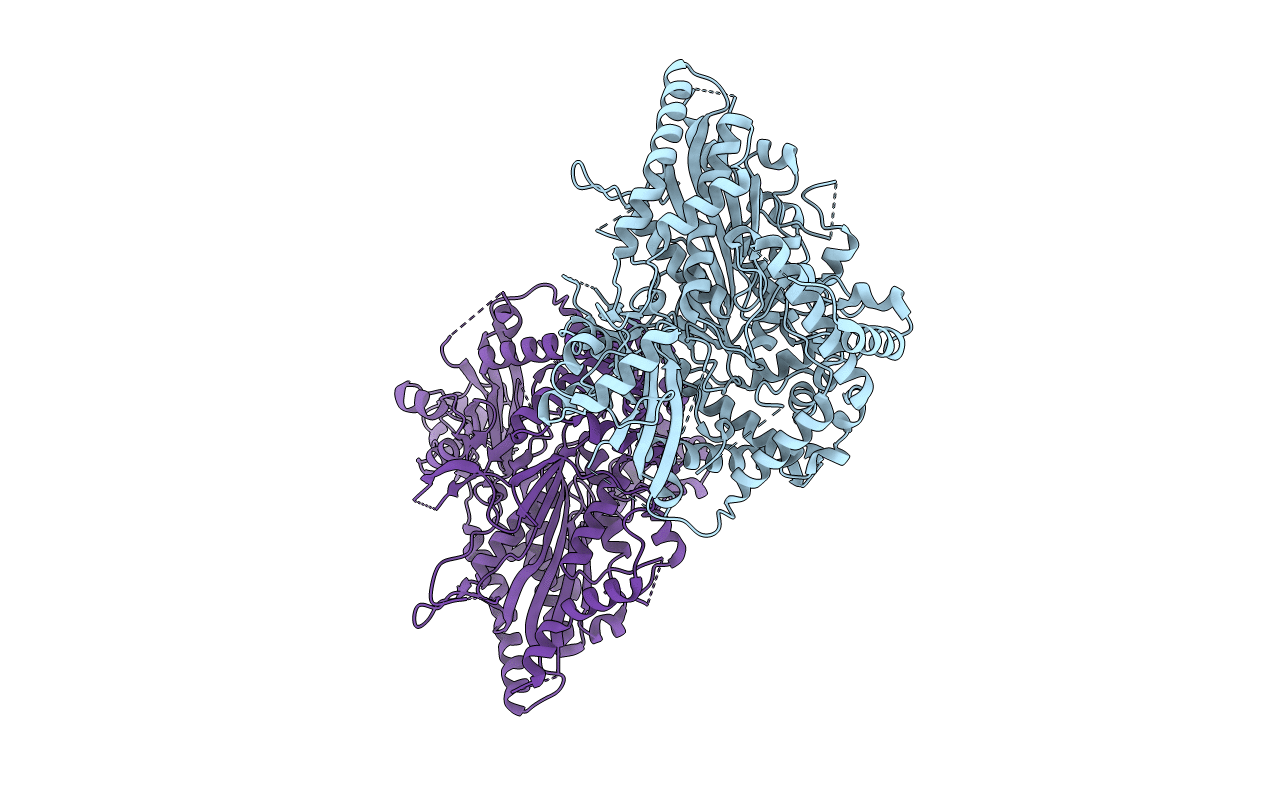
4O5P image
Deposition Date 2013-12-19
Release Date 2014-08-13
Last Version Date 2024-10-09
Entry Detail
PDB ID:
4O5P
Keywords:
Title:
Crystal structure of an uncharacterized protein from Pseudomonas aeruginosa
Biological Source:
Source Organism:
Host Organism:
Method Details:
Experimental Method:
Resolution:
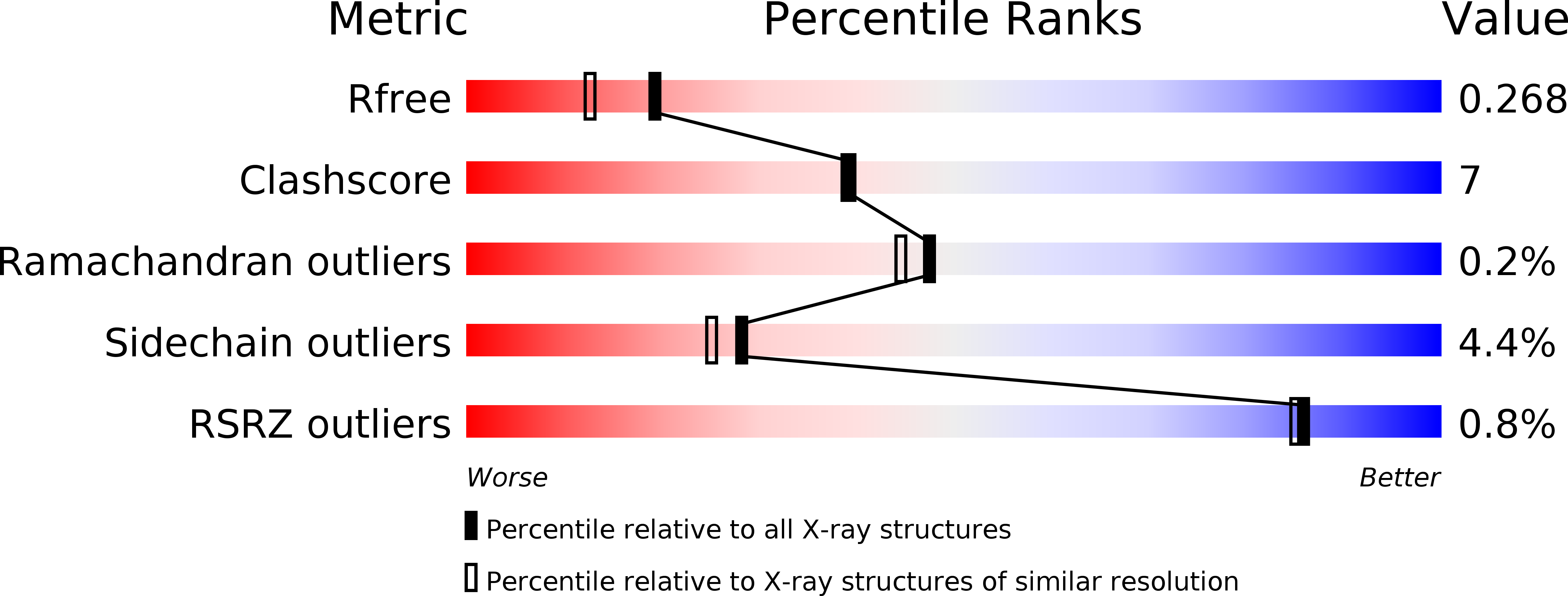
2.00 Å
R-Value Free:
0.26
R-Value Work:
0.22
R-Value Observed:
0.22
Space Group:
P 1
Macromolecular Entities
Structures with similar UniProt ID
Protein Blast
Polymer Type:polypeptide(L)
Molecule:Uncharacterized protein
Gene (Uniprot):PA3290
Chain IDs:A, B
Chain Length:884
Number of Molecules:2
Biological Source:Pseudomonas aeruginosa
Modified Residue
Compound ID Chain ID Parent Comp ID Details 2D Image
MSE A MET SELENOMETHIONINE
Primary Citation
Structure of the type VI secretion phospholipase effector Tle1 provides insight into its hydrolysis and membrane targeting.
Acta Crystallogr.,Sect.D 70 2175 2185 (2014)
PMID: 25084336 DOI: 10.1107/S1399004714012899

Abstact

A diverse superfamily of phospholipases consisting of the type VI lipase effectors Tle1-Tle5 secreted by the bacterial type VI secretion system (T6SS) have recently been identified as antibacterial effectors that hydrolyze membrane phospholipids. These effectors show no significant homology to known lipases, and their mechanism of membrane targeting and hydrolysis of phospholipids remains unknown. Here, the crystal structure of Tle1 (∼96.5 kDa) from Pseudomonas aeruginosa refined to 2.0 Å resolution is reported, representing the first structure of this superfamily. Its overall structure can be divided into two distinct parts, the phospholipase catalytic module and the putative membrane-anchoring module; this arrangement has not previously been observed in known lipase structures. The phospholipase catalytic module has a canonical α/β-hydrolase fold and mutation of any residue in the Ser-Asp-His catalytic triad abolishes its toxicity. The putative membrane-anchoring module adopts an open conformation composed of three amphipathic domains, and its partial folds are similar to those of several periplasmic or membrane proteins. A cell-toxicity assay revealed that the putative membrane-anchoring module is critical to Tle1 antibacterial activity. A molecular-dynamics (MD) simulation system in which the putative membrane-anchoring module embedded into a bilayer was stable over 50 ns. These structure-function studies provide insight into the hydrolysis and membrane-targeting process of the unique phospholipase Tle1.

Legend

Protein

Chemical

Disease

Primary Citation of related structures
Feedback Form
Name
Email
Institute
Feedback