4NYT image
Deposition Date 2013-12-11
Release Date 2014-10-29
Last Version Date 2024-11-13
Entry Detail
PDB ID:
4NYT
Keywords:
Title:
L-Ficolin Complexed to Phosphocholine
Biological Source:
Source Organism:
Homo sapiens (Taxon ID: 9606)
Host Organism:
Method Details:
Experimental Method:
Resolution:
2.25 Å
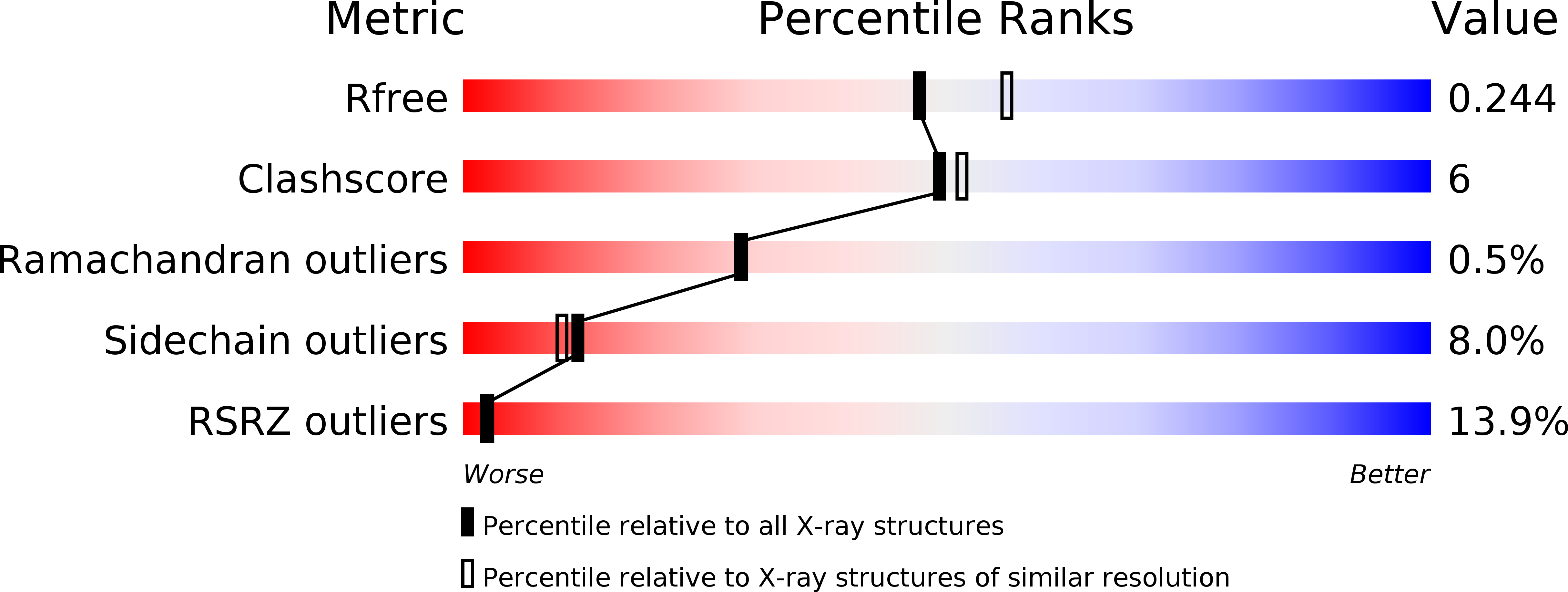
R-Value Free:
0.24
R-Value Work:
0.21
R-Value Observed:
0.21
Space Group:
P 32 2 1
Macromolecular Entities
Structures with similar UniProt ID
Protein Blast
Polymer Type:polypeptide(L)
Molecule:Ficolin-2
Gene (Uniprot):FCN2
Chain IDs:A (auth: C), B (auth: A), C (auth: B)
Chain Length:217
Number of Molecules:3
Biological Source:Homo sapiens
Modified Residue
Compound ID Chain ID Parent Comp ID Details 2D Image
ASN B ASN GLYCOSYLATION SITE
Primary Citation
Human L-ficolin recognizes phosphocholine moieties of pneumococcal teichoic Acid
J.Immunol. 193 5699 5708 (2014)
PMID: 25344472 DOI: 10.4049/jimmunol.1400127

Abstact

Human L-ficolin is a soluble protein of the innate immune system able to sense pathogens through its fibrinogen (FBG) recognition domains and to trigger activation of the lectin complement pathway through associated serine proteases. L-Ficolin has been previously shown to recognize pneumococcal clinical isolates, but its ligands and especially its molecular specificity remain to be identified. Using solid-phase binding assays, serum and recombinant L-ficolins were shown to interact with serotype 2 pneumococcal strain D39 and its unencapsulated R6 derivative. Incubation of both strains with serum triggered complement activation, as measured by C4b and C3b deposition, which was decreased by using ficolin-depleted serum. Recombinant L-ficolin and its FBG-like recognition domain bound to isolated pneumococcal cell wall extracts, whereas binding to cell walls depleted of teichoic acid (TA) was decreased. Both proteins were also shown to interact with two synthetic TA compounds, each comprising part structures of the complete lipoteichoic acid molecule with two PCho residues. Competition studies and direct interaction measurements by surface plasmon resonance identified PCho as a novel L-ficolin ligand. Structural analysis of complexes of the FBG domain of L-ficolin and PCho revealed that the phosphate moiety interacts with amino acids previously shown to define an acetyl binding site. Consequently, binding of L-ficolin to immobilized acetylated BSA was inhibited by PCho and synthetic TA. Binding of serum L-ficolin to immobilized synthetic TA and PCho-conjugated BSA triggered activation of the lectin complement pathway, thus further supporting the hypothesis of L-ficolin involvement in host antipneumococcal defense.

Legend

Protein

Chemical

Disease

Primary Citation of related structures
Feedback Form
Name
Email
Institute
Feedback