4NYK image
Deposition Date 2013-12-10
Release Date 2014-02-12
Last Version Date 2024-11-06
Entry Detail
PDB ID:
4NYK
Title:
Structure of a membrane protein
Biological Source:
Source Organism:
Gallus gallus (Taxon ID: 9031)
Host Organism:
Method Details:
Experimental Method:
Resolution:
3.00 Å
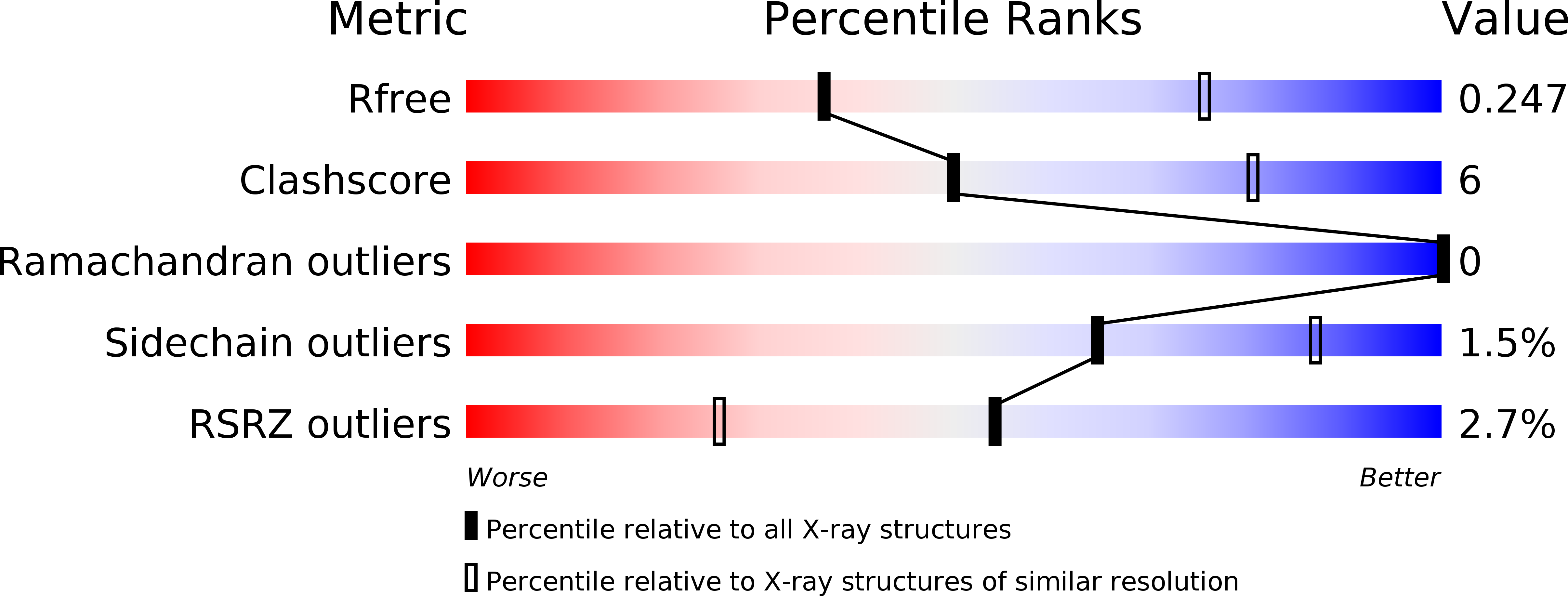
R-Value Free:
0.24
R-Value Work:
0.20
R-Value Observed:
0.20
Space Group:
H 3
Macromolecular Entities
Structures with similar UniProt ID
Protein Blast
Polymer Type:polypeptide(L)
Molecule:Acid-sensing ion channel 1
Gene (Uniprot):ASIC1
Chain IDs:A
Chain Length:470
Number of Molecules:1
Biological Source:Gallus gallus
Ligand Molecules
Primary Citation
Pore architecture and ion sites in acid-sensing ion channels and P2X receptors.
Nature 460 599 604 (2009)
PMID: 19641589 DOI: 10.1038/nature08218

Abstact

Acid-sensing ion channels are proton-activated, sodium-selective channels composed of three subunits, and are members of the superfamily of epithelial sodium channels, mechanosensitive and FMRF-amide peptide-gated ion channels. These ubiquitous eukaryotic ion channels have essential roles in biological activities as diverse as sodium homeostasis, taste and pain. Despite their crucial roles in biology and their unusual trimeric subunit stoichiometry, there is little knowledge of the structural and chemical principles underlying their ion channel architecture and ion-binding sites. Here we present the structure of a functional acid-sensing ion channel in a desensitized state at 3 A resolution, the location and composition of the approximately 8 A 'thick' desensitization gate, and the trigonal antiprism coordination of caesium ions bound in the extracellular vestibule. Comparison of the acid-sensing ion channel structure with the ATP-gated P2X(4) receptor reveals similarity in pore architecture and aqueous vestibules, suggesting that there are unanticipated yet common structural and mechanistic principles.

Legend

Protein

Chemical

Disease

Primary Citation of related structures
Feedback Form
Name
Email
Institute
Feedback