4NWV image
Deposition Date 2013-12-06
Release Date 2014-08-20
Last Version Date 2024-10-16
Entry Detail
PDB ID:
4NWV
Keywords:
Title:
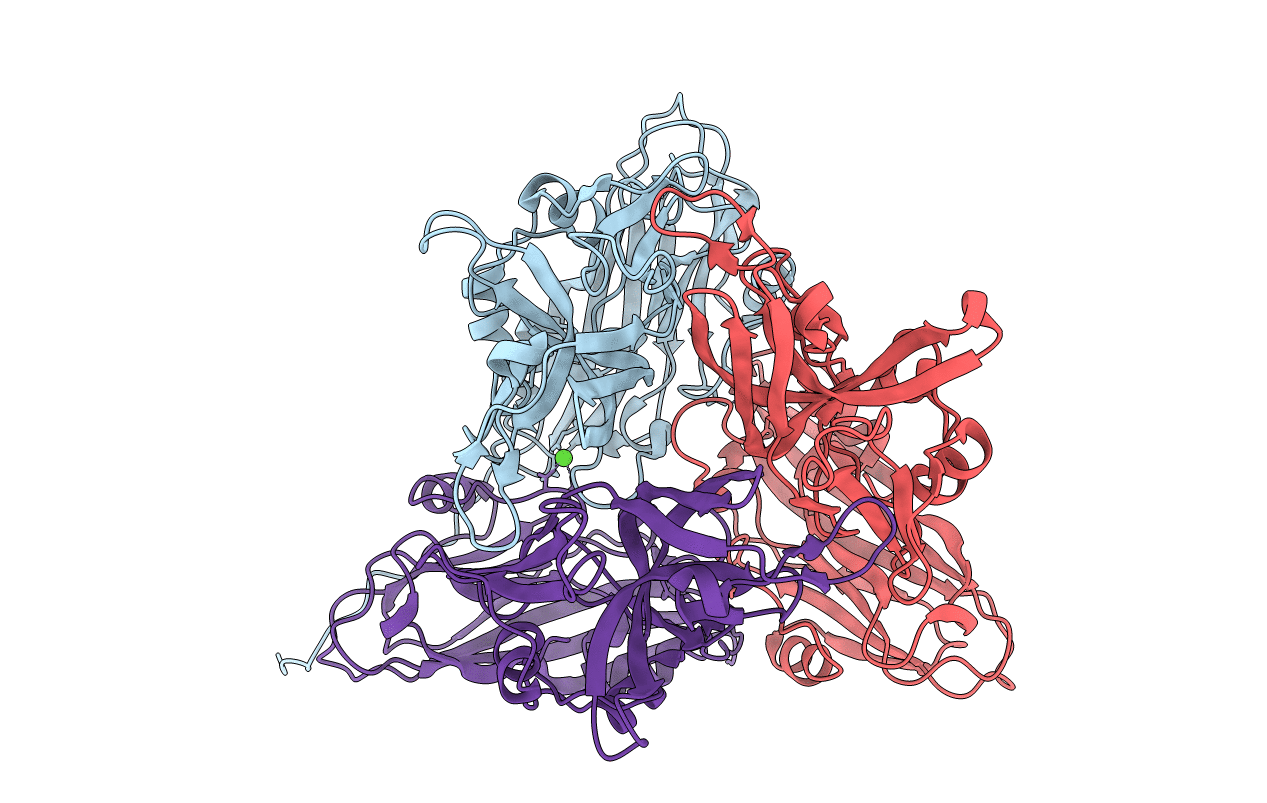
Crystal structure of Orsay virus-like particle
Biological Source:
Source Organism:
Orsay virus (Taxon ID: 977912)
Host Organism:
Method Details:
Experimental Method:
Resolution:
3.25 Å
R-Value Free:
0.27
R-Value Work:
0.27
R-Value Observed:
0.27
Space Group:
I 2 2 2
Macromolecular Entities
Structures with similar UniProt ID
Protein Blast
Polymer Type:polypeptide(L)
Molecule:Capsid protein
Chain IDs:A, B (auth: C), C (auth: B)
Chain Length:391
Number of Molecules:3
Biological Source:Orsay virus
Ligand Molecules
Primary Citation
Crystal structure of a nematode-infecting virus.
Proc.Natl.Acad.Sci.USA 111 12781 12786 (2014)
PMID: 25136116 DOI: 10.1073/pnas.1407122111

Abstact

Orsay, the first virus discovered to naturally infect Caenorhabditis elegans or any nematode, has a bipartite, positive-sense RNA genome. Sequence analyses show that Orsay is related to nodaviruses, but molecular characterizations of Orsay reveal several unique features, such as the expression of a capsid-δ fusion protein and the use of an ATG-independent mechanism for translation initiation. Here we report the crystal structure of an Orsay virus-like particle assembled from recombinant capsid protein (CP). Orsay capsid has a T = 3 icosahedral symmetry with 60 trimeric surface spikes. Each CP can be divided into three regions: an N-terminal arm that forms an extended protein interaction network at the capsid interior, an S domain with a jelly-roll, β-barrel fold forming the continuous capsid, and a P domain that forms surface spike projections. The structure of the Orsay S domain is best aligned to T = 3 plant RNA viruses but exhibits substantial differences compared with the insect-infecting alphanodaviruses, which also lack the P domain in their CPs. The Orsay P domain is remotely related to the P1 domain in calicivirus and hepatitis E virus, suggesting a possible evolutionary relationship. Removing the N-terminal arm produced a slightly expanded capsid with fewer nucleic acids packaged, suggesting that the arm is important for capsid stability and genome packaging. Because C. elegans-Orsay serves as a highly tractable model for studying viral pathogenesis, our results should provide a valuable structural framework for further studies of Orsay replication and infection.

Legend

Protein

Chemical

Disease

Primary Citation of related structures
Feedback Form
Name
Email
Institute
Feedback