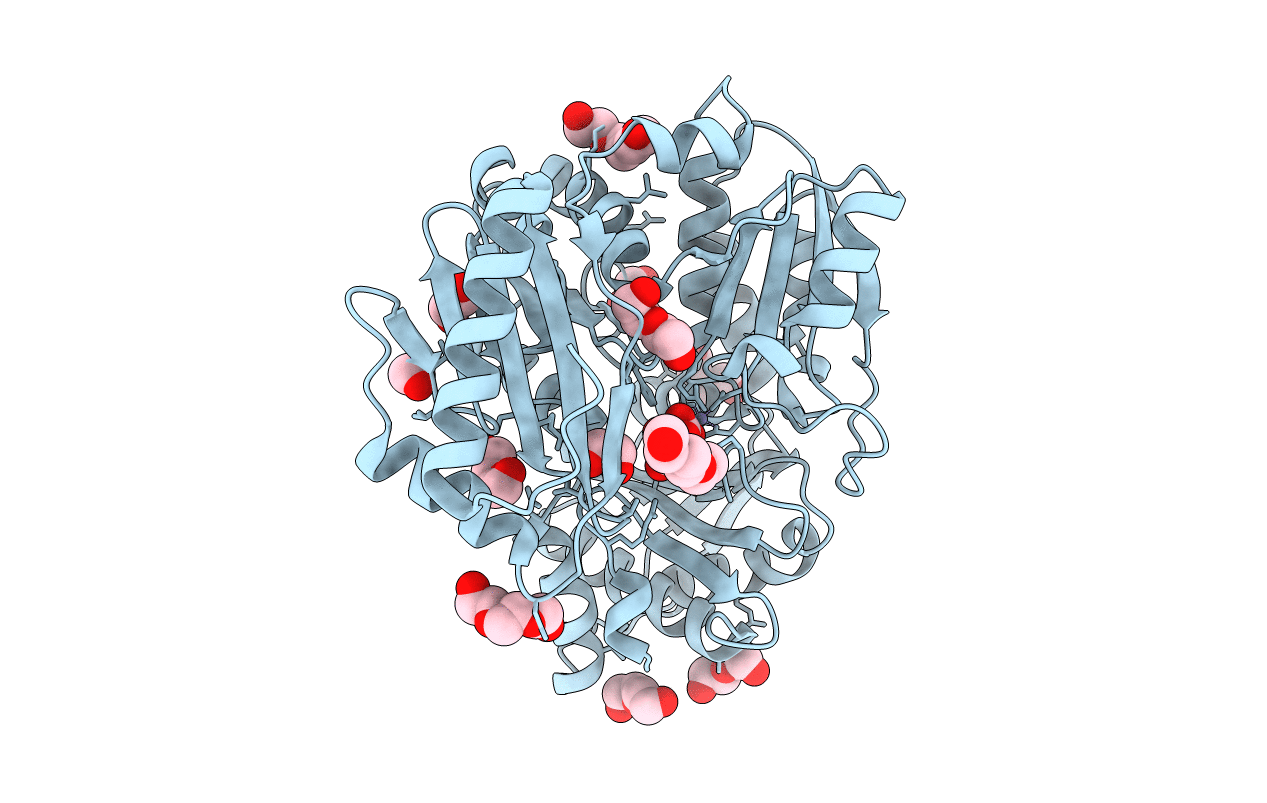
4MRQ image
Deposition Date 2013-09-17
Release Date 2014-01-08
Last Version Date 2023-09-20
Entry Detail
PDB ID:
4MRQ
Keywords:
Title:
Crystal Structure of wild-type unphosphorylated PMM/PGM
Biological Source:
Source Organism:
Host Organism:
Method Details:
Experimental Method:
Resolution:
1.90 Å
R-Value Free:
0.20
R-Value Work:
0.16
R-Value Observed:
0.16
Space Group:
P 21 21 21

Macromolecular Entities
Structures with similar UniProt ID
Protein Blast
Polymer Type:polypeptide(L)
Molecule:Phosphomannomutase/phosphoglucomutase
Gene (Uniprot):algC
Chain IDs:A
Chain Length:455
Number of Molecules:1
Biological Source:Pseudomonas aeruginosa
Primary Citation
Promotion of enzyme flexibility by dephosphorylation and coupling to the catalytic mechanism of a phosphohexomutase.
J.Biol.Chem. 289 4674 4682 (2014)
PMID: 24403075 DOI: 10.1074/jbc.M113.532226

Abstact

The enzyme phosphomannomutase/phosphoglucomutase (PMM/PGM) from Pseudomonas aeruginosa catalyzes an intramolecular phosphoryl transfer across its phosphosugar substrates, which are precursors in the synthesis of exoproducts involved in bacterial virulence. Previous structural studies of PMM/PGM have established a key role for conformational change in its multistep reaction, which requires a dramatic 180° reorientation of the intermediate within the active site. Here hydrogen-deuterium exchange by mass spectrometry and small angle x-ray scattering were used to probe the conformational flexibility of different forms of PMM/PGM in solution, including its active, phosphorylated state and the unphosphorylated state that occurs transiently during the catalytic cycle. In addition, the effects of ligand binding were assessed through use of a substrate analog. We found that both phosphorylation and binding of ligand produce significant effects on deuterium incorporation. Phosphorylation of the conserved catalytic serine has broad effects on residues in multiple domains and is supported by small angle x-ray scattering data showing that the unphosphorylated enzyme is less compact in solution. The effects of ligand binding are generally manifested near the active site cleft and at a domain interface that is a site of conformational change. These results suggest that dephosphorylation of the enzyme may play two critical functional roles: a direct role in the chemical step of phosphoryl transfer and secondly through propagation of structural flexibility. We propose a model whereby increased enzyme flexibility facilitates the reorientation of the reaction intermediate, coupling changes in structural dynamics with the unique catalytic mechanism of this enzyme.

Legend

Protein

Chemical

Disease

Primary Citation of related structures
Feedback Form
Name
Email
Institute
Feedback