4MR0 image
Deposition Date 2013-09-17
Release Date 2014-02-05
Last Version Date 2024-03-20
Entry Detail
PDB ID:
4MR0
Title:
Crystal structure of PfbA, a surface adhesin of Streptococcus pneumoniae
Biological Source:
Source Organism:
Host Organism:
Method Details:
Experimental Method:
Resolution:
1.95 Å
R-Value Free:
0.22
R-Value Work:
0.20
R-Value Observed:
0.22
Space Group:
P 1 21 1
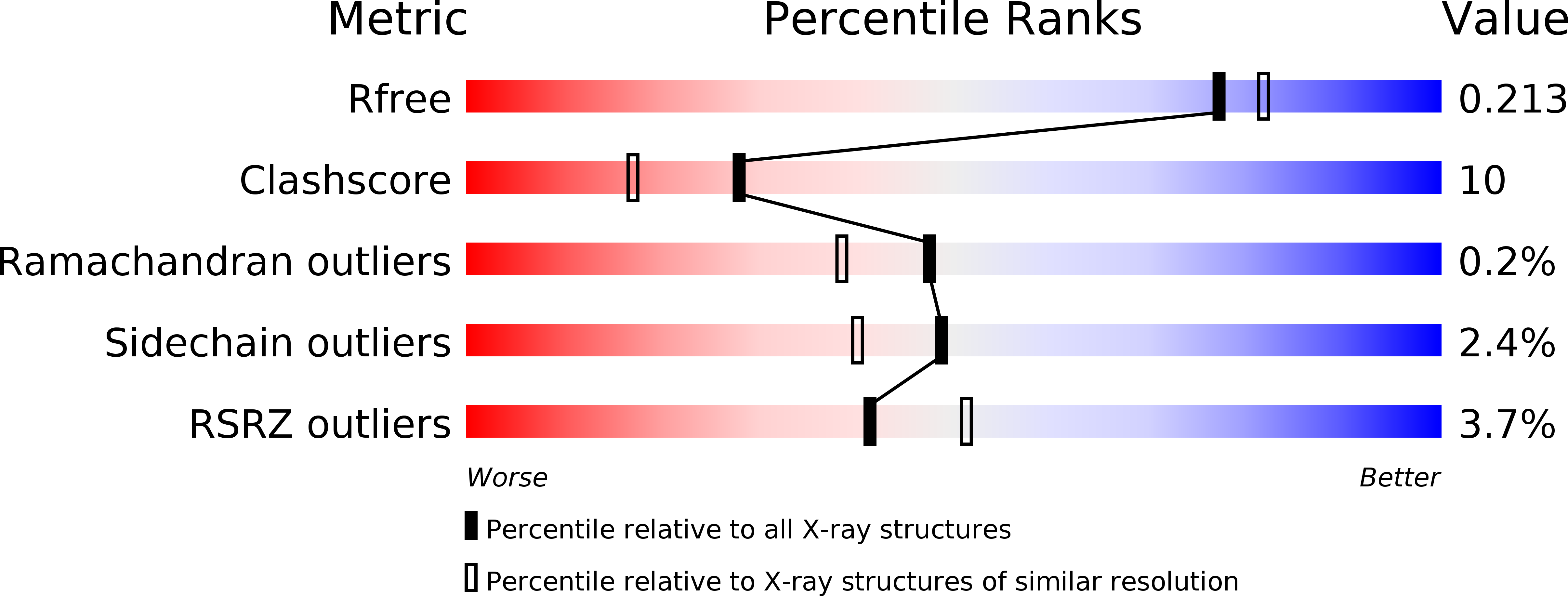
Macromolecular Entities
Structures with similar UniProt ID
Protein Blast
Polymer Type:polypeptide(L)
Molecule:Plasmin and fibronectin-binding protein A
Gene (Uniprot):pfbA
Chain IDs:A, B
Chain Length:648
Number of Molecules:2
Biological Source:Streptococcus pneumoniae
Primary Citation
Crystal structure of PfbA, a surface adhesin of Streptococcus pneumoniae, provides hints into its interaction with fibronectin
Int.J.Biol.Macromol. 64C 168 173 (2013)
PMID: 24321492 DOI: 10.1016/j.ijbiomac.2013.11.035

Abstact

PfbA is a surface adhesin and invasin of Streptococcus pneumoniae that binds to human fibronectin and plasminogen of the host extracellular matrix. It is a virulence factor for its pathogenesis. The crystal structure of recombinant PfbA150-607 from S. pneumoniae strain R6, was determined using multiwavelength anomalous dispersion (MAD) method and refined to 1.90Å resolution. The structure of rPfbA150-607 revealed that residues Thr150 to Lys570 form a rigid parallel beta helix, followed by a short disordered region (571-607) that consists of beta hairpins. The structural organization of the beta helix resembles that of polysaccharide-modifying enzymes. The structural and sequence features essential for fibronectin-binding observed in the well characterized fibronectin-binding proteins such as FnBPA of Staphylococcus aureus, SfbI of Streptococcus pyogenes and BBK32 of Borrelia burgdorferi has been found in rPfbA150-607. Based on this, it is predicted that the disordered region following the beta helix could be the fibronectin-binding region in PfbA. PfbA150-607 contains relatively high number of surface exposed lysines and these residues are probably involved in binding plasmin(ogen) as observed in other plasminogen-binding proteins.

Legend

Protein

Chemical

Disease

Primary Citation of related structures
Feedback Form
Name
Email
Institute
Feedback