4MKV image
Deposition Date 2013-09-05
Release Date 2013-10-16
Last Version Date 2024-11-06
Entry Detail
PDB ID:
4MKV
Keywords:
Title:
Structure of Pisum sativum Rubisco with ABA
Biological Source:
Source Organism:
Pisum sativum (Taxon ID: 3888)
Method Details:
Experimental Method:
Resolution:
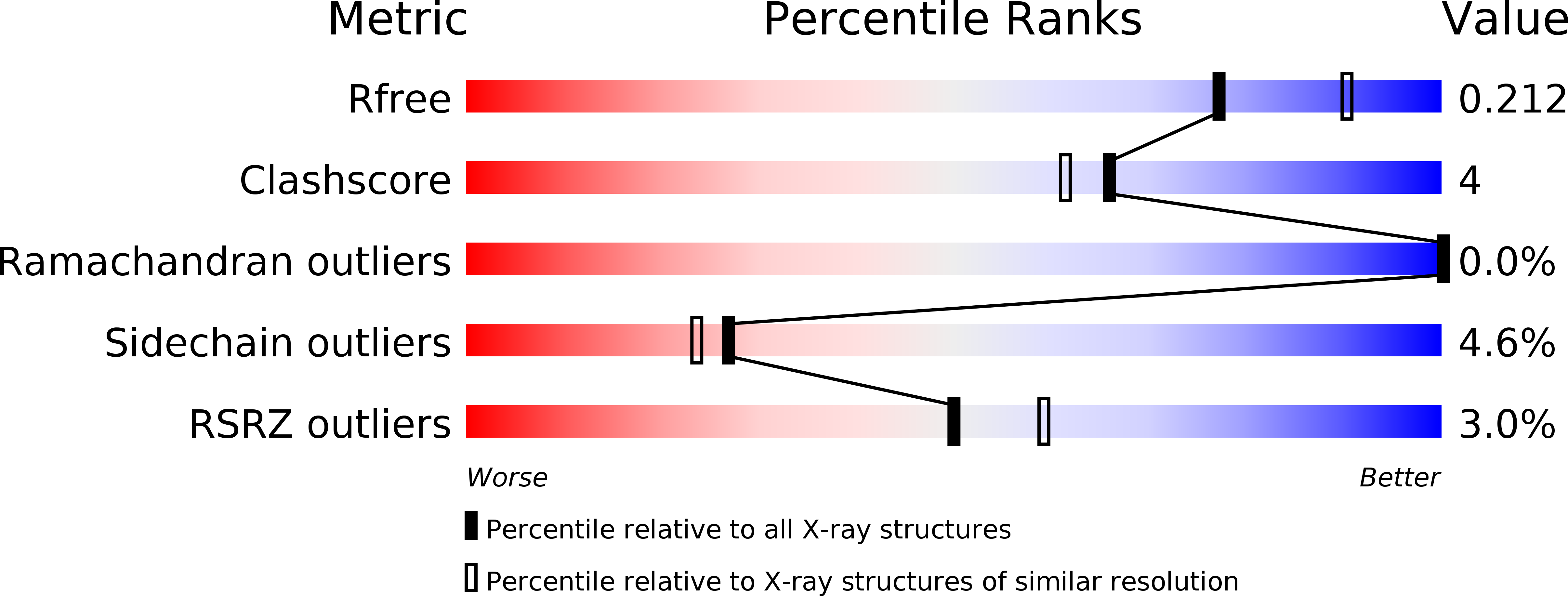
2.15 Å
R-Value Free:
0.19
R-Value Work:
0.16
R-Value Observed:
0.16
Space Group:
P 21 2 21
Macromolecular Entities
Structures with similar UniProt ID
Protein Blast
Polymer Type:polypeptide(L)
Molecule:Ribulose bisphosphate carboxylase large chain
Gene (Uniprot):rbcL
Chain IDs:A, B, C, D
Chain Length:458
Number of Molecules:4
Biological Source:Pisum sativum
Structures with similar UniProt ID
Protein Blast
Polymer Type:polypeptide(L)
Molecule:Ribulose bisphosphate carboxylase small chain 3A, chloroplastic
Gene (Uniprot):RBCS.3A
Chain IDs:E (auth: S), F (auth: T), G (auth: U), H (auth: V)
Chain Length:123
Number of Molecules:4
Biological Source:Pisum sativum
Primary Citation
Identification of Interactions between Abscisic Acid and Ribulose-1,5-Bisphosphate Carboxylase/Oxygenase.
Plos One 10 e0133033 e0133033 (2015)
PMID: 26197050 DOI: 10.1371/journal.pone.0133033

Abstact

Abscisic acid ((+)-ABA) is a phytohormone involved in the modulation of developmental processes and stress responses in plants. A chemical proteomics approach using an ABA mimetic probe was combined with in vitro assays, isothermal titration calorimetry (ITC), x-ray crystallography and in silico modelling to identify putative (+)-ABA binding-proteins in crude extracts of Arabidopsis thaliana. Ribulose-1,5-bisphosphate carboxylase/oxygenase (Rubisco) was identified as a putative ABA-binding protein. Radiolabelled-binding assays yielded a Kd of 47 nM for (+)-ABA binding to spinach Rubisco, which was validated by ITC, and found to be similar to reported and experimentally derived values for the native ribulose-1,5-bisphosphate (RuBP) substrate. Functionally, (+)-ABA caused only weak inhibition of Rubisco catalytic activity (Ki of 2.1 mM), but more potent inhibition of Rubisco activation (Ki of ~ 130 μM). Comparative structural analysis of Rubisco in the presence of (+)-ABA with RuBP in the active site revealed only a putative low occupancy (+)-ABA binding site on the surface of the large subunit at a location distal from the active site. However, subtle distortions in electron density in the binding pocket and in silico docking support the possibility of a higher affinity (+)-ABA binding site in the RuBP binding pocket. Overall we conclude that (+)-ABA interacts with Rubisco. While the low occupancy (+)-ABA binding site and weak non-competitive inhibition of catalysis may not be relevant, the high affinity site may allow ABA to act as a negative effector of Rubisco activation.

Legend

Protein

Chemical

Disease

Primary Citation of related structures
Feedback Form
Name
Email
Institute
Feedback