4MJW image
Deposition Date 2013-09-04
Release Date 2014-02-12
Last Version Date 2023-11-15
Entry Detail
PDB ID:
4MJW
Keywords:
Title:
Crystal Structure of Choline Oxidase in Complex with the Reaction Product Glycine Betaine
Biological Source:
Source Organism:
Host Organism:
Method Details:
Experimental Method:
Resolution:
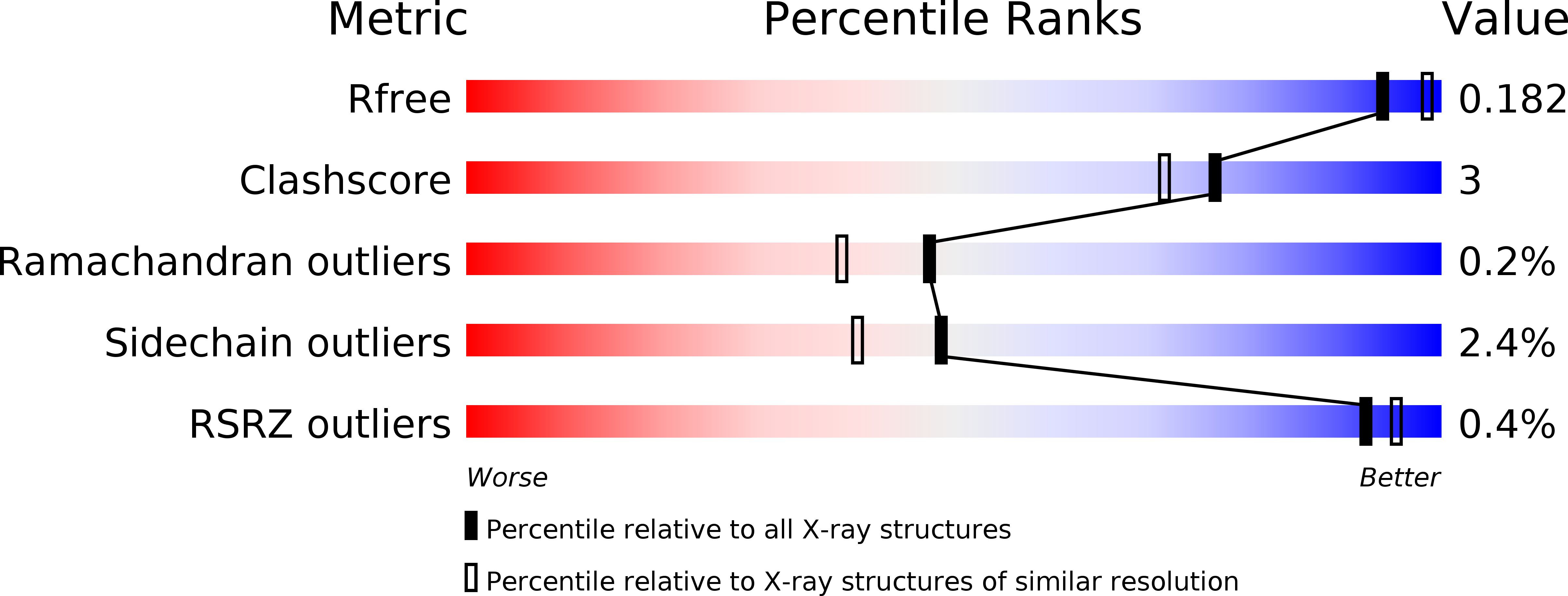
1.95 Å
R-Value Free:
0.18
R-Value Work:
0.15
R-Value Observed:
0.15
Space Group:
P 43 21 2
Macromolecular Entities
Structures with similar UniProt ID
Protein Blast
Polymer Type:polypeptide(L)
Molecule:Choline oxidase
Gene (Uniprot):codA
Chain IDs:A, B
Chain Length:546
Number of Molecules:2
Biological Source:Arthrobacter globiformis
Primary Citation
Structure of choline oxidase in complex with the reaction product glycine betaine.
Acta Crystallogr.,Sect.D 70 405 413 (2014)
PMID: 24531474 DOI: 10.1107/S1399004713029283

Abstact

Choline oxidase from Arthrobacter globiformis, which is involved in the biosynthesis of glycine betaine from choline, has been extensively characterized in its mechanistic and structural properties. Despite the knowledge gained on the enzyme, the details of substrate access to the active site are not fully understood. The `loop-and-lid' mechanism described for the glucose-methanol-choline enzyme superfamily has not been confirmed for choline oxidase. Instead, a hydrophobic cluster on the solvent-accessible surface of the enzyme has been proposed by molecular dynamics to control substrate access to the active site. Here, the crystal structure of the enzyme was solved in complex with glycine betaine at pH 6.0 at 1.95 Å resolution, allowing a structural description of the ligand-enzyme interactions in the active site. This structure is the first of choline oxidase in complex with a physiologically relevant ligand. The protein structures with and without ligand are virtually identical, with the exception of a loop at the dimer interface, which assumes two distinct conformations. The different conformations of loop 250-255 define different accessibilities of the proposed active-site entrance delimited by the hydrophobic cluster on the other subunit of the dimer, suggesting a role in regulating substrate access to the active site.

Legend

Protein

Chemical

Disease

Primary Citation of related structures
Feedback Form
Name
Email
Institute
Feedback