4MA9 image
Deposition Date 2013-08-15
Release Date 2013-11-20
Last Version Date 2023-09-20
Entry Detail
PDB ID:
4MA9
Keywords:
Title:
Wild type Salmonella Alkyl Hydroperoxide Reductase C in its substrate-ready conformation
Biological Source:
Expression System(s):
Method Details:
Experimental Method:
Resolution:
1.82 Å
R-Value Free:
0.24
R-Value Work:
0.20
Space Group:
C 2 2 21
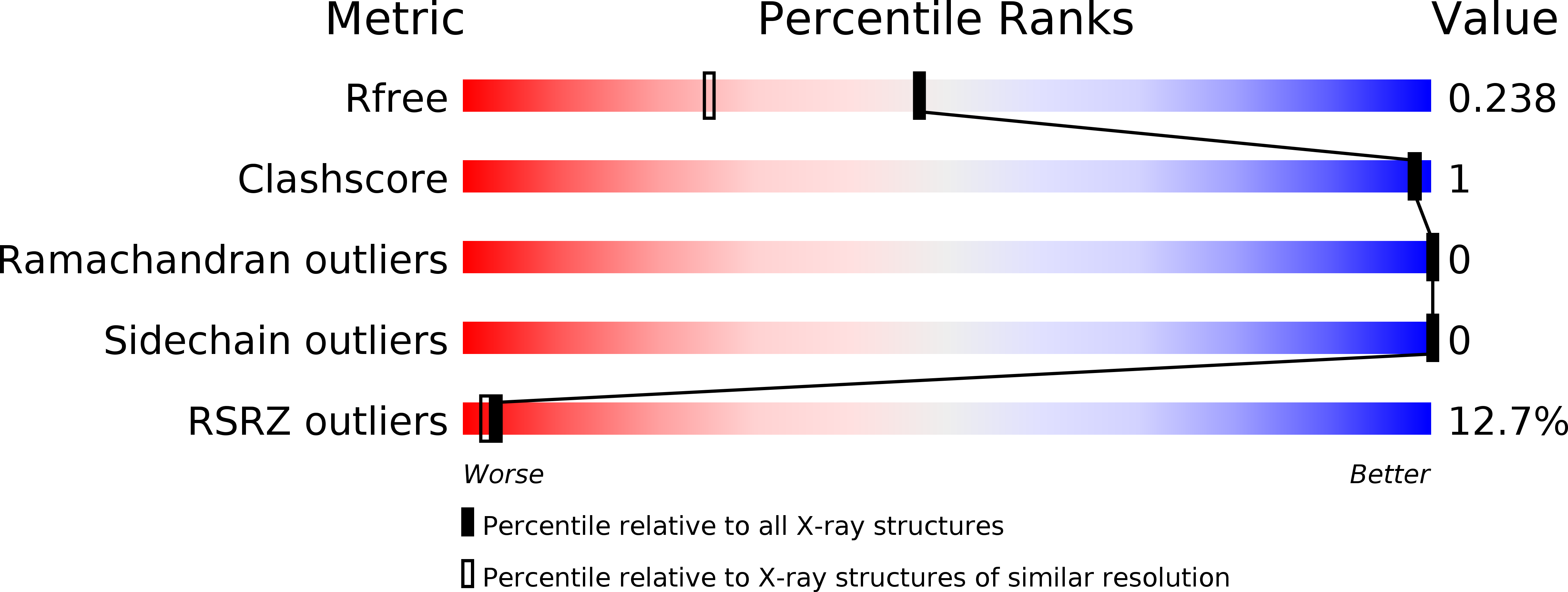
Macromolecular Entities
Structures with similar UniProt ID
Protein Blast
Polymer Type:polypeptide(L)
Molecule:Alkyl hydroperoxide reductase subunit C
Gene (Uniprot):ahpC
Chain IDs:A, B, C, D, E
Chain Length:186
Number of Molecules:5
Biological Source:Salmonella enterica subsp. enterica serovar Typhimurium
Primary Citation
The sensitive balance between the fully folded and locally unfolded conformations of a model peroxiredoxin.
Biochemistry 52 8708 8721 (2013)
PMID: 24175952 DOI: 10.1021/bi4011573

Abstact

To reduce peroxides, peroxiredoxins (Prxs) require a key "peroxidatic" Cys that, in a substrate-ready fully folded (FF) conformation, is oxidized to sulfenic acid and then, after a local unfolding (LU) of the active site, forms a disulfide bond with a second "resolving" Cys. For Salmonella typhimurium alkyl hydroperoxide reductase C (StAhpC) and some other Prxs, the FF structure is only known for a peroxidatic Cys→Ser variant, which may not accurately represent the wild-type enzyme. Here, we obtain the structure of authentic reduced wild-type StAhpC by dithiothreitol treatment of disulfide form crystals that fortuitously accommodate both the LU and FF conformations. The unique environment of one molecule in the crystal reveals a thermodynamic linkage between the folding of the active site loop and C-terminal regions, and comparisons with the Ser variant show structural and mobility differences from which we infer that the Cys→Ser mutation stabilizes the FF active site. A structure for the C165A variant (a resolving Cys to Ala mutant) in the same crystal form reveals that this mutation destabilizes the folding of the C-terminal region. These structures prove that subtle modifications to Prx structures can substantially influence enzymatic properties. We also present a simple thermodynamic framework for understanding the various mixtures of FF and LU conformations seen in these structures. On the basis of this framework, we rationalize how physiologically relevant regulatory post-translational modifications may modulate activity, and we propose a nonconventional strategy for designing selective Prx inhibitors.

Legend

Protein

Chemical

Disease

Primary Citation of related structures
Feedback Form
Name
Email
Institute
Feedback