4M6F image
Deposition Date 2013-08-09
Release Date 2014-03-12
Last Version Date 2024-02-28
Entry Detail
PDB ID:
4M6F
Keywords:
Title:
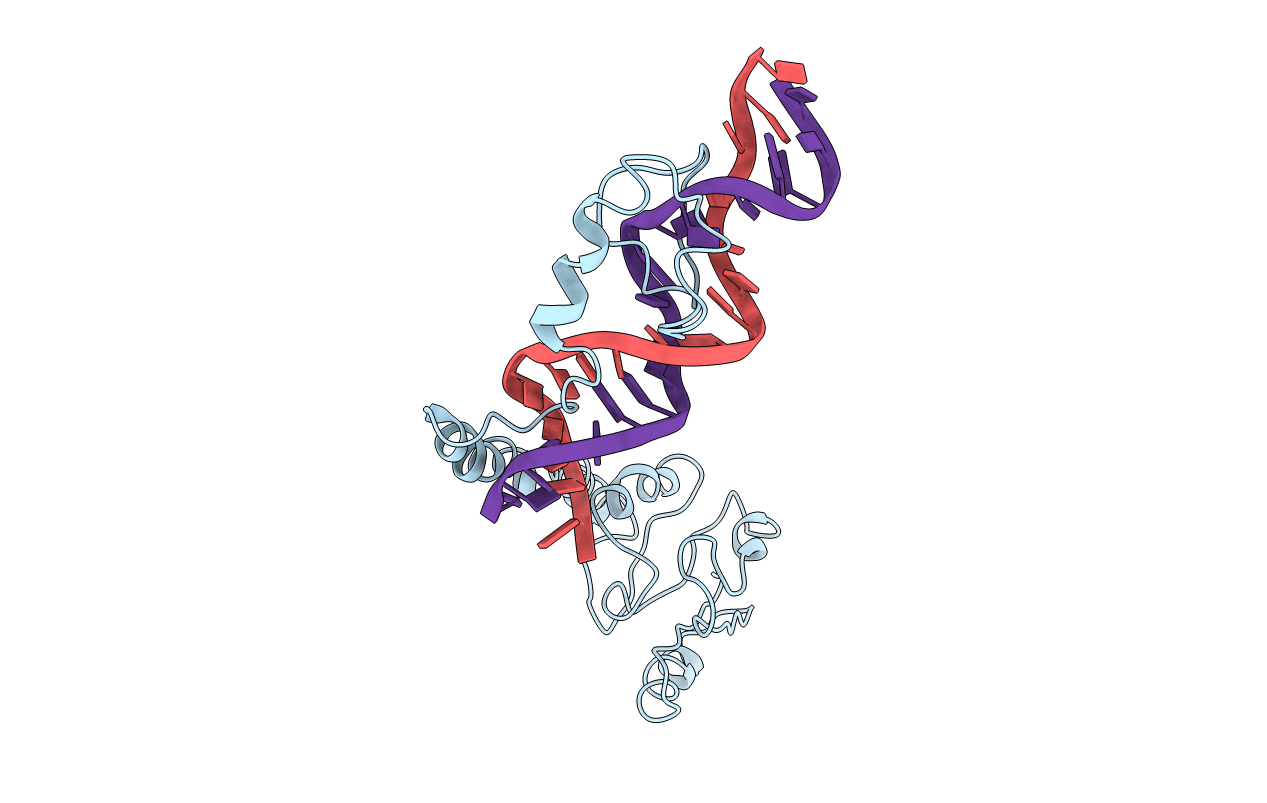
Dimer of the G-Segment Invertase bound to a DNA substrate
Biological Source:
Source Organism:
Method Details:
Experimental Method:
Resolution:
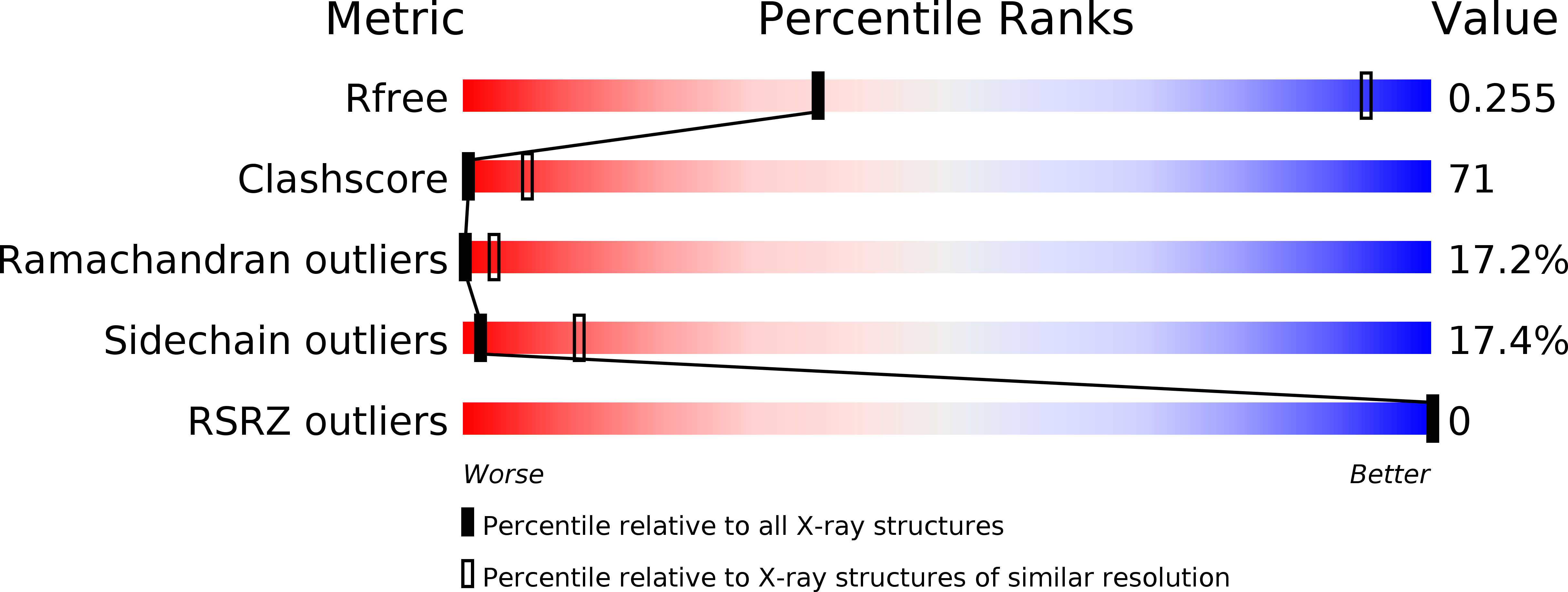
4.99 Å
R-Value Free:
0.28
R-Value Work:
0.22
R-Value Observed:
0.23
Space Group:
P 64 2 2
Macromolecular Entities
Structures with similar UniProt ID
Protein Blast
Polymer Type:polypeptide(L)
Molecule:DNA-invertase
Gene (Uniprot):gin
Chain IDs:A
Chain Length:193
Number of Molecules:1
Biological Source:Enterobacteria phage Mu
Polymer Type:polydeoxyribonucleotide
Molecule:gix site analog
Chain IDs:B
Chain Length:17
Number of Molecules:1
Biological Source:synthetic construct
Polymer Type:polydeoxyribonucleotide
Molecule:gix site analog
Chain IDs:C
Chain Length:18
Number of Molecules:1
Biological Source:synthetic construct
Ligand Molecules
Primary Citation
Exploiting large non-isomorphous differences for phase determination of a G-segment invertase-DNA complex.
Acta Crystallogr.,Sect.D 70 685 693 (2014)
PMID: 24598738 DOI: 10.1107/S1399004713032392

Abstact

Crystals of the G-segment invertase in complex with a 37-base-pair asymmetric DNA duplex substrate had an unusually high solvent content of 88% and diffracted to a maximal resolution of about 5.0 Å. These crystals exhibited a high degree of non-isomorphism and anisotropy, which presented a serious challenge for structure determination by isomorphous replacement. Here, a procedure of cross-crystal averaging is described that uses large non-isomorphous crystallographic data with a priori information of an approximate molecular boundary as determined from a minimal amount of experimental phase information. Using this procedure, high-quality experimental phases were obtained that have enabled it to be shown that the conformation of the bound substrate DNA duplex significantly differs from those of substrates bound in other serine recombinase-DNA complexes.

Legend

Protein

Chemical

Disease

Primary Citation of related structures
Feedback Form
Name
Email
Institute
Feedback