4LL7 image
Deposition Date 2013-07-09
Release Date 2014-02-12
Last Version Date 2024-02-28
Entry Detail
PDB ID:
4LL7
Title:
Structure of She3p amino terminus.
Biological Source:
Source Organism:
Host Organism:
Method Details:
Experimental Method:
Resolution:
2.31 Å
R-Value Free:
0.26
R-Value Work:
0.23
Space Group:
P 1
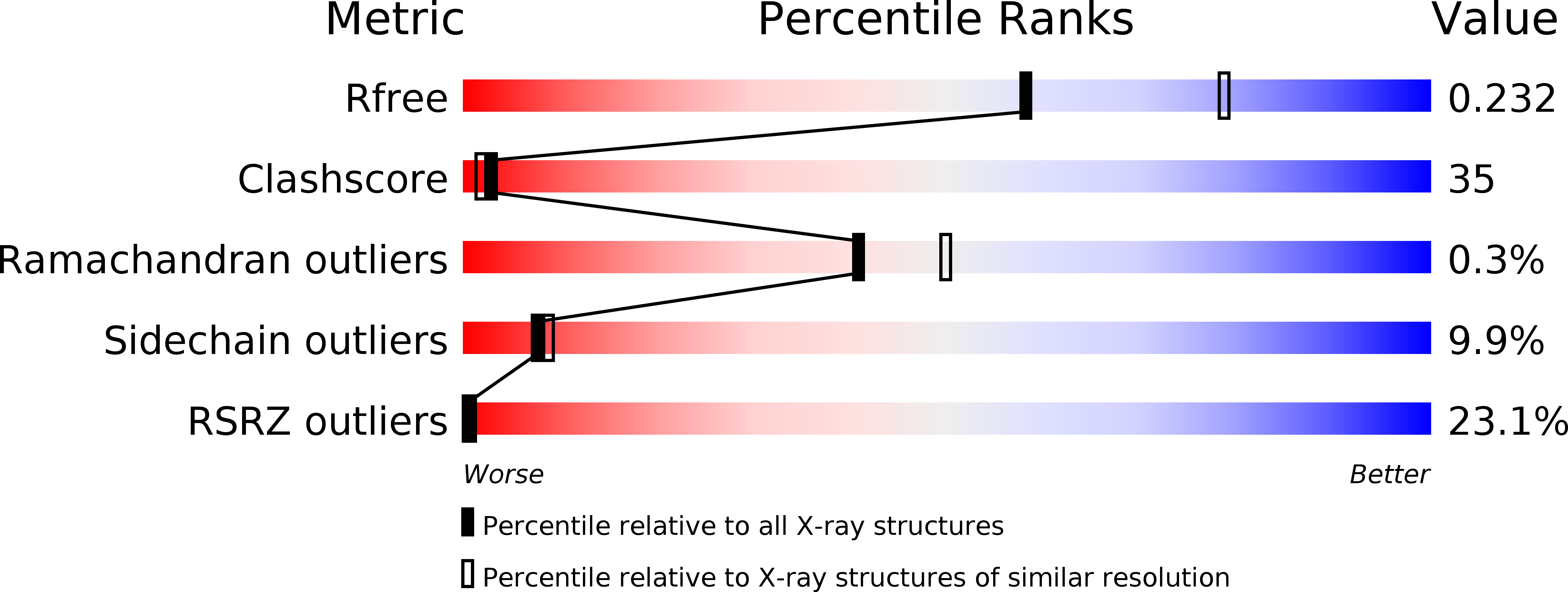
Macromolecular Entities
Structures with similar UniProt ID
Protein Blast
Polymer Type:polypeptide(L)
Molecule:SWI5-dependent HO expression protein 3
Gene (Uniprot):SHE3
Chain IDs:A, B, C, D, E, F, G, H
Chain Length:96
Number of Molecules:8
Biological Source:Saccharomyces cerevisiae
Primary Citation
Structure of a myosinbulletadaptor complex and pairing by cargo.
Proc.Natl.Acad.Sci.USA 111 E1082 E1090 (2014)
PMID: 24522109 DOI: 10.1073/pnas.1401428111

Abstact

Myosin 4 protein (Myo4p), one of five distinct myosins of yeast, is dedicated to cytoplasmic transport of two types of cargos, zipcoded messenger ribonucleoprotein particles (mRNPs) and tubular endoplasmic reticulum (tER). Neither cargo binds directly to Myo4p. Instead, swi5p-dependent HO expression 3 protein (She3p) serves as an "adaptor" that contains three binding modules, one for Myo4p and one each for zipcoded mRNP and tER. The assembly of a transport-competent motor complex is poorly understood. Here, we report that Myo4p•She3p forms a stable 1:2 heterotrimer in solution. In the Myo4p•She3p crystal structure, Myo4p's C-terminal domain (CTD) assumes a lobster claw-shaped form, the minor prong of which adheres to a pseudocoiled-coil region of She3p. The extensive Myo4p•She3p interactome buries 3,812 Å(2) surface area and is primarily hydrophobic. Because the Myo4p•She3p heterotrimer contains only one myosin molecule, it is not transport-competent. By stepwise reconstitution, we found a single molecule of synthetic oligonucleotide (representing the mRNA zipcode element) bound to a single tetramer of zipcode binding protein She2p to be sufficient for Myo4p•She3p dimerization. Therefore, cargo initiates cross-linking of two Myo4p•She3p heterotrimers to an ensemble that contains two myosin molecules obligatory for movement. An additional crystal structure comprising an overlapping upstream portion of She3p showed continuation of the pseudocoiled-coil structure and revealed another highly conserved surface region. We suggest this region as a candidate binding site for a yet unidentified tER ligand. We propose a model whereby zipcoded mRNP and/or tER ligands couple two Myo4p•She3p heterotrimers and thereby generate a transport-competent motor complex either for separate transport or cotransport of these two cargos.

Legend

Protein

Chemical

Disease

Primary Citation of related structures
Feedback Form
Name
Email
Institute
Feedback