4L67 image
Deposition Date 2013-06-12
Release Date 2013-08-14
Last Version Date 2024-10-30
Entry Detail
PDB ID:
4L67
Keywords:
Title:
Crystal Structure of Catalytic Domain of PAK4
Biological Source:
Source Organism:
Homo sapiens (Taxon ID: 9606)
Host Organism:
Method Details:
Experimental Method:
Resolution:
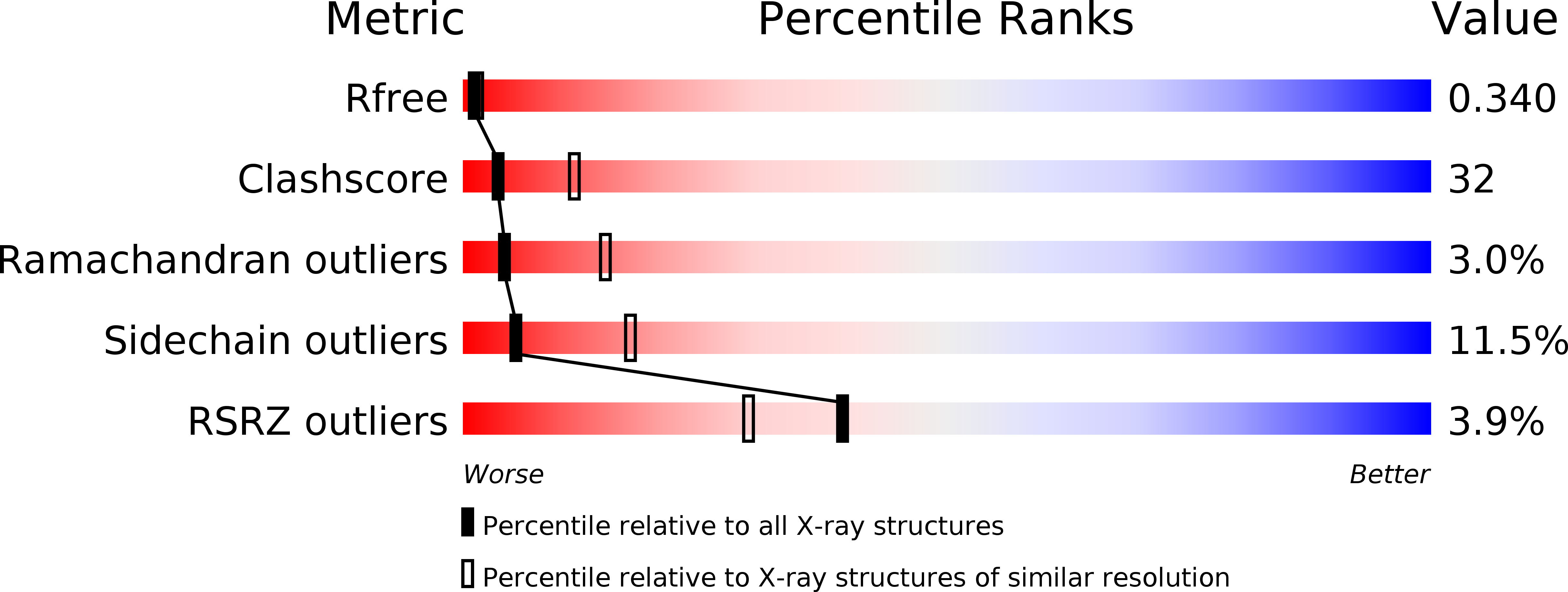
2.80 Å
R-Value Free:
0.33
R-Value Work:
0.22
R-Value Observed:
0.23
Space Group:
P 41 21 2
Macromolecular Entities
Structures with similar UniProt ID
Protein Blast
Polymer Type:polypeptide(L)
Molecule:Serine/threonine-protein kinase PAK 4
Gene (Uniprot):PAK4
Chain IDs:A
Chain Length:292
Number of Molecules:1
Biological Source:Homo sapiens
Structures with similar UniProt ID
Protein Blast
Polymer Type:polypeptide(L)
Molecule:Serine/threonine-protein kinase PAK 4
Gene (Uniprot):PAK4
Chain IDs:B
Chain Length:25
Number of Molecules:1
Biological Source:Homo sapiens
Modified Residue
Compound ID Chain ID Parent Comp ID Details 2D Image
SEP A SER PHOSPHOSERINE
Primary Citation
NMR binding and crystal structure reveal that intrinsically-unstructured regulatory domain auto-inhibits PAK4 by a mechanism different for that of PAK1
Biochem.Biophys.Res.Commun. 438 169 174 (2013)
PMID: 23876315 DOI: 10.1016/j.bbrc.2013.07.047

Abstact

Six human PAK members are classified into groups I (PAKs 1-3) and II (PAK4-6). Previously, only group I PAKs were thought to be auto-inhibited but very recently PAK4, the prototype of group II PAKs, has also been shown to be auto-inhibited by its N-terminal regulatory domain. However, the complete auto-inhibitory domain (AID) sequence remains undefined and the mechanism underlying its auto-inhibition is largely elusive. Here, the N-terminal regulatory domain of PAK4 sufficient for auto-inhibiting and binding Cdc42/Rac was characterized to be intrinsically unstructured, but nevertheless we identified the entire AID sequence by NMR. Strikingly, an AID peptide was derived by deleting the binding-unnecessary residues, which has a Kd of 320 nM to the PAK4 catalytic domain. Consequently, the PAK4 crystal structure complexed with the entire AID has been determined, which reveals that the complete kinase cleft is occupied by 20 AID residuescomposed of an N-terminal α-helix and a previously-identified pseudosubstrate motif, thus achieving auto-inhibition. Our study reveals that PAK4 is auto-inhibited by a novel mechanism which is completely different from that for PAK1, thus bearing critical implications for design of inhibitors specific for group II PAKs.

Legend

Protein

Chemical

Disease

Primary Citation of related structures
Feedback Form
Name
Email
Institute
Feedback