4L3O image
Deposition Date 2013-06-06
Release Date 2014-02-19
Last Version Date 2023-11-08
Entry Detail
PDB ID:
4L3O
Title:
Crystal Structure of SIRT2 in complex with the macrocyclic peptide S2iL5
Biological Source:
Source Organism:
Homo sapiens (Taxon ID: 9606)
Host Organism:
Method Details:
Experimental Method:
Resolution:
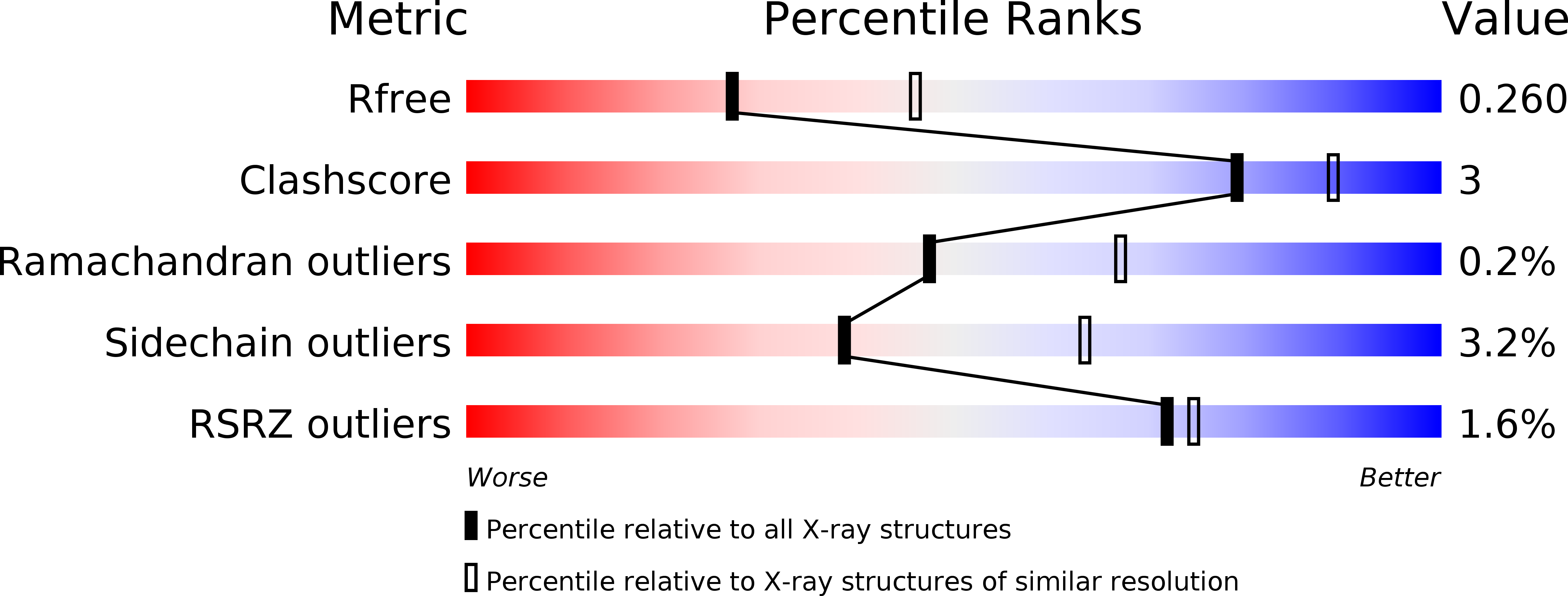
2.52 Å
R-Value Free:
0.26
R-Value Work:
0.21
R-Value Observed:
0.21
Space Group:
P 21 21 21
Macromolecular Entities
Structures with similar UniProt ID
Protein Blast
Polymer Type:polypeptide(L)
Molecule:NAD-dependent protein deacetylase sirtuin-2
Gene (Uniprot):SIRT2
Chain IDs:A, B, C, D
Chain Length:302
Number of Molecules:4
Biological Source:Homo sapiens
Polymer Type:polypeptide(L)
Molecule:cyclic peptide S2iL5
Chain IDs:E, F, G, H
Chain Length:16
Number of Molecules:4
Biological Source:
Modified Residue
Compound ID Chain ID Parent Comp ID Details 2D Image
FAK E LYS N~6~-(TRIFLUOROACETYL)-L-LYSINE
Peptide-like Molecules
PRD_001104
Primary Citation
Structural Basis for Potent Inhibition of SIRT2 Deacetylase by a Macrocyclic Peptide Inducing Dynamic Structural Change
Structure 22 345 352 (2013)
PMID: 24389023 DOI: 10.1016/j.str.2013.12.001

Abstact

SIRT2 deacetylates specific acetyllysine residues in diverse proteins and is implicated in a variety of cellular processes. SIRT2 inhibition thus has potentials to treat human diseases such as cancers and neurodegenerative disorders. We have recently developed a series of ε-trifluoroacetyllysine-containing macrocyclic peptides, which inhibit the SIRT2 activity more potently than most other known inhibitors. Here, we report the crystal structure of human SIRT2 in complex with a macrocyclic peptide inhibitor, S2iL5, at 2.5 Å resolution. The structure revealed that S2iL5 binds to the active site of SIRT2 through extensive interactions. A structural comparison of the SIRT2-S2iL5 complex with SIRT2 in the free form, and in complex with ADP-ribose, revealed that S2iL5 induces an open-to-closed domain movement and an unexpected helix-to-coil transition in a SIRT2-specific region. Our findings unveil the potential of macrocyclic peptides to bind target proteins by inducing dynamic structural changes.

Legend

Protein

Chemical

Disease

Primary Citation of related structures
Feedback Form
Name
Email
Institute
Feedback