4L2W image
Deposition Date 2013-06-04
Release Date 2014-04-16
Last Version Date 2024-02-28
Entry Detail
PDB ID:
4L2W
Keywords:
Title:
Crystal structure of the Shroom-Binding domain of human Rock1
Biological Source:
Source Organism:
Homo sapiens (Taxon ID: 9606)
Host Organism:
Method Details:
Experimental Method:
Resolution:
2.49 Å
R-Value Free:
0.27
R-Value Work:
0.23
R-Value Observed:
0.23
Space Group:
C 1 2 1
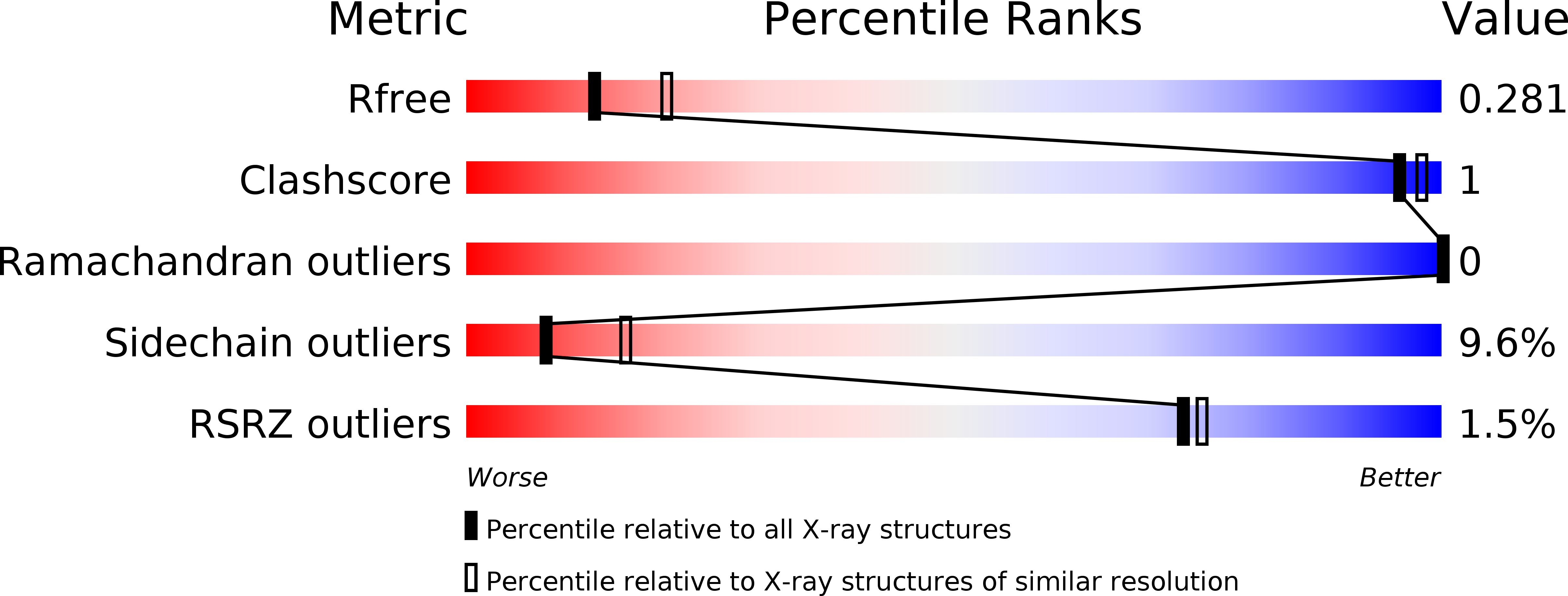
Macromolecular Entities
Structures with similar UniProt ID
Protein Blast
Polymer Type:polypeptide(L)
Molecule:Rho-associated protein kinase 1
Gene (Uniprot):ROCK1
Mutagens:E884A, K885A, E886A
Chain IDs:A (auth: C), B (auth: D), C (auth: A), D (auth: B)
Chain Length:87
Number of Molecules:4
Biological Source:Homo sapiens
Primary Citation
Structure of a highly conserved domain of Rock1 required for Shroom-mediated regulation of cell morphology.
Plos One 8 e81075 e81075 (2013)
PMID: 24349032 DOI: 10.1371/journal.pone.0081075

Abstact

Rho-associated coiled coil containing protein kinase (Rho-kinase or Rock) is a well-defined determinant of actin organization and dynamics in most animal cells characterized to date. One of the primary effectors of Rock is non-muscle myosin II. Activation of Rock results in increased contractility of myosin II and subsequent changes in actin architecture and cell morphology. The regulation of Rock is thought to occur via autoinhibition of the kinase domain via intramolecular interactions between the N-terminus and the C-terminus of the kinase. This autoinhibited state can be relieved via proteolytic cleavage, binding of lipids to a Pleckstrin Homology domain near the C-terminus, or binding of GTP-bound RhoA to the central coiled-coil region of Rock. Recent work has identified the Shroom family of proteins as an additional regulator of Rock either at the level of cellular distribution or catalytic activity or both. The Shroom-Rock complex is conserved in most animals and is essential for the formation of the neural tube, eye, and gut in vertebrates. To address the mechanism by which Shroom and Rock interact, we have solved the structure of the coiled-coil region of Rock that binds to Shroom proteins. Consistent with other observations, the Shroom binding domain is a parallel coiled-coil dimer. Using biochemical approaches, we have identified a large patch of residues that contribute to Shrm binding. Their orientation suggests that there may be two independent Shrm binding sites on opposing faces of the coiled-coil region of Rock. Finally, we show that the binding surface is essential for Rock colocalization with Shroom and for Shroom-mediated changes in cell morphology.

Legend

Protein

Chemical

Disease

Primary Citation of related structures
Feedback Form
Name
Email
Institute
Feedback