4KOM image
Deposition Date 2013-05-12
Release Date 2013-11-06
Last Version Date 2024-11-27
Entry Detail
PDB ID:
4KOM
Keywords:
Title:
The structure of hemagglutinin from avian-origin H7N9 influenza virus in complex with avian receptor analog 3'SLNLN (NeuAcα2-3Galβ1-4GlcNAcβ1-3Galβ1-4Glc)
Biological Source:
Source Organism:
Host Organism:
Method Details:
Experimental Method:
Resolution:
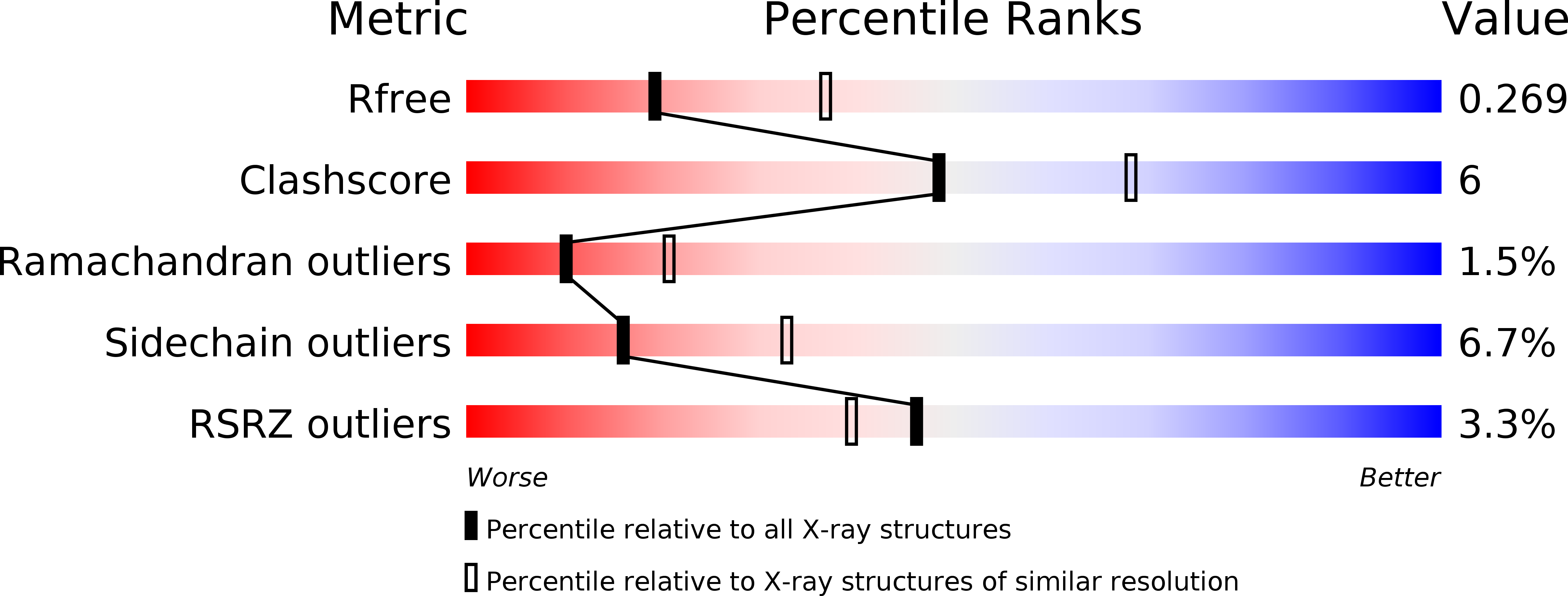
2.60 Å
R-Value Free:
0.27
R-Value Work:
0.22
R-Value Observed:
0.22
Space Group:
H 3 2
Macromolecular Entities
Structures with similar UniProt ID
Protein Blast
Polymer Type:polypeptide(L)
Molecule:Hemagglutinin HA1
Chain IDs:A
Chain Length:314
Number of Molecules:1
Biological Source:Influenza A virus
Structures with similar UniProt ID
Protein Blast
Polymer Type:polypeptide(L)
Molecule:Hemagglutinin HA2
Chain IDs:B
Chain Length:169
Number of Molecules:1
Biological Source:Influenza A virus
Modified Residue
Compound ID Chain ID Parent Comp ID Details 2D Image
ASN A ASN GLYCOSYLATION SITE
Ligand Molecules
Primary Citation
Structures and receptor binding of hemagglutinins from human-infecting H7N9 influenza viruses.
Science 342 243 247 (2013)
PMID: 24009358 DOI: 10.1126/science.1242917

Abstact

An avian-origin human-infecting influenza (H7N9) virus was recently identified in China. We have evaluated the viral hemagglutinin (HA) receptor-binding properties of two human H7N9 isolates, A/Shanghai/1/2013 (SH-H7N9) (containing the avian-signature residue Gln(226)) and A/Anhui/1/2013 (AH-H7N9) (containing the mammalian-signature residue Leu(226)). We found that SH-H7N9 HA preferentially binds the avian receptor analog, whereas AH-H7N9 HA binds both avian and human receptor analogs. Furthermore, an AH-H7N9 mutant HA (Leu(226) → Gln) was found to exhibit dual receptor-binding property, indicating that other amino acid substitutions contribute to the receptor-binding switch. The structures of SH-H7N9 HA, AH-H7N9 HA, and its mutant in complex with either avian or human receptor analogs show how AH-H7N9 can bind human receptors while still retaining the avian receptor-binding property.

Legend

Protein

Chemical

Disease

Primary Citation of related structures
Feedback Form
Name
Email
Institute
Feedback