4KAK image
Deposition Date 2013-04-22
Release Date 2013-10-09
Last Version Date 2023-09-20
Entry Detail
PDB ID:
4KAK
Title:
Crystal structure of human dihydrofolate reductase complexed with NADPH and 6-ethyl-5-[(3S)-3-[3-methoxy-5-(pyridine-4-yl)phenyl]but-1-yn-1-yl]pyrimidine-2,4-diamine (UCP1006)
Biological Source:
Source Organism:
Homo sapiens (Taxon ID: 9606)
Host Organism:
Method Details:
Experimental Method:
Resolution:
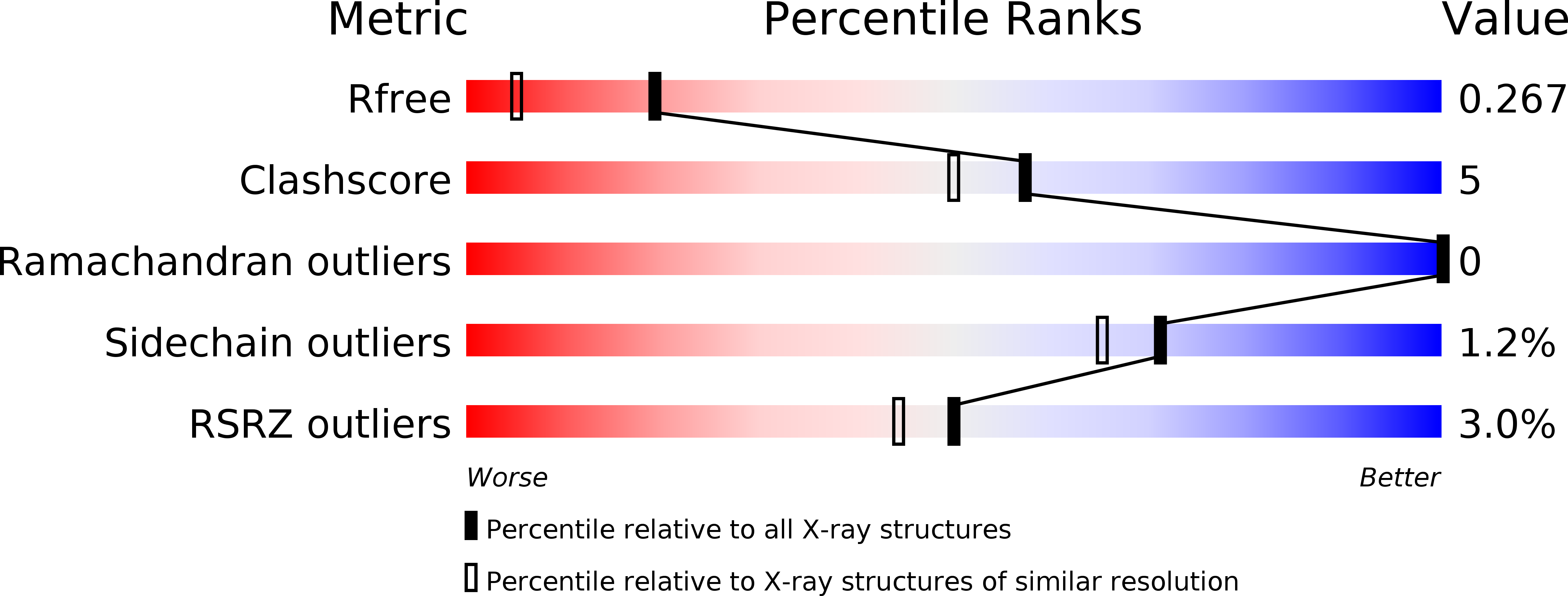
1.80 Å
R-Value Free:
0.26
R-Value Work:
0.22
R-Value Observed:
0.22
Space Group:
C 2 2 21
Macromolecular Entities
Structures with similar UniProt ID
Protein Blast
Polymer Type:polypeptide(L)
Molecule:Dihydrofolate reductase
Gene (Uniprot):DHFR
Chain IDs:A, B
Chain Length:186
Number of Molecules:2
Biological Source:Homo sapiens
Primary Citation
Elucidating features that drive the design of selective antifolates using crystal structures of human dihydrofolate reductase.
Biochemistry 52 7318 7326 (2013)
PMID: 24053334 DOI: 10.1021/bi400852h

Abstact

The pursuit of antimicrobial drugs that target dihydrofolate reductase (DHFR) exploits differences in sequence and dynamics between the pathogenic and human enzymes. Here, we present five crystal structures of human DHFR bound to a new class of antimicrobial agents, the propargyl-linked antifolates (PLAs), with a range of potency (IC50 values of 0.045-1.07 μM) for human DHFR. These structures reveal that interactions between the ligands and Asn 64, Phe 31, and Phe 34 are important for increased affinity for human DHFR and that loop residues 58-64 undergo ligand-induced conformational changes. The utility of these structural studies was demonstrated through the design of three new ligands that reduce the number of contacts with Asn 64, Phe 31, and Phe 34. Synthesis and evaluation show that one of the designed inhibitors exhibits the lowest affinity for human DHFR of any of the PLAs (2.64 μM). Comparisons of structures of human and Staphylococcus aureus DHFR bound to the same PLA reveal a conformational change in the ligand that enhances interactions with residues Phe 92 (Val 115 in huDHFR) and Ile 50 (Ile 60 in huDHFR) in S. aureus DHFR, yielding selectivity. Likewise, comparisons of human and Candida glabrata DHFR bound to the same ligand show that hydrophobic interactions with residues Ile 121 and Phe 66 (Val 115 and Asn 64 in human DHFR) yield selective inhibitors. The identification of residue substitutions that are important for selectivity and the observation of active site flexibility will help guide antimicrobial antifolate development for the inhibition of pathogenic species.

Legend

Protein

Chemical

Disease

Primary Citation of related structures
Feedback Form
Name
Email
Institute
Feedback