4JNA image
Deposition Date 2013-03-14
Release Date 2014-03-05
Last Version Date 2023-11-15
Entry Detail
PDB ID:
4JNA
Title:
Crystal structure of the DepH complex with dimethyl-FK228
Biological Source:
Source Organism:
Host Organism:
Method Details:
Experimental Method:
Resolution:
2.00 Å
R-Value Free:
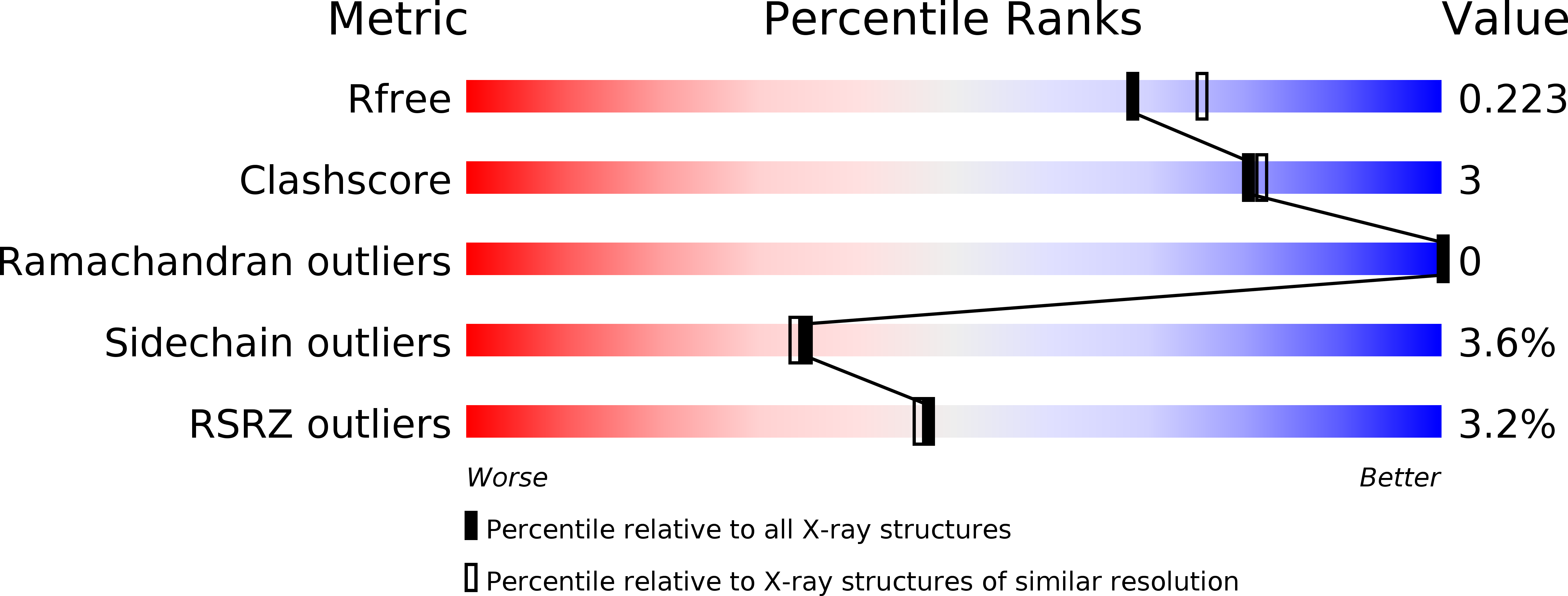
0.22
R-Value Work:
0.15
R-Value Observed:
0.15
Space Group:
P 43 21 2
Macromolecular Entities
Structures with similar UniProt ID
Protein Blast
Polymer Type:polypeptide(L)
Molecule:DepH
Gene (Uniprot):depH
Chain IDs:A, B
Chain Length:340
Number of Molecules:2
Biological Source:Chromobacterium violaceum
Modified Residue
Compound ID Chain ID Parent Comp ID Details 2D Image
DBU C THR (2Z)-2-AMINOBUT-2-ENOIC ACID
Peptide-like Molecules
PRD_001184
Primary Citation
The structural basis of an NADP+-independent dithiol oxidase in FK228 biosynthesis.
Sci Rep 4 4145 4145 (2014)
PMID: 24553401 DOI: 10.1038/srep04145

Abstact

The disulfide bond is unusual in natural products and critical for thermal stability, cell permeability and bioactivity. DepH from Chromobacterium violaceum No. 968 is an FAD-dependent enzyme responsible for catalyzing the disulfide bond formation of FK228, an anticancer prodrug approved for the treatment of cutaneous T-cell lymphoma. Here we report the crystal structures of DepH and DepH complexed with a substrate analogue S,S'-dimethyl FK228 at 1.82 Å and 2.00 Å, respectively. Structural and biochemical analyses revealed that DepH, in contrast to the well characterized low molecular weight thioredoxin reductases (LMW TrxRs), is an NADP(+)-independent dithiol oxidase. DepH not only lacks a conserved GGGDXAXE motif necessary for NADP(+) binding in the canonical LMW TrxRs, but also contains a 11-residue sequence which physically impedes the binding of NADP(+). These observations explain the difference between NADP(+)-independent small molecule dithiol oxidases and NADP(+)-dependent thioredoxin reductases and provide insights for understanding the catalytic mechanism of dithiol oxidases involved in natural product biosynthesis.

Legend

Protein

Chemical

Disease

Primary Citation of related structures
Feedback Form
Name
Email
Institute
Feedback