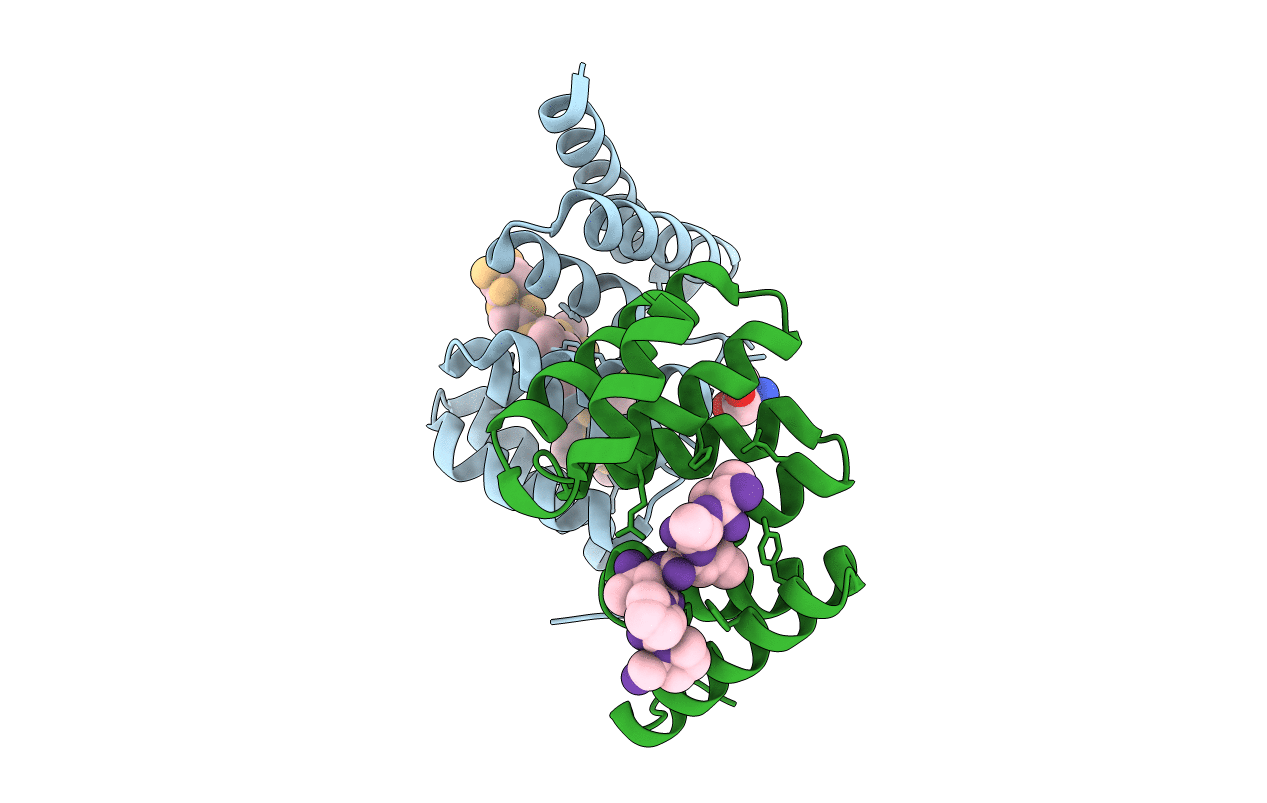
4JL0 image
Deposition Date 2013-03-12
Release Date 2013-12-11
Last Version Date 2023-09-20
Entry Detail
PDB ID:
4JL0
Keywords:
Title:
Crystal structure of PcrH in complex with the chaperone binding region of PopB
Biological Source:
Source Organism:
Host Organism:
Method Details:
Experimental Method:
Resolution:
2.22 Å
R-Value Free:
0.26
R-Value Work:
0.21
R-Value Observed:
0.21
Space Group:
P 21 2 21
Macromolecular Entities
Structures with similar UniProt ID
Protein Blast
Polymer Type:polypeptide(L)
Molecule:Regulatory protein PcrH
Gene (Uniprot):pcrH
Chain IDs:A, B
Chain Length:142
Number of Molecules:2
Biological Source:Pseudomonas aeruginosa
Structures with similar UniProt ID
Protein Blast
Polymer Type:polypeptide(L)
Molecule:PopB
Gene (Uniprot):popB
Chain IDs:C, D
Chain Length:9
Number of Molecules:2
Biological Source:Pseudomonas aeruginosa
Ligand Molecules
Primary Citation
Membrane and Chaperone Recognition by the Major Translocator Protein PopB of the Type III Secretion System of Pseudomonas aeruginosa.
J.Biol.Chem. 289 3591 3601 (2014)
PMID: 24297169 DOI: 10.1074/jbc.M113.517920

Abstact

The type III secretion system is a widespread apparatus used by pathogenic bacteria to inject effectors directly into the cytoplasm of eukaryotic cells. A key component of this highly conserved system is the translocon, a pore formed in the host membrane that is essential for toxins to bypass this last physical barrier. In Pseudomonas aeruginosa the translocon is composed of PopB and PopD, both of which before secretion are stabilized within the bacterial cytoplasm by a common chaperone, PcrH. In this work we characterize PopB, the major translocator, in both membrane-associated and PcrH-bound forms. By combining sucrose gradient centrifugation experiments, limited proteolysis, one-dimensional NMR, and β-lactamase reporter assays on eukaryotic cells, we show that PopB is stably inserted into bilayers with its flexible N-terminal domain and C-terminal tail exposed to the outside. In addition, we also report the crystal structure of the complex between PcrH and an N-terminal region of PopB (residues 51-59), which reveals that PopB lies within the concave face of PcrH, employing mostly backbone residues for contact. PcrH is thus the first chaperone whose structure has been solved in complex with both type III secretion systems translocators, revealing that both molecules employ the same surface for binding and excluding the possibility of formation of a ternary complex. The characterization of the major type III secretion system translocon component in both membrane-bound and chaperone-bound forms is a key step for the eventual development of antibacterials that block translocon assembly.

Legend

Protein

Chemical

Disease

Primary Citation of related structures
Feedback Form
Name
Email
Institute
Feedback