4JGX image
Deposition Date 2013-03-04
Release Date 2013-12-18
Last Version Date 2023-11-08
Entry Detail
PDB ID:
4JGX
Title:
The Structure of Sterol Carrier Protein 2 from the Yeast Yarrowia Lipolytica
Biological Source:
Source Organism:
Host Organism:
Method Details:
Experimental Method:
Resolution:
2.20 Å
R-Value Free:
0.21
R-Value Work:
0.18
R-Value Observed:
0.18
Space Group:
P 31 2 1
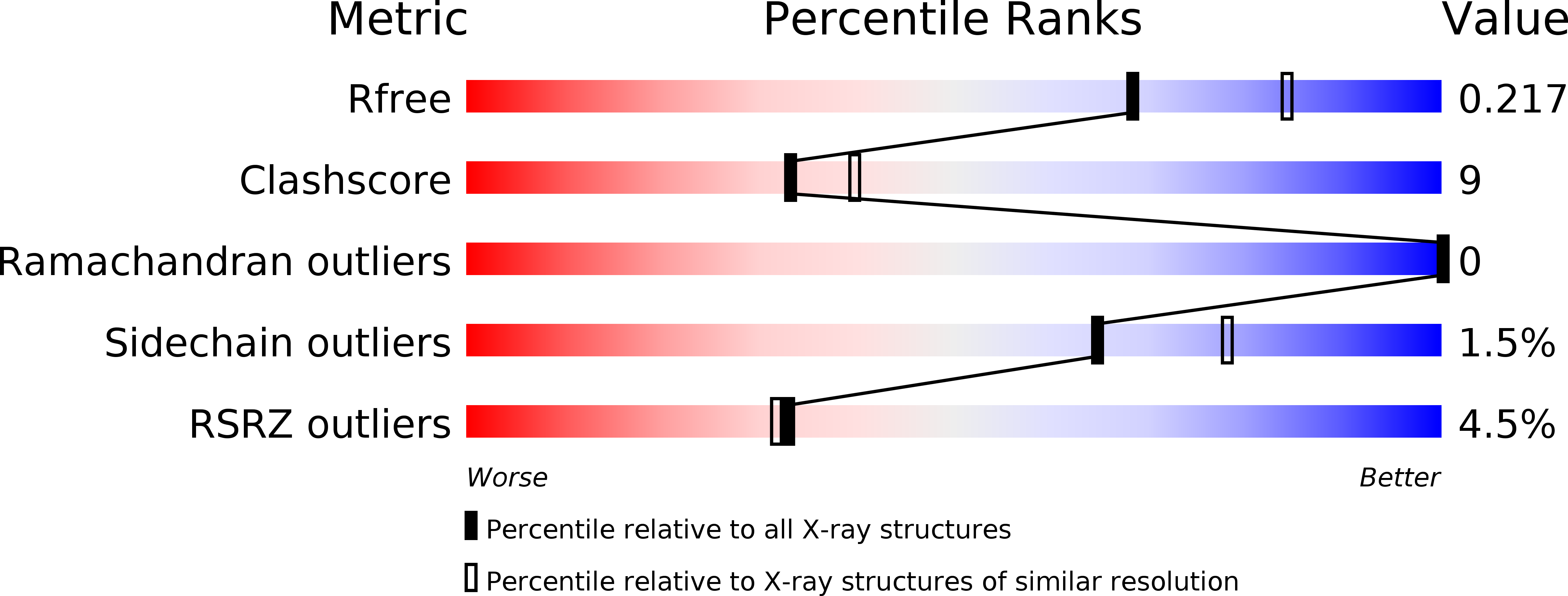
Macromolecular Entities
Structures with similar UniProt ID
Protein Blast
Polymer Type:polypeptide(L)
Molecule:Fatty acid-binding protein
Gene (Uniprot):SCP2
Chain IDs:A, B
Chain Length:129
Number of Molecules:2
Biological Source:Yarrowia lipolytica
Primary Citation
The crystal structure of sterol carrier protein 2 from Yarrowia lipolytica and the evolutionary conservation of a large, non-specific lipid-binding cavity.
J.Struct.Funct.Genom. 14 145 153 (2013)
PMID: 24241823 DOI: 10.1007/s10969-013-9166-6

Abstact

Sterol carrier protein 2 (SCP2), a small intracellular domain present in all forms of life, binds with high affinity a broad spectrum of lipids. Due to its involvement in the metabolism of long-chain fatty acids and cholesterol uptake, it has been the focus of intense research in mammals and insects; much less characterized are SCP2 from other eukaryotic cells and microorganisms. We report here the X-ray structure of Yarrowia lipolytica SCP2 (YLSCP2) at 2.2 Å resolution in complex with palmitic acid. This is the first fungal SCP2 structure solved, and it consists of the canonical five-stranded β-sheet covered on the internal face by a layer of five α-helices. The overall fold is conserved among the SCP2 family, however, YLSCP2 is most similar to the SCP2 domain of human MFE-2, a bifunctional enzyme acting on peroxisomal β-oxidation. We have identified the common structural elements defining the shape and volume of the large binding cavity in all species characterized. Moreover, we found that the cavity of the SCP2 domains is distinctly formed by carbon atoms, containing neither organized water nor rigid polar interactions with the ligand. These features are in contrast with those of fatty acid binding proteins, whose internal cavities are more polar and contain bound water. The results will help to design experiments to unveil the SCP2 function in very different cellular contexts and metabolic conditions.

Legend

Protein

Chemical

Disease

Primary Citation of related structures
Feedback Form
Name
Email
Institute
Feedback