4IWN image
Deposition Date 2013-01-24
Release Date 2013-05-29
Last Version Date 2023-09-20
Entry Detail
PDB ID:
4IWN
Keywords:
Title:
Crystal structure of a putative methyltransferase CmoA in complex with a novel SAM derivative
Biological Source:
Source Organism:
Escherichia coli (Taxon ID: 562)
Host Organism:
Method Details:
Experimental Method:
Resolution:
1.73 Å
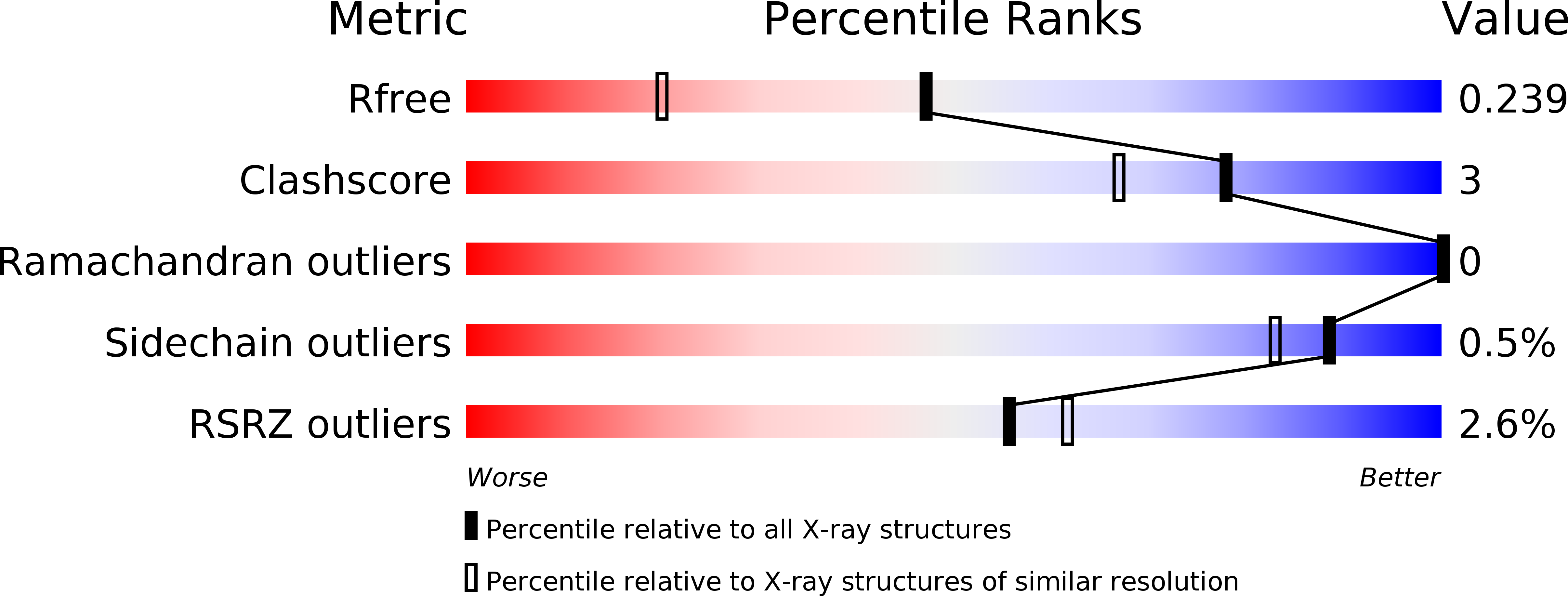
R-Value Free:
0.23
R-Value Work:
0.19
R-Value Observed:
0.19
Space Group:
P 21 21 2
Macromolecular Entities
Structures with similar UniProt ID
Protein Blast
Polymer Type:polypeptide(L)
Molecule:tRNA (cmo5U34)-methyltransferase
Gene (Uniprot):cmoA
Chain IDs:A, B
Chain Length:229
Number of Molecules:2
Biological Source:Escherichia coli
Primary Citation
S-Adenosyl-S-carboxymethyl-L-homocysteine: a novel cofactor found in the putative tRNA-modifying enzyme CmoA.
Acta Crystallogr.,Sect.D 69 1090 1098 (2013)
PMID: 23695253 DOI: 10.1107/S0907444913004939

Abstact

Uridine at position 34 of bacterial transfer RNAs is commonly modified to uridine-5-oxyacetic acid (cmo(5)U) to increase the decoding capacity. The protein CmoA is involved in the formation of cmo(5)U and was annotated as an S-adenosyl-L-methionine-dependent (SAM-dependent) methyltransferase on the basis of its sequence homology to other SAM-containing enzymes. However, both the crystal structure of Escherichia coli CmoA at 1.73 Å resolution and mass spectrometry demonstrate that it contains a novel cofactor, S-adenosyl-S-carboxymethyl-L-homocysteine (SCM-SAH), in which the donor methyl group is substituted by a carboxymethyl group. The carboxyl moiety forms a salt-bridge interaction with Arg199 that is conserved in a large group of CmoA-related proteins but is not conserved in other SAM-containing enzymes. This raises the possibility that a number of enzymes that have previously been annotated as SAM-dependent are in fact SCM-SAH-dependent. Indeed, inspection of electron density for one such enzyme with known X-ray structure, PDB entry 1im8, suggests that the active site contains SCM-SAH and not SAM.

Legend

Protein

Chemical

Disease

Primary Citation of related structures
Feedback Form
Name
Email
Institute
Feedback