4IOV image
Deposition Date 2013-01-08
Release Date 2014-04-02
Last Version Date 2024-02-28
Entry Detail
PDB ID:
4IOV
Keywords:
Title:
The structure of AAVrh32.33, a Novel Gene Delivery Vector
Biological Source:
Source Organism:
Method Details:
Experimental Method:
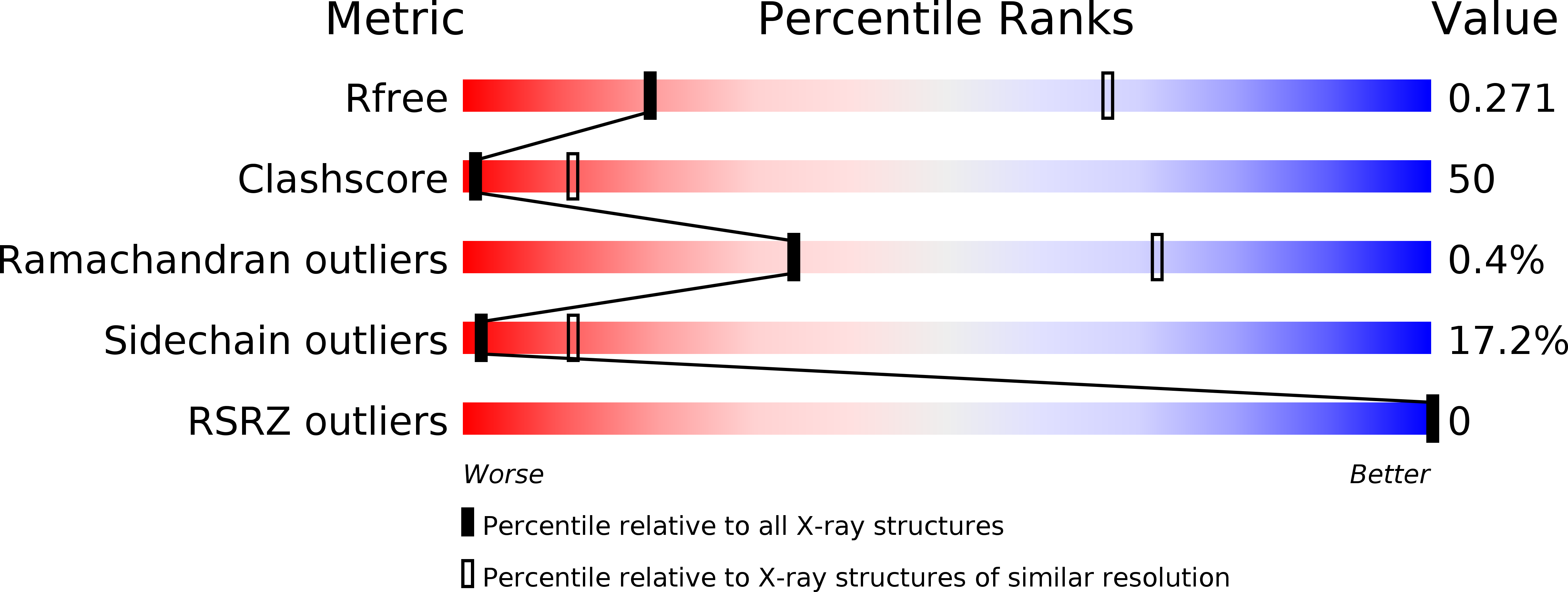
Resolution:
3.50 Å
R-Value Free:
0.26
R-Value Work:
0.27
R-Value Observed:
0.27
Space Group:
P 1
Macromolecular Entities
Structures with similar UniProt ID
Protein Blast
Polymer Type:polypeptide(L)
Molecule:Capsid protein VP1
Chain IDs:A
Chain Length:733
Number of Molecules:1
Biological Source:Adeno-associated virus
Ligand Molecules
Primary Citation
The structure of AAVrh32.33, a novel gene delivery vector.
J.Struct.Biol. 186 308 317 (2014)
PMID: 24704217 DOI: 10.1016/j.jsb.2014.03.020

Abstact

The Adeno-associated viruses (AAVs) are being developed as gene delivery vectors for therapeutic clinical applications. However, the host antibody immune response directed against their capsid, prevalent in ∼40-70% of the general population, depending on serotype, negatively impacts efficacy. AAVrh32.33, a novel vector developed from rhesus macaques isolates, has significantly lower seroprevalence in human populations compared to AAV2 and AAV8, which are both in clinical use. To better understand the capsid determinants of this differential immune response to AAVrh32.33, its structure was determined by X-ray crystallography to 3.5 Å resolution. The capsid viral protein (VP) structure conserves the eight-stranded β-barrel core and αA helix reported for other parvoviruses and the distinct capsid surface topology of the AAVs: a depression at the icosahedral twofold axis, three protrusions surrounding the threefold axis, and a depression surround a cylindrical channel at the fivefold axis. A comparison to AAV2, AAV4, and AAV8, to which AAVrh32.33 shares ∼61%, ∼81%, and ∼63% identity, respectively, identified differences in previously defined AAV VP structurally variable regions (VR-1 to VR-IX) which function as receptor attachment, transduction efficiency, and/or antigenic determinants. This structure thus provides a 3D platform for capsid engineering in ongoing efforts to develop AAVrh32.33, as well as other AAV serotypes, for tissue targeted gene-therapy applications with vectors that can evade pre-existing antibody responses against the capsid. These features are required for full clinical realization of the promising AAV gene delivery system.

Legend

Protein

Chemical

Disease

Primary Citation of related structures
Feedback Form
Name
Email
Institute
Feedback