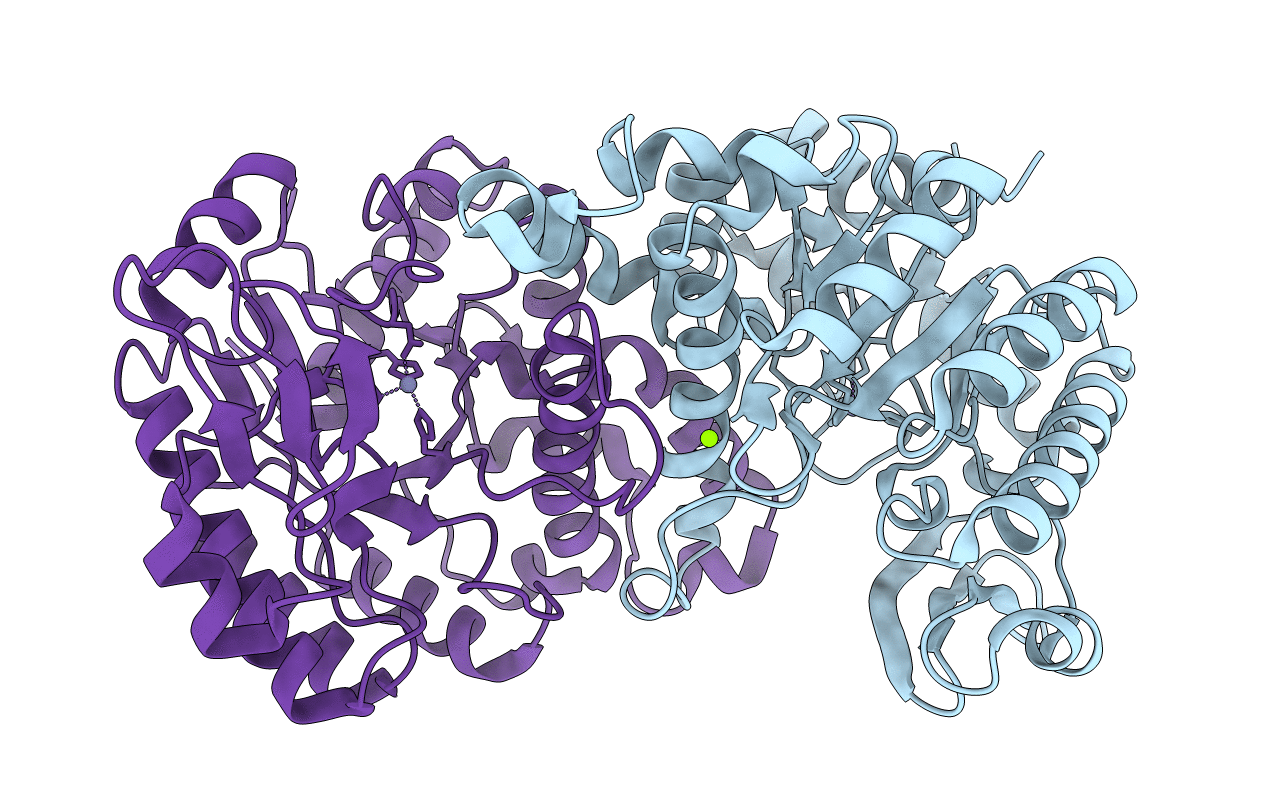
4IFK image
Deposition Date 2012-12-14
Release Date 2013-09-18
Last Version Date 2023-09-20
Entry Detail
PDB ID:
4IFK
Keywords:
Title:
Arginines 51 and 239* from a Neighboring Subunit are Essential for Catalysis in a Zinc-dependent Decarboxylase
Biological Source:
Source Organism:
Host Organism:
Method Details:
Experimental Method:
Resolution:
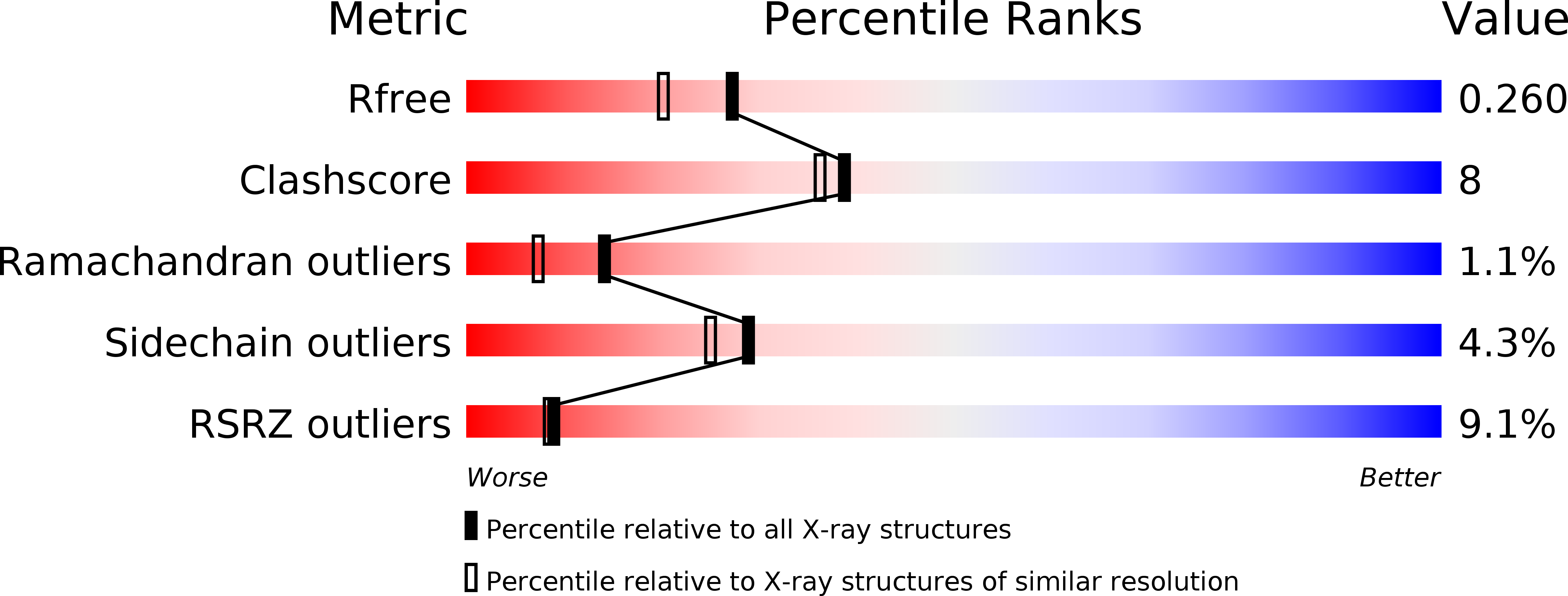
2.01 Å
R-Value Free:
0.26
R-Value Work:
0.20
R-Value Observed:
0.21
Space Group:
C 1 2 1
Macromolecular Entities
Structures with similar UniProt ID
Protein Blast
Polymer Type:polypeptide(L)
Molecule:2-amino-3-carboxymuconate 6-semialdehyde decarboxylase
Gene (Uniprot):nbaD
Mutagens:R239A
Chain IDs:A
Chain Length:331
Number of Molecules:1
Biological Source:Pseudomonas fluorescens
Structures with similar UniProt ID
Protein Blast
Polymer Type:polypeptide(L)
Molecule:2-amino-3-carboxymuconate 6-semialdehyde decarboxylase
Gene (Uniprot):nbaD
Mutagens:R51A
Chain IDs:B
Chain Length:331
Number of Molecules:1
Biological Source:Pseudomonas fluorescens
Primary Citation
The power of two: arginine 51 and arginine 239* from a neighboring subunit are essential for catalysis in alpha-amino-beta-carboxymuconate-epsilon-semialdehyde decarboxylase.
J.Biol.Chem. 288 30862 30871 (2013)
PMID: 24019523 DOI: 10.1074/jbc.M113.496869

Abstact

Although the crystal structure of α-amino-β-carboxymuconate-ε-semialdehyde decarboxylase from Pseudomonas fluorescens was solved as a dimer, this enzyme is a mixture of monomer, dimer, and higher order structures in solution. In this work, we found that the dimeric state, not the monomeric state, is the functionally active form. Two conserved arginine residues are present in the active site: Arg-51 and an intruding Arg-239* from the neighboring subunit. In this study, they were each mutated to alanine and lysine, and all four mutants were catalytically inactive. The mutants were also incapable of accommodating pyridine-2,6-dicarboxylic acid, a competitive inhibitor of the native enzyme, suggesting that the two Arg residues are involved in substrate binding. It was also observed that the decarboxylase activity was partially recovered in a heterodimer hybridization experiment when inactive R51(A/K) and R239(A/K) mutants were mixed together. Of the 20 crystal structures obtained from mixing inactive R51A and R239A homodimers that diffracted to a resolution lower than 3.00 Å, two structures are clearly R51A/R239A heterodimers and belong to the C2 space group. They were refined to 1.80 and 2.00 Å resolutions, respectively. Four of the remaining crystals are apparently single mutants and belong to the P42212 space group. In the heterodimer structures, one active site is shown to contain dual mutation of Ala-51 and Ala-239*, whereas the other contains the native Arg-51 and Arg-239* residues, identical to the wild-type structure. Thus, these observations provide the foundation for a molecular mechanism by which the oligomerization state of α-amino-β-carboxymuconate-ε-semialdehyde decarboxylase could regulate the enzyme activity.

Legend

Protein

Chemical

Disease

Primary Citation of related structures
Feedback Form
Name
Email
Institute
Feedback