4I60 image
Deposition Date 2012-11-29
Release Date 2013-08-14
Last Version Date 2024-11-20
Entry Detail
PDB ID:
4I60
Title:
Crystal structure of avidin - biotinylruthenocene complex
Biological Source:
Source Organism:
Gallus gallus (Taxon ID: 9031)
Method Details:
Experimental Method:
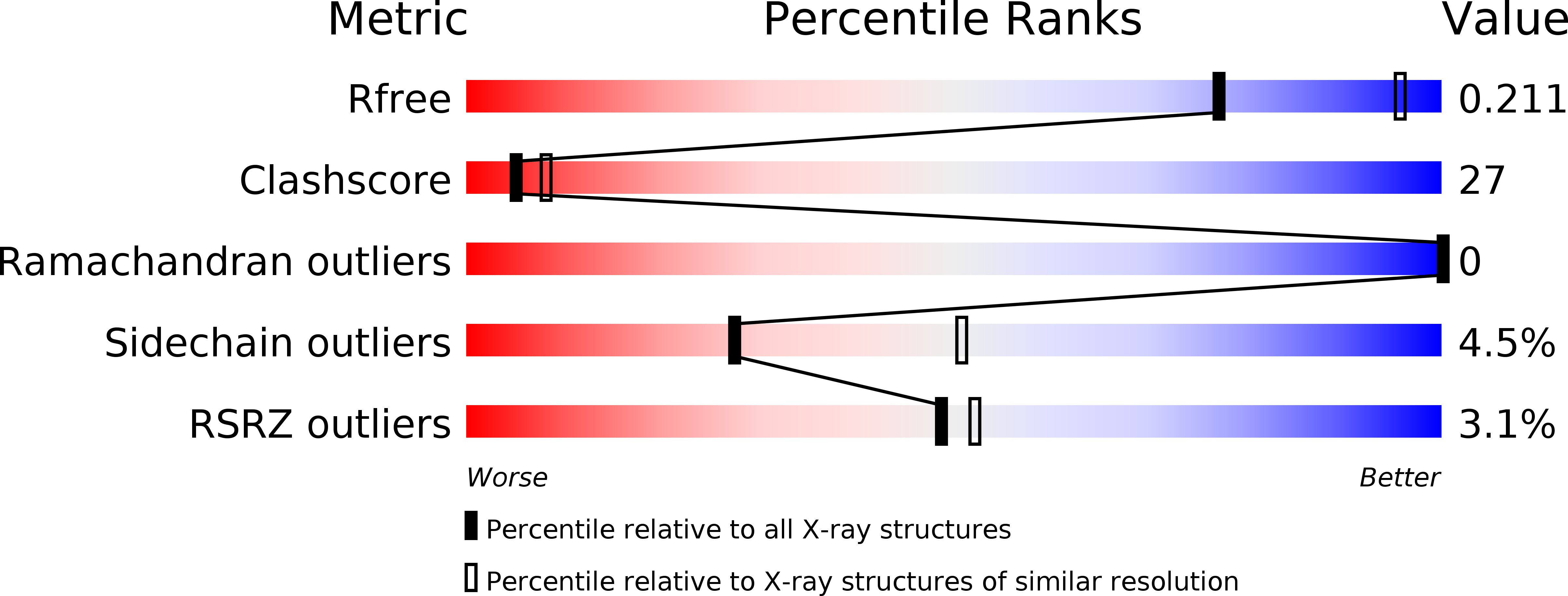
Resolution:
2.50 Å
R-Value Free:
0.21
R-Value Work:
0.16
R-Value Observed:
0.16
Space Group:
P 42 21 2
Macromolecular Entities
Structures with similar UniProt ID
Protein Blast
Polymer Type:polypeptide(L)
Molecule:Avidin
Gene (Uniprot):AVD
Chain IDs:A
Chain Length:128
Number of Molecules:1
Biological Source:Gallus gallus
Modified Residue
Compound ID Chain ID Parent Comp ID Details 2D Image
ASN A ASN GLYCOSYLATION SITE
Ligand Molecules
Primary Citation
Structural investigation of the interactions of biotinylruthenocene with avidin.
Chem.Biol.Interact 204 6 12 (2013)
PMID: 23603015 DOI: 10.1016/j.cbi.2013.04.005

Abstact

The crystal structure of avidin, a protein from hen egg white, was determined in the form of a complex with biotinylruthenocene. This biotin-derived organometallic ligand is a potential anticancer agent for targeted therapy based upon avidin-biotin technology. Isothermal titration calorimetry experiments, involving avidin complexes with biotin (vitamin H or B7) derivatives, show differences in their affinity to the protein in comparison to its avidin-biotin complex, the strongest known biochemical interaction in Nature. The crystal structure of the first complex of avidin with biotinylruthenocene, determined at 2.5Å resolution (PDB: 4I60), shows unique interactions of the ruthenocene moiety with avidin. Biotin derivatives exhibit weaker affinity to avidin then biotin, which allows their wider use in biotechnology. The specific properties of biotinylruthenocene and the knowledge of its interactions with avidin may be useful in biochemical, medical, and nanotechnological applications.

Legend

Protein

Chemical

Disease

Primary Citation of related structures
Feedback Form
Name
Email
Institute
Feedback