4HQJ image
Deposition Date 2012-10-25
Release Date 2013-10-02
Last Version Date 2024-11-13
Entry Detail
PDB ID:
4HQJ
Title:
Crystal structure of Na+,K+-ATPase in the Na+-bound state
Biological Source:
Source Organism:
Sus scrofa (Taxon ID: 9823)
Method Details:
Experimental Method:
Resolution:
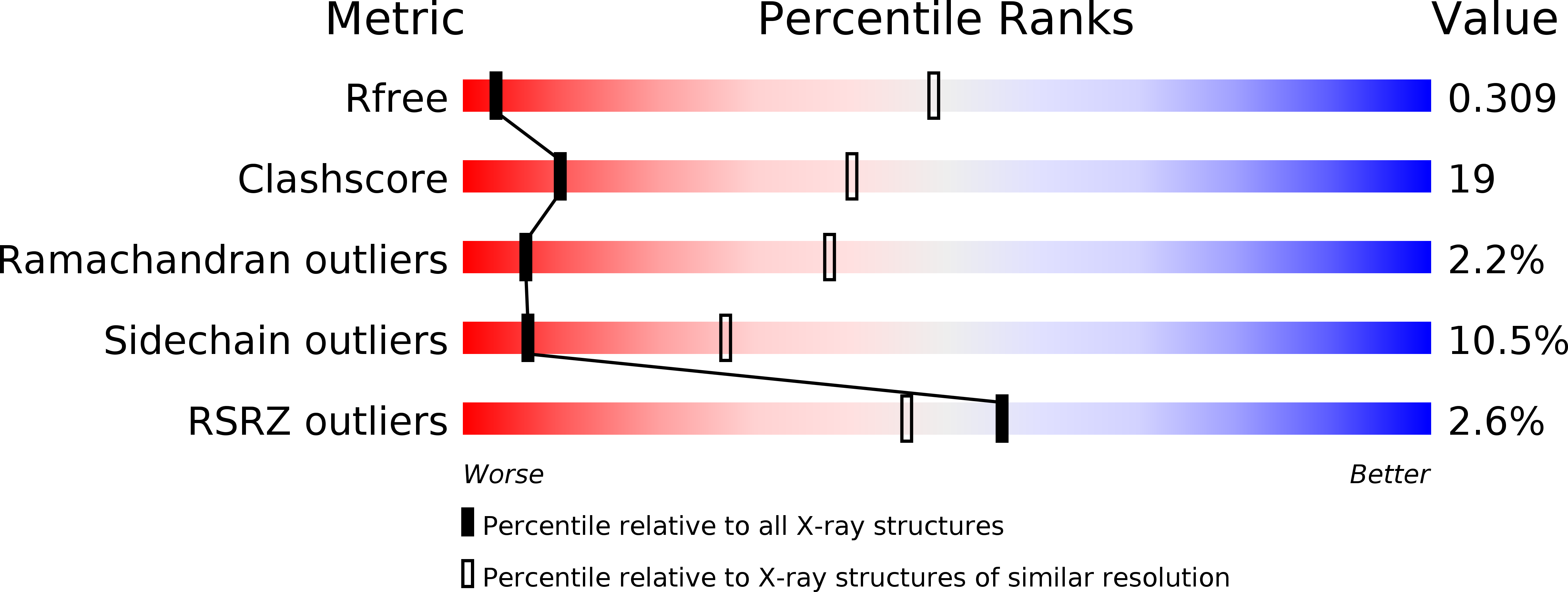
4.30 Å
R-Value Free:
0.28
R-Value Work:
0.26
R-Value Observed:
0.26
Space Group:
P 21 21 21
Macromolecular Entities
Structures with similar UniProt ID
Protein Blast
Polymer Type:polypeptide(L)
Molecule:Sodium/potassium-transporting ATPase subunit alpha-1
Gene (Uniprot):ATP1A1
Chain IDs:A, D (auth: C)
Chain Length:1021
Number of Molecules:2
Biological Source:Sus scrofa
Structures with similar UniProt ID
Protein Blast
Polymer Type:polypeptide(L)
Molecule:Sodium/potassium-transporting ATPase subunit beta-1
Gene (Uniprot):ATP1B1
Chain IDs:B, E (auth: D)
Chain Length:303
Number of Molecules:2
Biological Source:Sus scrofa
Structures with similar UniProt ID
Protein Blast
Polymer Type:polypeptide(L)
Molecule:Na+/K+ ATPase gamma subunit transcript variant a
Gene (Uniprot):FXYD2
Chain IDs:C (auth: G), F (auth: E)
Chain Length:65
Number of Molecules:2
Biological Source:Sus scrofa
Primary Citation
Crystal structure of Na+, K(+)-ATPase in the Na(+)-bound state.
Science 342 123 127 (2013)
PMID: 24051246 DOI: 10.1126/science.1243352

Abstact

The Na(+), K(+)-adenosine triphosphatase (ATPase) maintains the electrochemical gradients of Na(+) and K(+) across the plasma membrane--a prerequisite for electrical excitability and secondary transport. Hitherto, structural information has been limited to K(+)-bound or ouabain-blocked forms. We present the crystal structure of a Na(+)-bound Na(+), K(+)-ATPase as determined at 4.3 Å resolution. Compared with the K(+)-bound form, large conformational changes are observed in the α subunit whereas the β and γ subunit structures are maintained. The locations of the three Na(+) sites are indicated with the unique site III at the recently suggested IIIb, as further supported by electrophysiological studies on leak currents. Extracellular release of the third Na(+) from IIIb through IIIa, followed by exchange of Na(+) for K(+) at sites I and II, is suggested.

Legend

Protein

Chemical

Disease

Primary Citation of related structures
Feedback Form
Name
Email
Institute
Feedback