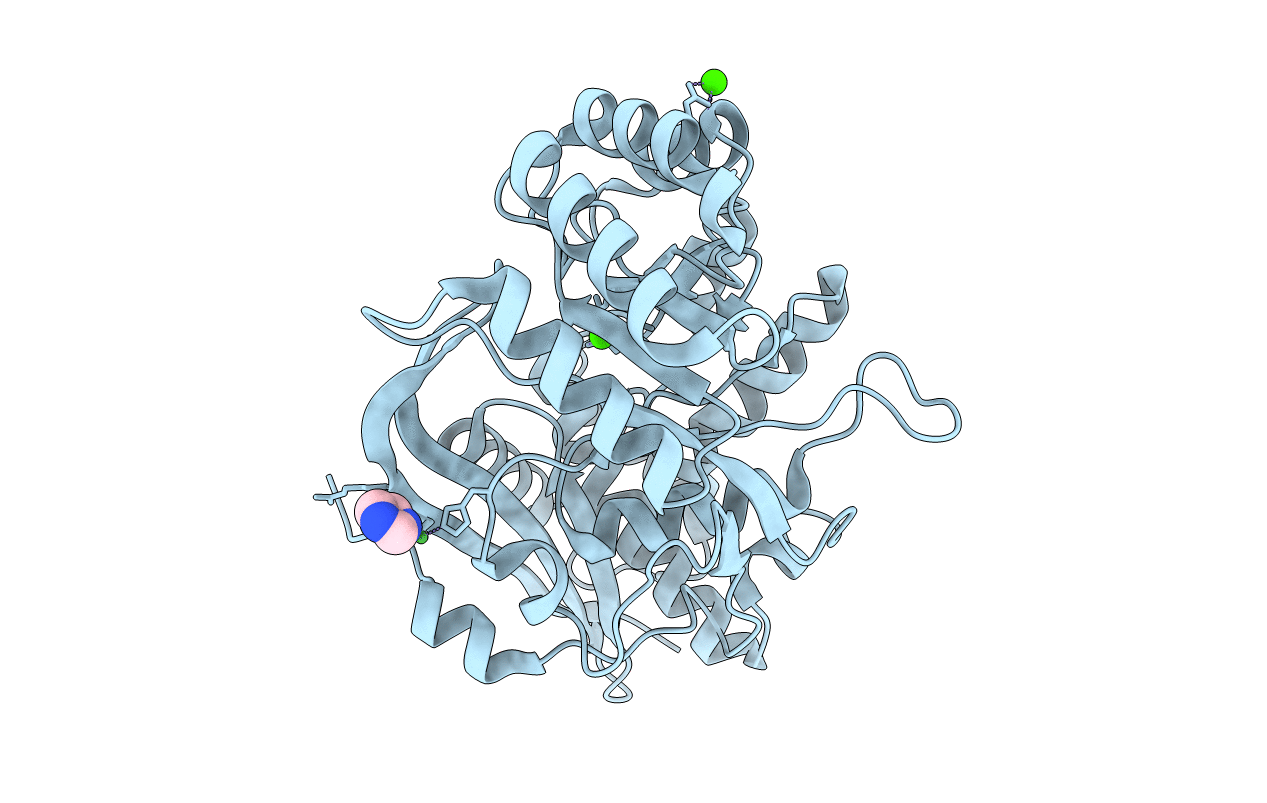
4HPN image
Deposition Date 2012-10-24
Release Date 2012-11-07
Last Version Date 2023-09-20
Entry Detail
PDB ID:
4HPN
Keywords:
Title:
Crystal structure of a proposed galactarolactone cycloisomerase from Agrobacterium Tumefaciens, target EFI-500704, with bound Ca, ordered loops
Biological Source:
Source Organism:
Host Organism:
Method Details:
Experimental Method:
Resolution:
1.60 Å
R-Value Free:
0.16
R-Value Work:
0.13
R-Value Observed:
0.13
Space Group:
I 4 2 2

Macromolecular Entities
Structures with similar UniProt ID
Protein Blast
Polymer Type:polypeptide(L)
Molecule:Putative uncharacterized protein
Gene (Uniprot):gci
Chain IDs:A
Chain Length:378
Number of Molecules:1
Biological Source:Agrobacterium tumefaciens
Primary Citation
Purification, crystallization and structural elucidation of D-galactaro-1,4-lactone cycloisomerase from Agrobacterium tumefaciens involved in pectin degradation.
Acta Crystallogr F Struct Biol Commun 72 36 41 (2016)
PMID: 26750482 DOI: 10.1107/S2053230X15023286

Abstact

Pectin is found in the cell wall of plants and is often discarded as waste. A number of research groups are interested in redirecting this biomass waste stream for the production of fuel and bulk chemicals. The primary monomeric subunit of this polysaccharide is D-galacturonate, a six-carbon acid sugar that is degraded in a five-step pathway to central metabolic intermediates by some bacteria, including Agrobacterium tumefaciens. In the third step of the pathway, D-galactaro-1,4-lactone is converted to 2-keto-3-deoxy-L-threo-hexarate by a member of the mandelate racemase subgroup of the enolase superfamily with a novel activity for the superfamily. The 1.6 Å resolution structure of this enzyme was determined, revealing an overall modified (β/α)7β TIM-barrel domain, a hallmark of the superfamily. D-Galactaro-1,4-lactone was manually docked into the active site located at the interface between the N-terminal lid domain and the C-terminal barrel domain. On the basis of the position of the lactone in the active site, Lys166 is predicted to be the active-site base responsible for abstraction of the α proton. His296 on the opposite side of the active site is predicted to be the general acid that donates a proton to the β carbon as the lactone ring opens. The lactone ring appears to be oriented within the active site by stacking interactions with Trp298.

Legend

Protein

Chemical

Disease

Primary Citation of related structures
Feedback Form
Name
Email
Institute
Feedback