4HNJ image
Deposition Date 2012-10-19
Release Date 2013-01-23
Last Version Date 2023-09-20
Entry Detail
PDB ID:
4HNJ
Title:
Crystallographic structure of BCL-xL domain-swapped dimer in complex with PUMA BH3 peptide at 2.9A resolution
Biological Source:
Source Organism:
Homo sapiens (Taxon ID: 9606)
Host Organism:
Method Details:
Experimental Method:
Resolution:
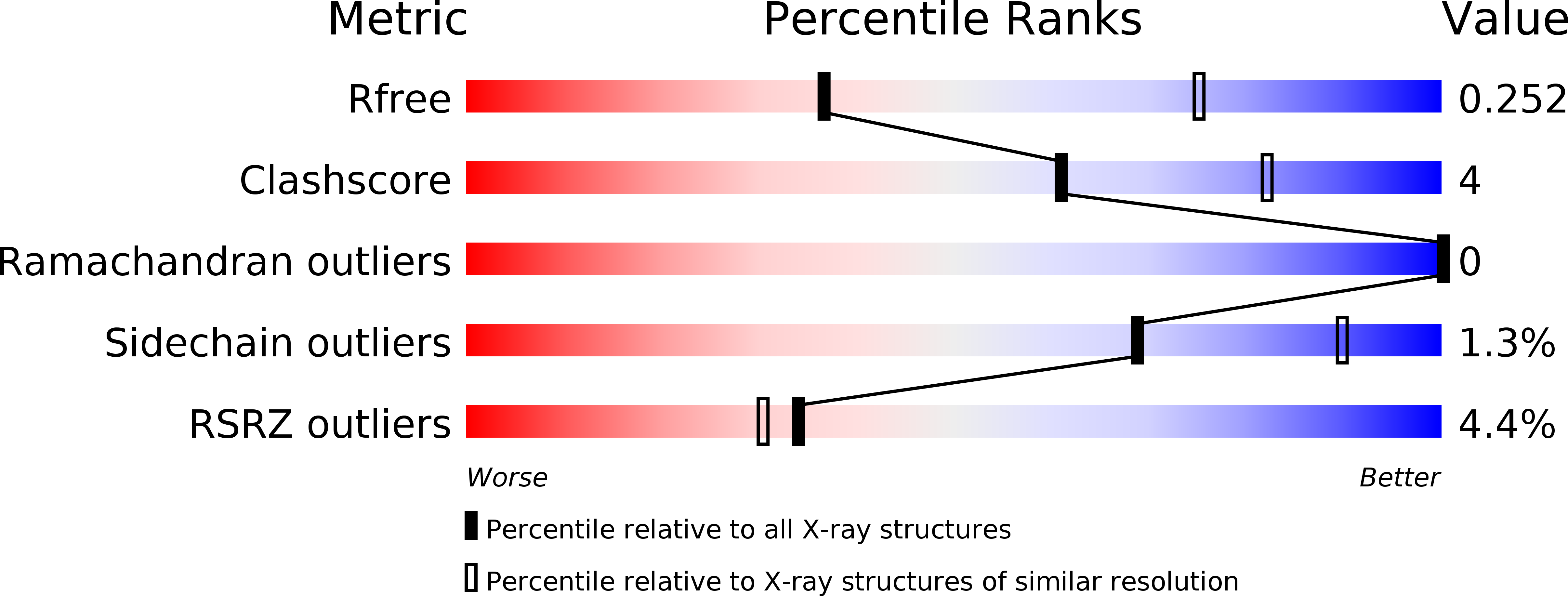
2.90 Å
R-Value Free:
0.25
R-Value Work:
0.20
R-Value Observed:
0.20
Space Group:
P 42 2 2
Macromolecular Entities
Structures with similar UniProt ID
Protein Blast
Polymer Type:polypeptide(L)
Molecule:Bcl-2-like protein 1
Gene (Uniprot):BCL2L1
Chain IDs:A, B
Chain Length:212
Number of Molecules:2
Biological Source:Homo sapiens
Structures with similar UniProt ID
Protein Blast
Polymer Type:polypeptide(L)
Molecule:Bcl-2-binding component 3
Gene (Uniprot):BBC3
Chain IDs:C
Chain Length:25
Number of Molecules:1
Biological Source:Homo sapiens
Primary Citation
PUMA binding induces partial unfolding within BCL-xL to disrupt p53 binding and promote apoptosis.
Nat.Chem.Biol. 9 163 168 (2013)
PMID: 23340338 DOI: 10.1038/nchembio.1166

Abstact

Following DNA damage, nuclear p53 induces the expression of PUMA, a BH3-only protein that binds and inhibits the antiapoptotic BCL-2 repertoire, including BCL-xL. PUMA, unique among BH3-only proteins, disrupts the interaction between cytosolic p53 and BCL-xL, allowing p53 to promote apoptosis via direct activation of the BCL-2 effector molecules BAX and BAK. Structural investigations using NMR spectroscopy and X-ray crystallography revealed that PUMA binding induced partial unfolding of two α-helices within BCL-xL. Wild-type PUMA or a PUMA mutant incapable of causing binding-induced unfolding of BCL-xL equivalently inhibited the antiapoptotic BCL-2 repertoire to sensitize for death receptor-activated apoptosis, but only wild-type PUMA promoted p53-dependent, DNA damage-induced apoptosis. Our data suggest that PUMA-induced partial unfolding of BCL-xL disrupts interactions between cytosolic p53 and BCL-xL, releasing the bound p53 to initiate apoptosis. We propose that regulated unfolding of BCL-xL provides a mechanism to promote PUMA-dependent signaling within the apoptotic pathways.

Legend

Protein

Chemical

Disease

Primary Citation of related structures
Feedback Form
Name
Email
Institute
Feedback