4HMQ image
Deposition Date 2012-10-18
Release Date 2013-09-04
Last Version Date 2024-03-20
Entry Detail
PDB ID:
4HMQ
Title:
Crystal structure of streptococcus pneumoniae TIGR4 PiaA in complex with ferrichrome
Biological Source:
Source Organism:
Host Organism:
Method Details:
Experimental Method:
Resolution:
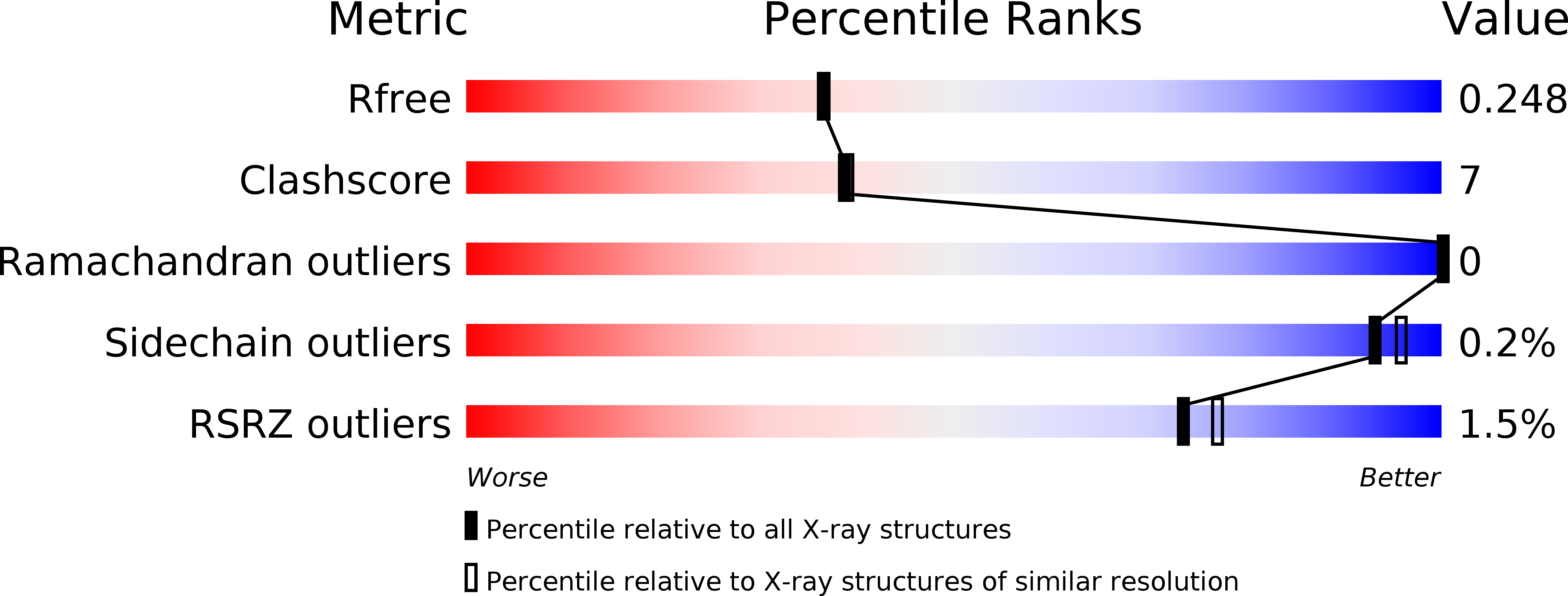
2.10 Å
R-Value Free:
0.24
R-Value Work:
0.19
R-Value Observed:
0.20
Space Group:
P 21 21 21
Macromolecular Entities
Structures with similar UniProt ID
Protein Blast
Polymer Type:polypeptide(L)
Molecule:Iron-compound ABC transporter, iron compound-binding protein
Chain IDs:A, B
Chain Length:328
Number of Molecules:2
Biological Source:Streptococcus pneumoniae
Primary Citation
Structures of Streptococcus pneumoniae PiaA and Its Complex with Ferrichrome Reveal Insights into the Substrate Binding and Release of High Affinity Iron Transporters
Plos One 8 e71451 e71451 (2013)
PMID: 23951167 DOI: 10.1371/journal.pone.0071451

Abstact

Iron scarcity is one of the nutrition limitations that the Gram-positive infectious pathogens Streptococcus pneumoniae encounter in the human host. To guarantee sufficient iron supply, the ATP binding cassette (ABC) transporter Pia is employed to uptake iron chelated by hydroxamate siderophore, via the membrane-anchored substrate-binding protein PiaA. The high affinity towards ferrichrome enables PiaA to capture iron at a very low concentration in the host. We presented here the crystal structures of PiaA in both apo and ferrichrome-complexed forms at 2.7 and 2.1 Å resolution, respectively. Similar to other class III substrate binding proteins, PiaA is composed of an N-terminal and a C-terminal domain bridged by an α-helix. At the inter-domain cleft, a molecule of ferrichrome is stabilized by a number of highly conserved residues. Upon ferrichrome binding, two highly flexible segments at the entrance of the cleft undergo significant conformational changes, indicating their contribution to the binding and/or release of ferrichrome. Superposition to the structure of Escherichia coli ABC transporter BtuF enabled us to define two conserved residues: Glu119 and Glu262, which were proposed to form salt bridges with two arginines of the permease subunits. Further structure-based sequence alignment revealed that the ferrichrome binding pattern is highly conserved in a series of PiaA homologs encoded by both Gram-positive and negative bacteria, which were predicted to be sensitive to albomycin, a sideromycin antibiotic derived from ferrichrome.

Legend

Protein

Chemical

Disease

Primary Citation of related structures
Feedback Form
Name
Email
Institute
Feedback