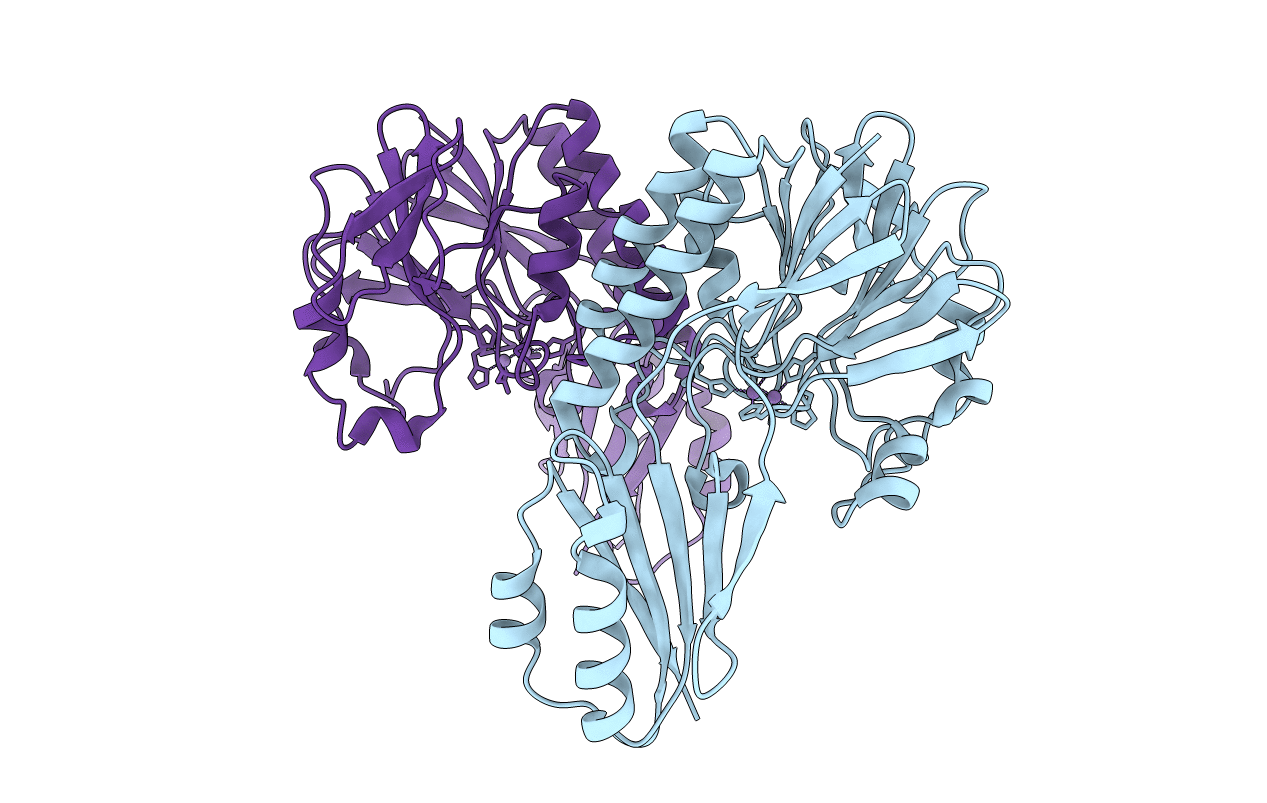
4HD0 image
Deposition Date 2012-10-01
Release Date 2012-10-31
Last Version Date 2024-02-28
Entry Detail
PDB ID:
4HD0
Title:
Mre11 ATLD17/18 mutation retains Tel1/ATM activity but blocks DNA double-strand break repair
Biological Source:
Source Organism:
Host Organism:
Method Details:
Experimental Method:
Resolution:
2.30 Å
R-Value Free:
0.27
R-Value Work:
0.22
R-Value Observed:
0.22
Space Group:
P 1 21 1

Macromolecular Entities
Structures with similar UniProt ID
Protein Blast
Polymer Type:polypeptide(L)
Molecule:DNA double-strand break repair protein Mre11
Gene (Uniprot):mre11
Mutagens:L204R
Chain IDs:A, B
Chain Length:339
Number of Molecules:2
Biological Source:Pyrococcus furiosus
Ligand Molecules
Primary Citation
Mre11 ATLD17/18 mutation retains Tel1/ATM activity but blocks DNA double-strand break repair.
Nucleic Acids Res. 40 11435 11449 (2012)
PMID: 23080121 DOI: 10.1093/nar/gks954

Abstact

The Mre11 complex (Mre11-Rad50-Nbs1 or MRN) binds double-strand breaks where it interacts with CtIP/Ctp1/Sae2 and ATM/Tel1 to preserve genome stability through its functions in homology-directed repair, checkpoint signaling and telomere maintenance. Here, we combine biochemical, structural and in vivo functional studies to uncover key properties of Mre11-W243R, a mutation identified in two pediatric cancer patients with enhanced ataxia telangiectasia-like disorder. Purified human Mre11-W243R retains nuclease and DNA binding activities in vitro. X-ray crystallography of Pyrococcus furiosus Mre11 indicates that an analogous mutation leaves the overall Mre11 three-dimensional structure and nuclease sites intact but disorders surface loops expected to regulate DNA and Rad50 interactions. The equivalent W248R allele in fission yeast allows Mre11 to form an MRN complex that efficiently binds double-strand breaks, activates Tel1/ATM and maintains telomeres; yet, it causes hypersensitivity to ionizing radiation and collapsed replication forks, increased Rad52 foci, defective Chk1 signaling and meiotic failure. W248R differs from other ataxia telangiectasia-like disorder analog alleles by the reduced stability of its interaction with Rad50 in cell lysates. Collective results suggest a separation-of-function mutation that disturbs interactions amongst the MRN subunits and Ctp1 required for DNA end processing in vivo but maintains interactions sufficient for Tel1/ATM checkpoint and telomere maintenance functions.

Legend

Protein

Chemical

Disease

Primary Citation of related structures
Feedback Form
Name
Email
Institute
Feedback