4H9G image
Deposition Date 2012-09-24
Release Date 2013-09-11
Last Version Date 2024-02-28
Entry Detail
PDB ID:
4H9G
Keywords:
Title:
Probing EF-Tu with a very small brominated fragment library identifies the CCA pocket
Biological Source:
Source Organism(s):
Expression System(s):
Method Details:
Experimental Method:
Resolution:
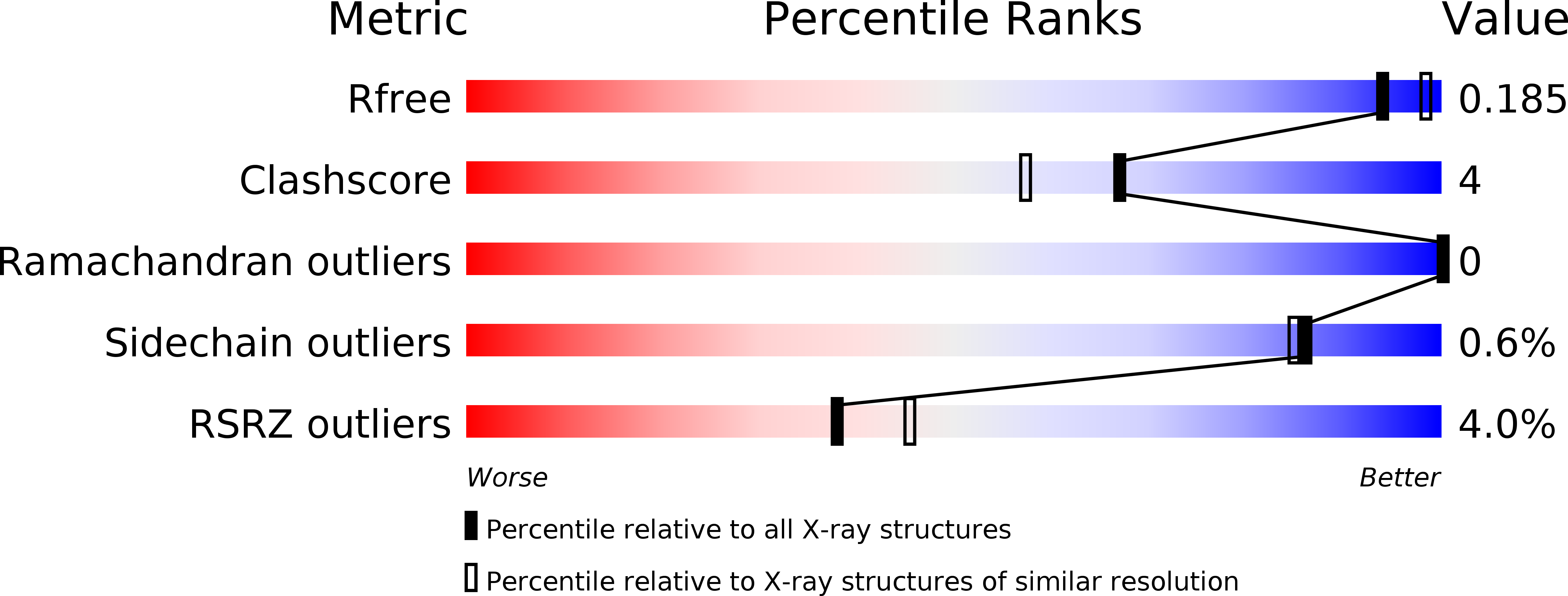
1.93 Å
R-Value Free:
0.18
R-Value Work:
0.15
R-Value Observed:
0.15
Space Group:
C 1 2 1
Macromolecular Entities
Structures with similar UniProt ID
Protein Blast
Polymer Type:polypeptide(L)
Molecule:Elongation factor Tu-A
Gene (Uniprot):tufA
Chain IDs:A
Chain Length:405
Number of Molecules:1
Biological Source:Thermus thermophilus
Primary Citation
Identifying ligand-binding hot spots in proteins using brominated fragments.
Acta Crystallogr.,Sect.F 69 1060 1065 (2013)
PMID: 23989163 DOI: 10.1107/S1744309113018551

Abstact

High-quality crystals of Thermus thermophilus EF-Tu in the GTP-bound conformation at 1.7-2.7 Å resolution were used to test 18 small organic molecules, all brominated for confident identification in the anomalous difference maps. From this relatively small collection, it was possible to identify a small molecule bound in the functionally important tRNA CCA-end binding pocket. The antibiotic GE2270 A is known to interact with the same pocket in EF-Tu and to disrupt the association with tRNA. Bromide could be located from peaks in the anomalous map in data truncated to very low resolution without refining the structure. Considering the speed with which diffraction data can be collected today, it is proposed that it is worthwhile to collect the extra data from fragment screens while crystals are at hand to increase the knowledge of biological function and drug binding in an experimental structural context.

Legend

Protein

Chemical

Disease

Primary Citation of related structures
Feedback Form
Name
Email
Institute
Feedback