4H4B image
Deposition Date 2012-09-17
Release Date 2012-12-26
Last Version Date 2023-09-20
Entry Detail
PDB ID:
4H4B
Title:
Human cytosolic 5'-nucleotidase II in complex with Anthraquinone-2,6- disulfonic acid
Biological Source:
Source Organism:
Homo sapiens (Taxon ID: 9606)
Host Organism:
Method Details:
Experimental Method:
Resolution:
2.90 Å
R-Value Free:
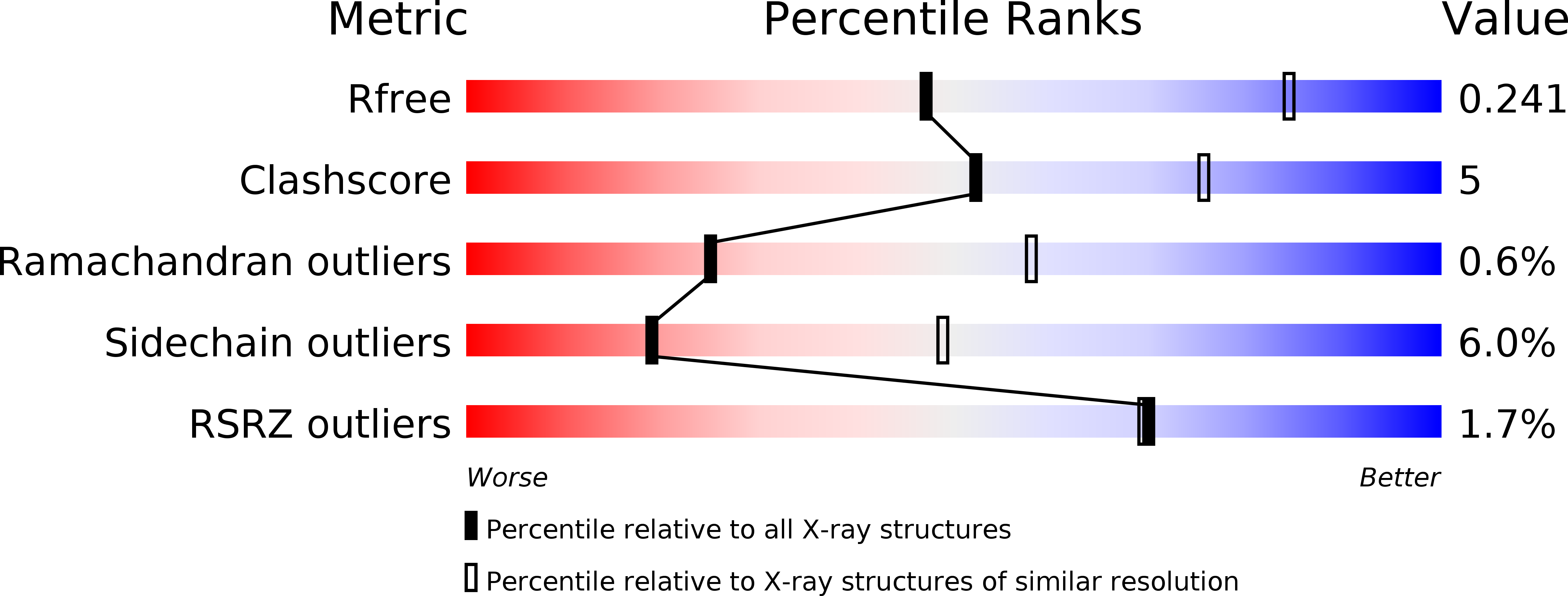
0.24
R-Value Work:
0.18
R-Value Observed:
0.18
Space Group:
I 2 2 2
Macromolecular Entities
Structures with similar UniProt ID
Protein Blast
Polymer Type:polypeptide(L)
Molecule:Cytosolic purine 5'-nucleotidase
Gene (Uniprot):NT5C2
Chain IDs:A
Chain Length:555
Number of Molecules:1
Biological Source:Homo sapiens
Primary Citation
Identification and characterization of inhibitors of cytoplasmic 5'-nucleotidase cN-II issued from virtual screening.
Biochem Pharmacol 85 497 506 (2013)
PMID: 23220537 DOI: 10.1016/j.bcp.2012.11.024

Abstact

Clinical and preclinical observations have lead to the hypothesis that 5'-nucleotidase cN-II could constitute a therapeutic target in oncology, either per se or to increase the activity of cytotoxic nucleoside analogs. To identify potential cN-II inhibitors, we performed in silico screening of freely available chemical databases, in vitro enzymatic assays with recombinant cN-II, soaking experiments with crystals of truncated cN-II as well as biological evaluation of selected compounds, alone or in combination with cytotoxic nucleoside analogs, on cancer cells. The top ranked compounds from virtual screening included an anthraquinone derivative (AdiS) that were shown to block the enzyme activity with a K(i) of 2.0mM. Soaking experiments performed with crystals of truncated cN-II allowed to obtain crystallographic data at a resolution of 2.9 Å and indicating interaction between AdiS and F354/I152 situated in the effector site 1 of cN-II. In addition, this compound exhibited different levels of cytotoxicity in vitro on several cancer cell lines and increased the induction of apoptosis in RL cells incubated with 0.5 or 1.5 μM cladribine, 0.05 μM clofarabine or 30 μM fludarabine. Finally, AdiS showed synergy with cladribine and additivity with clofarabine. This study showed that virtual screening is a useful tool for the identification of potent cN-II inhibitors, and our biological results indicated interesting activity for one lead compound that can be further developed as therapeutics.

Legend

Protein

Chemical

Disease

Primary Citation of related structures
Feedback Form
Name
Email
Institute
Feedback