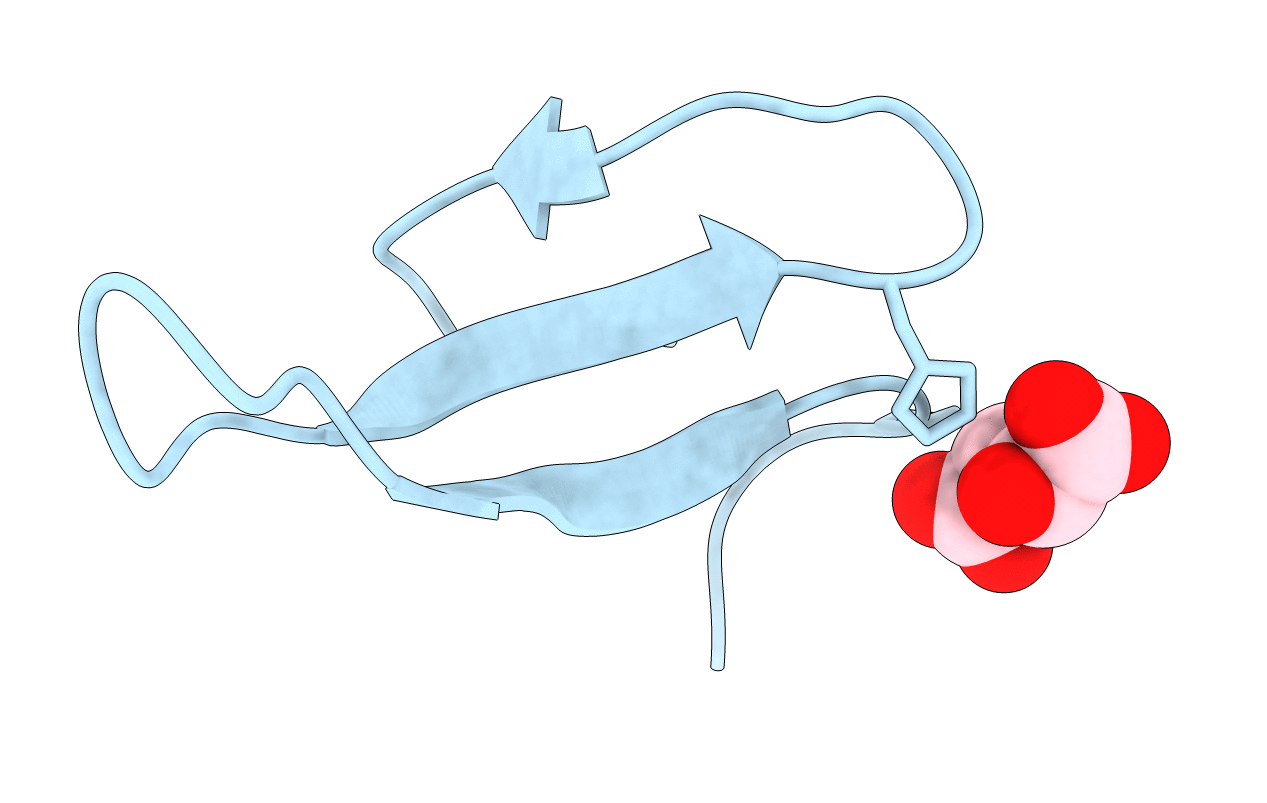
4GWT image
Deposition Date 2012-09-03
Release Date 2013-10-16
Last Version Date 2023-09-13
Entry Detail
PDB ID:
4GWT
Keywords:
Title:
Structure of racemic Pin1 WW domain cocrystallized with DL-malic acid
Biological Source:
Source Organism:
Homo sapiens (Taxon ID: 9606)
Method Details:
Experimental Method:
Resolution:
2.25 Å
R-Value Free:
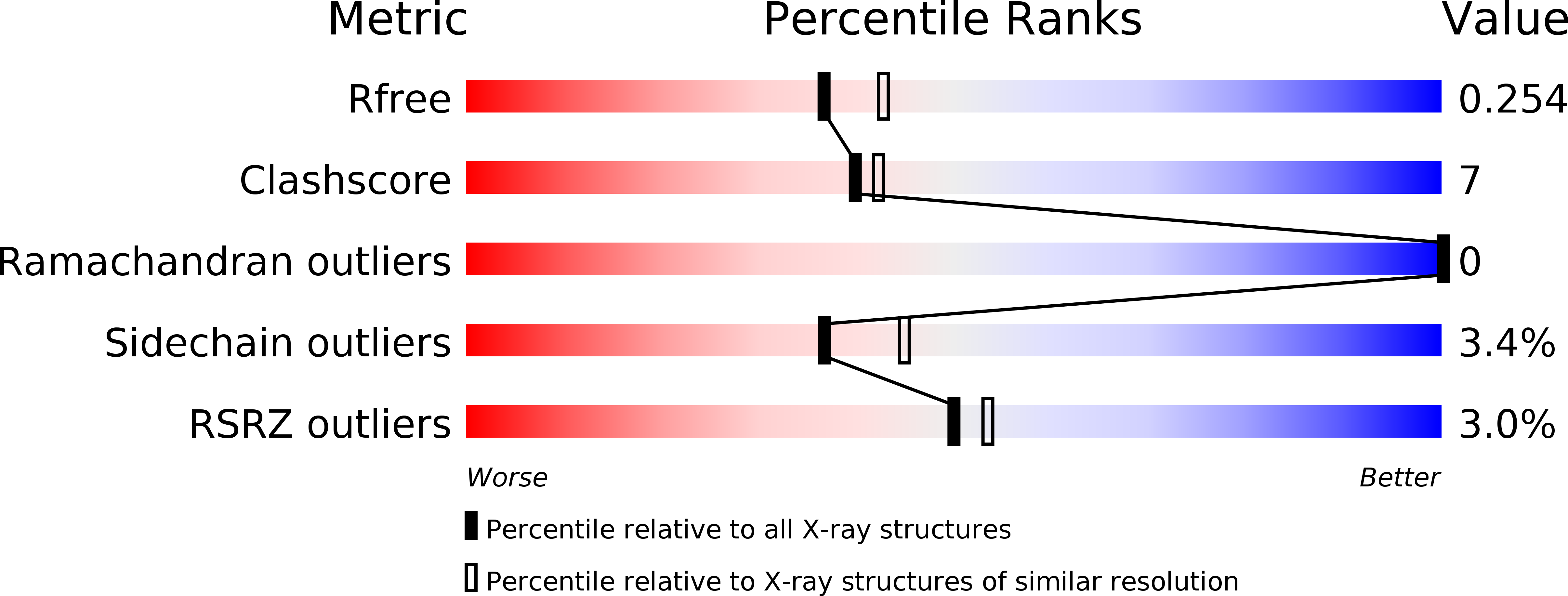
0.25
R-Value Work:
0.23
R-Value Observed:
0.23
Space Group:
I 41/a
Macromolecular Entities
Structures with similar UniProt ID
Protein Blast
Polymer Type:polypeptide(L)
Molecule:Peptidyl-prolyl cis-trans isomerase NIMA-interacting 1
Gene (Uniprot):PIN1
Chain IDs:A
Chain Length:36
Number of Molecules:1
Biological Source:Homo sapiens
Ligand Molecules
Primary Citation
Evidence for small-molecule-mediated loop stabilization in the structure of the isolated Pin1 WW domain.
Acta Crystallogr.,Sect.D 69 2506 2512 (2013)
PMID: 24311591 DOI: 10.1107/S090744491302444X

Abstact

The human Pin1 WW domain is a small autonomously folding protein that has been useful as a model system for biophysical studies of β-sheet folding. This domain has resisted previous attempts at crystallization for X-ray diffraction studies, perhaps because of intrinsic conformational flexibility that interferes with the formation of a crystal lattice. Here, the crystal structure of the human Pin1 WW domain has been obtained via racemic crystallization in the presence of small-molecule additives. Both enantiomers of a 36-residue variant of the Pin1 WW domain were synthesized chemically, and the L- and D-polypeptides were combined to afford diffracting crystals. The structural data revealed packing interactions of small carboxylic acids, either achiral citrate or a D,L mixture of malic acid, with a mobile loop region of the WW-domain fold. These interactions with solution additives may explain our success in crystallization of this protein racemate. Molecular-dynamics simulations starting from the structure of the Pin1 WW domain suggest that the crystal structure closely resembles the conformation of this domain in solution. The structural data presented here should provide a basis for further studies of this important model system.

Legend

Protein

Chemical

Disease

Primary Citation of related structures
Feedback Form
Name
Email
Institute
Feedback