4GU9 image
Deposition Date 2012-08-29
Release Date 2013-09-04
Last Version Date 2024-10-16
Entry Detail
PDB ID:
4GU9
Keywords:
Title:
Focal adhesion kinase catalytic domain in complex with (2-Fluoro-phenyl)-(1H-pyrazolo[3,4-d]pyrimidin-4-yl)-amine
Biological Source:
Source Organism:
Homo sapiens (Taxon ID: 9606)
Host Organism:
Method Details:
Experimental Method:
Resolution:
2.40 Å
R-Value Free:
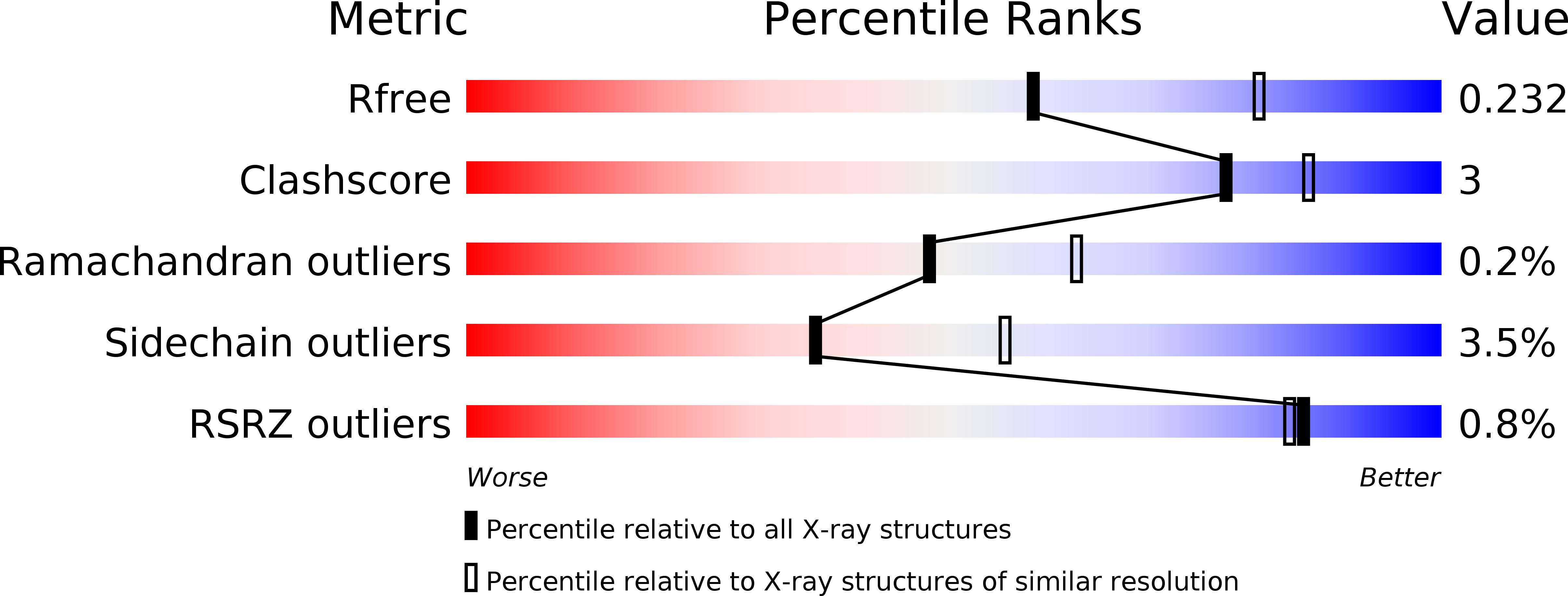
0.22
R-Value Work:
0.17
R-Value Observed:
0.18
Space Group:
P 21 21 21
Macromolecular Entities
Structures with similar UniProt ID
Protein Blast
Polymer Type:polypeptide(L)
Molecule:Focal adhesion kinase 1
Gene (Uniprot):PTK2
Chain IDs:A, B
Chain Length:279
Number of Molecules:2
Biological Source:Homo sapiens
Ligand Molecules
Primary Citation
Fragment-based discovery of new highly substituted 1H-pyrrolo[2,3-b]- and 3H-imidazolo[4,5-b]-pyridines as focal adhesion kinase inhibitors.
J.Med.Chem. 56 1160 1170 (2013)
PMID: 23294348 DOI: 10.1021/jm3016014

Abstact

Focal adhesion kinase (FAK) is considered as an attractive target for oncology, and small-molecule inhibitors are reported to be in clinical testing. In a surface plasmon resonance (SPR)-mediated fragment screening campaign, we discovered bicyclic scaffolds like 1H-pyrazolo[3,4-d]pyrimidines binding to the hinge region of FAK. By an accelerated knowledge-based fragment growing approach, essential pharmacophores were added. The establishment of highly substituted unprecedented 1H-pyrrolo[2,3-b]pyridine derivatizations provided compounds with submicromolar cellular FAK inhibition potential. The combination of substituents on the bicyclic templates and the nature of the core structure itself have a significant impact on the compounds FAK selectivity. Structural analysis revealed that the appropriately substituted pyrrolo[2,3-b]pyridine induced a rare helical DFG-loop conformation. The discovered synthetic route to introduce three different substituents independently paves the way for versatile applications of the 7-azaindole core.

Legend

Protein

Chemical

Disease

Primary Citation of related structures
Feedback Form
Name
Email
Institute
Feedback