4GIF image
Deposition Date 2012-08-08
Release Date 2012-12-05
Last Version Date 2024-02-28
Entry Detail
PDB ID:
4GIF
Title:
C-terminal coiled-coil domain of transient receptor potential channel TRPP3 (PKD2L1, Polycystin-L)
Biological Source:
Source Organism:
Homo sapiens (Taxon ID: 9606)
Host Organism:
Method Details:
Experimental Method:
Resolution:
2.80 Å
R-Value Free:
0.28
R-Value Work:
0.23
R-Value Observed:
0.24
Space Group:
P 3 2 1
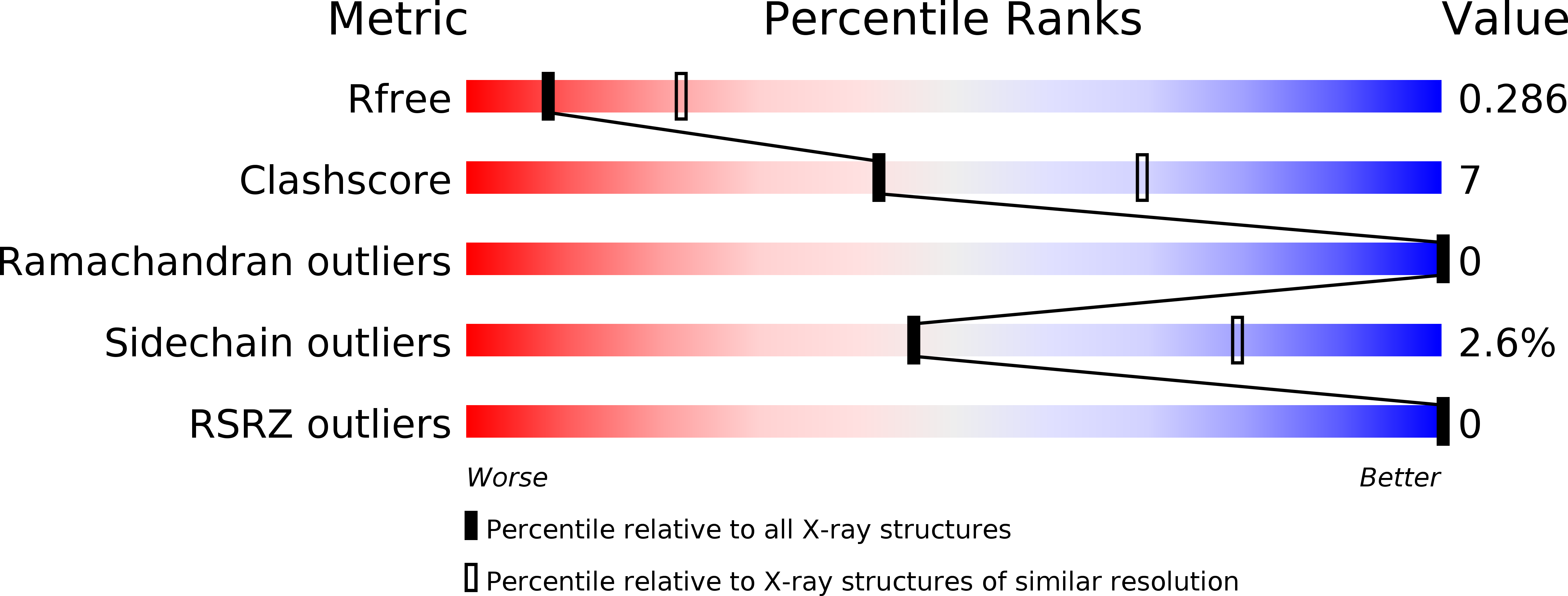
Macromolecular Entities
Structures with similar UniProt ID
Protein Blast
Polymer Type:polypeptide(L)
Molecule:Polycystic kidney disease 2-like 1 protein
Gene (Uniprot):PKD2L1
Chain IDs:A
Chain Length:45
Number of Molecules:1
Biological Source:Homo sapiens
Primary Citation
Molecular mechanism of the assembly of an acid-sensing receptor ion channel complex.
Nat Commun 3 1252 1252 (2012)
PMID: 23212381 DOI: 10.1038/ncomms2257

Abstact

Polycystic kidney disease (PKD) family proteins associate with transient receptor potential (TRP) channel family proteins to form functionally important complexes. PKD proteins differ from known ion channel-forming proteins and are generally thought to act as membrane receptors. Here we find that PKD1L3, a PKD protein, functions as a channel-forming subunit in an acid-sensing heteromeric complex formed by PKD1L3 and TRPP3, a TRP channel protein. Single amino-acid mutations in the putative pore region of both proteins alter the channel's ion selectivity. The PKD1L3/TRPP3 complex in the plasma membrane of live cells contains one PKD1L3 and three TRPP3. A TRPP3 C-terminal coiled-coil domain forms a trimer in solution and in crystal, and has a crucial role in the assembly and surface expression of the PKD1L3/TRPP3 complex. These results demonstrate that PKD subunits constitute a new class of channel-forming proteins, enriching our understanding of the function of PKD proteins and PKD/TRPP complexes.

Legend

Protein

Chemical

Disease

Primary Citation of related structures
Feedback Form
Name
Email
Institute
Feedback