4GF9 image
Deposition Date 2012-08-03
Release Date 2012-09-26
Last Version Date 2024-11-20
Entry Detail
PDB ID:
4GF9
Title:
Structural insights into the dual strategy of recognition of peptidoglycan recognition protein, PGRP-S: ternary complex of PGRP-S with LPS and fatty acid
Biological Source:
Source Organism:
Method Details:
Experimental Method:
Resolution:
2.80 Å
R-Value Free:
0.26
R-Value Work:
0.22
R-Value Observed:
0.22
Space Group:
I 2 2 2
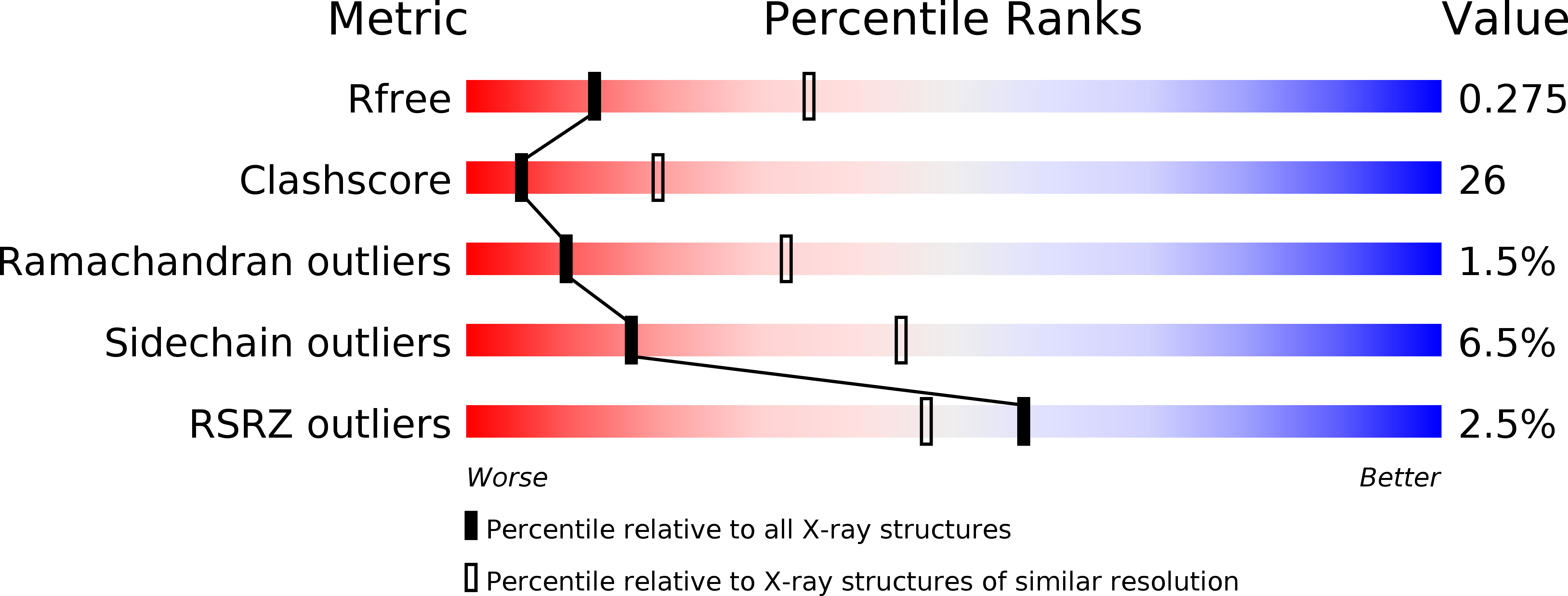
Macromolecular Entities
Structures with similar UniProt ID
Protein Blast
Polymer Type:polypeptide(L)
Molecule:Peptidoglycan recognition protein 1
Gene (Uniprot):PGLYRP1
Chain IDs:A, B, C, D
Chain Length:171
Number of Molecules:4
Biological Source:Camelus dromedarius
Primary Citation
Structural insights into the dual strategy of recognition by peptidoglycan recognition protein, PGRP-S: structure of the ternary complex of PGRP-S with lipopolysaccharide and stearic acid.
Plos One 8 e53756 e53756 (2013)
PMID: 23326499 DOI: 10.1371/journal.pone.0053756

Abstact

Peptidoglycan recognition proteins (PGRPs) are part of the innate immune system. The 19 kDa Short PGRP (PGRP-S) is one of the four mammalian PGRPs. The concentration of PGRP-S in camel (CPGRP-S) has been shown to increase considerably during mastitis. The structure of CPGRP-S consists of four protein molecules designated as A, B, C and D forming stable intermolecular contacts, A-B and C-D. The A-B and C-D interfaces are located on the opposite sides of the same monomer leading to the the formation of a linear chain with alternating A-B and C-D contacts. Two ligand binding sites, one at C-D contact and another at A-B contact have been observed. CPGRP-S binds to the components of bacterial cell wall molecules such as lipopolysaccharide (LPS), lipoteichoic acid (LTA), and peptidoglycan (PGN) from both gram-positive and gram-negative bacteria. It also binds to fatty acids including mycolic acid of the Mycobacterium tuberculosis (Mtb). Previous structural studies of binary complexes of CPGRP-S with LPS and stearic acid (SA) have shown that LPS binds to CPGRP-S at C-D contact (Site-1) while SA binds to it at the A-B contact (Site-2). The binding studies using surface plasmon resonance showed that LPS and SA bound to CPGRP-S in the presence of each other. The structure determination of the ternary complex showed that LPS and SA bound to CPGRP-S at Site-1 and Site-2 respectively. LPS formed 13 hydrogen bonds and 159 van der Waals contacts (distances ≤4.2 Å) while SA formed 56 van der Waals contacts. The ELISA test showed that increased levels of productions of pro-inflammatory cytokines TNF-α and IFN-γ due to LPS and SA decreased considerably upon the addition of CPGRP-S.

Legend

Protein

Chemical

Disease

Primary Citation of related structures
Feedback Form
Name
Email
Institute
Feedback