4G2K image
Deposition Date 2012-07-12
Release Date 2012-09-12
Last Version Date 2024-11-27
Entry Detail
PDB ID:
4G2K
Keywords:
Title:
Crystal structure of the Marburg Virus GP2 ectodomain in its post-fusion conformation
Biological Source:
Source Organism:
Host Organism:
Method Details:
Experimental Method:
Resolution:
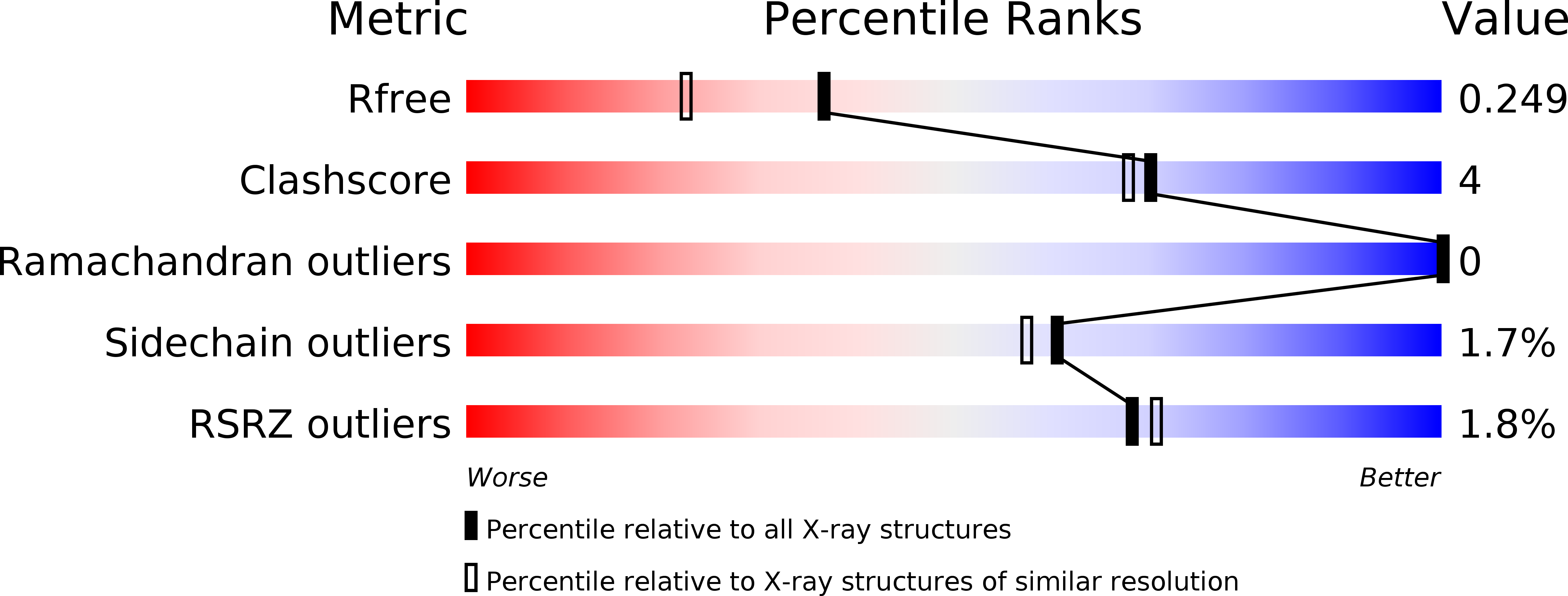
1.90 Å
R-Value Free:
0.24
R-Value Work:
0.19
R-Value Observed:
0.19
Space Group:
P 21 21 2
Macromolecular Entities
Protein Blast
Polymer Type:polypeptide(L)
Molecule:General control protein GCN4, Envelope glycoprotein GP2 chimera
Gene (Uniprot):GCN4, GP
Chain IDs:A, B, C
Chain Length:125
Number of Molecules:3
Biological Source:Saccharomyces cerevisiae, Lake Victoria marburgvirus
Primary Citation
Crystal Structure of the Marburg Virus GP2 Core Domain in Its Postfusion Conformation.
Biochemistry 51 7665 7675 (2012)
PMID: 22935026 DOI: 10.1021/bi300976m

Abstact

Marburg virus (MARV) and Ebola virus (EBOV) are members of the family Filoviridae ("filoviruses") and cause severe hemorrhagic fever with human case fatality rates of up to 90%. Filovirus infection requires fusion of the host cell and virus membranes, a process that is mediated by the envelope glycoprotein (GP). GP contains two subunits, the surface subunit (GP1), which is responsible for cell attachment, and the transmembrane subunit (GP2), which catalyzes membrane fusion. The GP2 ectodomain contains two heptad repeat regions, N-terminal and C-terminal (NHR and CHR, respectively), that adopt a six-helix bundle during the fusion process. The refolding of this six-helix bundle provides the thermodynamic driving force to overcome barriers associated with membrane fusion. Here we report the crystal structure of the MARV GP2 core domain in its postfusion (six-helix bundle) conformation at 1.9 Å resolution. The MARV GP2 core domain backbone conformation is virtually identical to that of EBOV GP2 (reported previously), and consists of a central NHR core trimeric coiled coil packed against peripheral CHR α-helices and an intervening loop and helix-turn-helix segments. We previously reported that the stability of the MARV GP2 postfusion structure is highly pH-dependent, with increasing stability at lower pH [Harrison, J. S., Koellhoffer, J. K., Chandran, K., and Lai, J. R. (2012) Biochemistry51, 2515-2525]. We hypothesized that this pH-dependent stability provides a mechanism for conformational control such that the postfusion six-helix bundle is promoted in the environments of appropriately mature endosomes. In this report, a structural rationale for this pH-dependent stability is described and involves a high-density array of core and surface acidic side chains at the midsection of the structure, termed the "anion stripe". In addition, many surface-exposed salt bridges likely contribute to the stabilization of the postfusion structure at low pH. These results provide structural insights into the mechanism of MARV GP2-mediated membrane fusion.

Legend

Protein

Chemical

Disease

Primary Citation of related structures
Feedback Form
Name
Email
Institute
Feedback