4EMO image
Deposition Date 2012-04-12
Release Date 2012-05-02
Last Version Date 2024-11-27
Entry Detail
PDB ID:
4EMO
Keywords:
Title:
Crystal structure of the PH domain of SHARPIN
Biological Source:
Source Organism:
Homo sapiens (Taxon ID: 9606)
Host Organism:
Method Details:
Experimental Method:
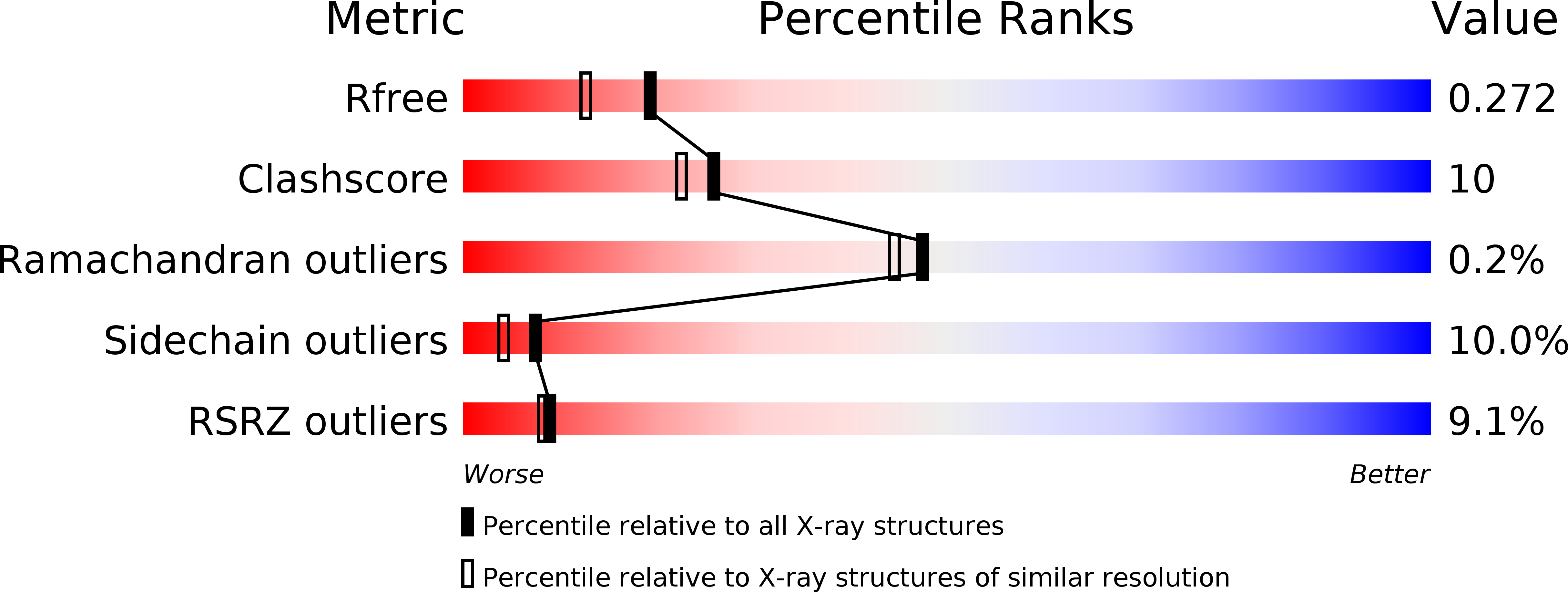
Resolution:
2.00 Å
R-Value Free:
0.26
R-Value Work:
0.20
R-Value Observed:
0.21
Space Group:
P 43 21 2
Macromolecular Entities
Structures with similar UniProt ID
Protein Blast
Polymer Type:polypeptide(L)
Molecule:Sharpin
Gene (Uniprot):SHARPIN
Mutagens:L21M, L101M
Chain IDs:A, B, C, D
Chain Length:129
Number of Molecules:4
Biological Source:Homo sapiens
Modified Residue
Compound ID Chain ID Parent Comp ID Details 2D Image
MSE A MET SELENOMETHIONINE
Primary Citation
Structural Analysis of SHARPIN, a Subunit of a Large Multi-protein E3 Ubiquitin Ligase, Reveals a Novel Dimerization Function for the Pleckstrin Homology Superfold.
J.Biol.Chem. 287 20823 20829 (2012)
PMID: 22549881 DOI: 10.1074/jbc.M112.359547

Abstact

SHARPIN (SHANK-associated RH domain interacting protein) is part of a large multi-protein E3 ubiquitin ligase complex called LUBAC (linear ubiquitin chain assembly complex), which catalyzes the formation of linear ubiquitin chains and regulates immune and apoptopic signaling pathways. The C-terminal half of SHARPIN contains ubiquitin-like domain and Npl4-zinc finger domains that mediate the interaction with the LUBAC subunit HOIP and ubiquitin, respectively. In contrast, the N-terminal region does not show any homology with known protein interaction domains but has been suggested to be responsible for self-association of SHARPIN, presumably via a coiled-coil region. We have determined the crystal structure of the N-terminal portion of SHARPIN, which adopts the highly conserved pleckstrin homology superfold that is often used as a scaffold to create protein interaction modules. We show that in SHARPIN, this domain does not appear to be used as a ligand recognition domain because it lacks many of the surface properties that are present in other pleckstrin homology fold-based interaction modules. Instead, it acts as a dimerization module extending the functional applications of this superfold.

Legend

Protein

Chemical

Disease

Primary Citation of related structures
Feedback Form
Name
Email
Institute
Feedback