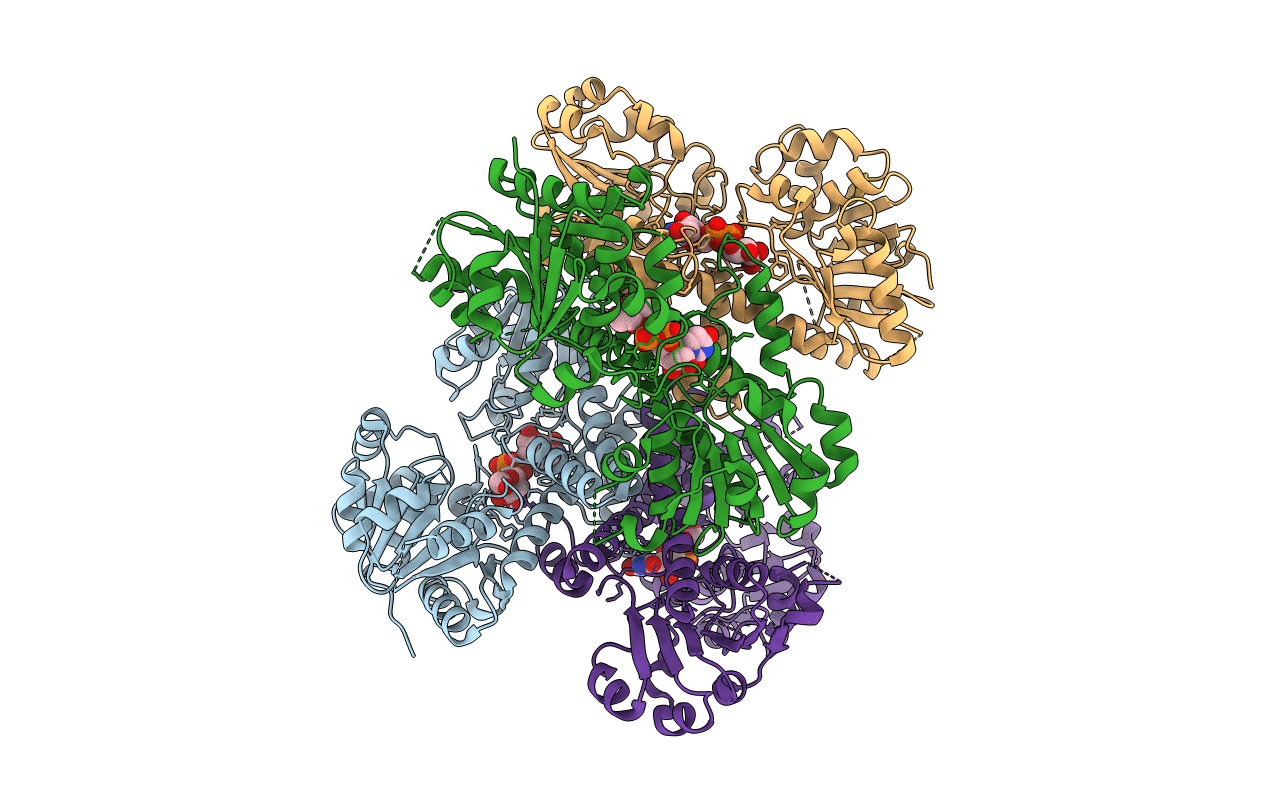
4EDF image
Deposition Date 2012-03-27
Release Date 2012-11-21
Last Version Date 2023-09-13
Entry Detail
PDB ID:
4EDF
Keywords:
Title:
Dimeric hUGDH, K94E
Biological Source:
Source Organism(s):
Homo sapiens (Taxon ID: 9606)
Expression System(s):
Method Details:
Experimental Method:
Resolution:
2.08 Å
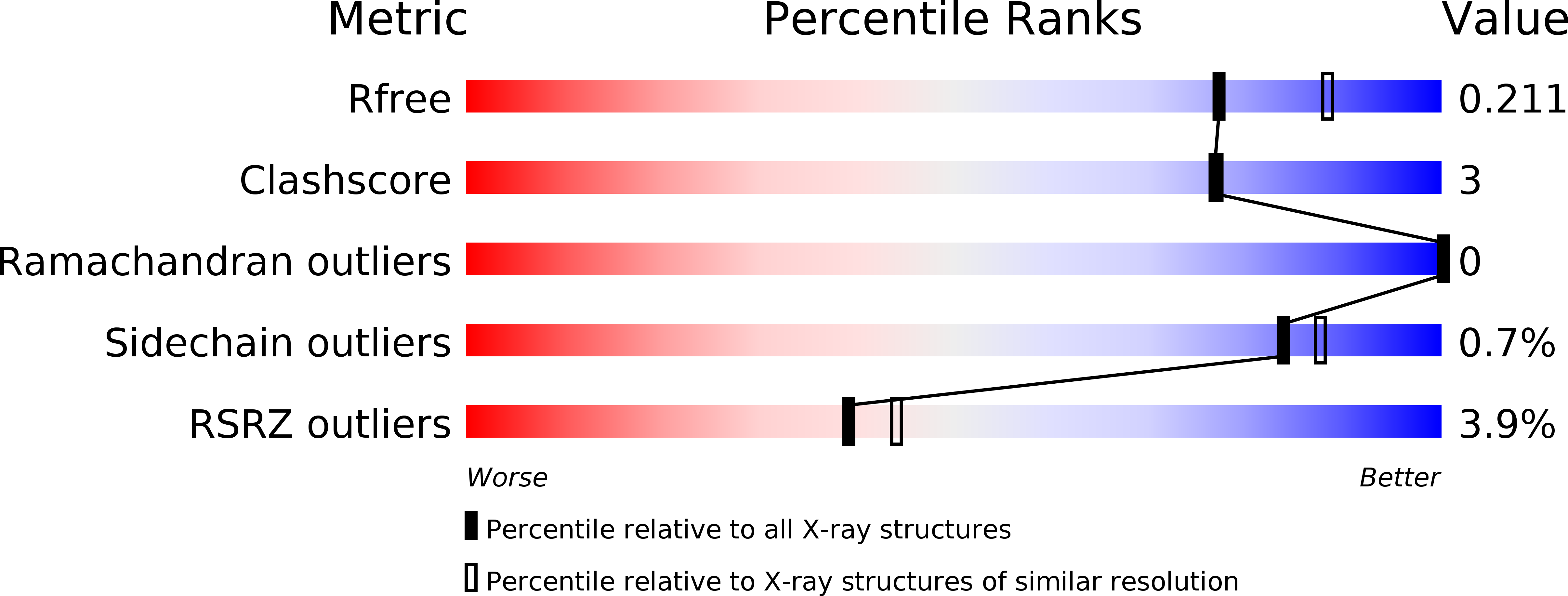
R-Value Free:
0.23
R-Value Work:
0.18
R-Value Observed:
0.18
Space Group:
P 1 21 1
Macromolecular Entities
Structures with similar UniProt ID
Protein Blast
Polymer Type:polypeptide(L)
Molecule:UDP-glucose 6-dehydrogenase
Gene (Uniprot):UGDH
Mutagens:K94E
Chain IDs:A, B, C, D
Chain Length:494
Number of Molecules:4
Biological Source:Homo sapiens
Ligand Molecules
Primary Citation
Cofactor binding triggers a molecular switch to allosterically activate human UDP-{alpha}-D-glucose 6-dehydrogenase.
Biochemistry 51 9364 9374 (2012)
PMID: 23106432 DOI: 10.1021/bi301067w

Abstact

Human UDP-α-D-glucose dehydrogenase (hUGDH) catalyzes the NAD(+)-dependent oxidation of UDP-α-D-glucose (UDG) to produce UDP-α-D-glucuronic acid. The oligomeric structure of hUGDH is dynamic and can form two distinct hexameric complexes in solution. The active form of hUGDH consists of dimers that undergo a concentration-dependent association to form a hexamer with 32 symmetry. In the presence of the allosteric feedback inhibitor UDP-α-D-xylose (UDX), hUGDH changes shape to form an inactive, horseshoe-shaped complex. Previous studies have identified the UDX-induced allosteric mechanism that changes the hexameric structure to inhibit the enzyme. Here, we investigate the role of the 32 symmetry hexamer in the catalytic cycle. We engineered a stable hUGDH dimer by introducing a charge-switch substitution (K94E) in the hexamer-building interface (hUGDH(K94E)). The k(cat) of hUGDH(K94E) is ~160-fold lower than that of the wild-type enzyme, suggesting that the hexamer is the catalytically relevant state. We also show that cofactor binding triggers the formation of the 32 symmetry hexamer, but UDG is needed for the stability of the complex. The hUGDH(K94E) crystal structure at 2.08 Å resolution identifies loop(88-110) as the cofactor-responsive allosteric switch that drives hexamer formation; loop(88-110) directly links cofactor binding to the stability of the hexamer-building interface. In the interface, loop(88-110) packs against the Thr131-loop/α6 helix, the allosteric switch that responds to the feedback inhibitor UDX. We also identify a structural element (the S-loop) that explains the indirect stabilization of the hexamer by substrate and supports a sequential, ordered binding of the substrate and cofactor. These observations support a model in which (i) UDG binds to the dimer and stabilizes the S-loop to promote cofactor binding and (ii) cofactor binding orders loop(88-110) to induce formation of the catalytically active hexamer.

Legend

Protein

Chemical

Disease

Primary Citation of related structures
Feedback Form
Name
Email
Institute
Feedback