4E0F image
Deposition Date 2012-03-03
Release Date 2013-10-16
Last Version Date 2023-09-13
Entry Detail
PDB ID:
4E0F
Keywords:
Title:
Crystallographic structure of trimeric Riboflavin Synthase from Brucella abortus in complex with riboflavin
Biological Source:
Source Organism:
Brucella abortus (Taxon ID: 235)
Host Organism:
Method Details:
Experimental Method:
Resolution:
2.85 Å
R-Value Free:
0.26
R-Value Work:
0.21
R-Value Observed:
0.21
Space Group:
P 21 21 21
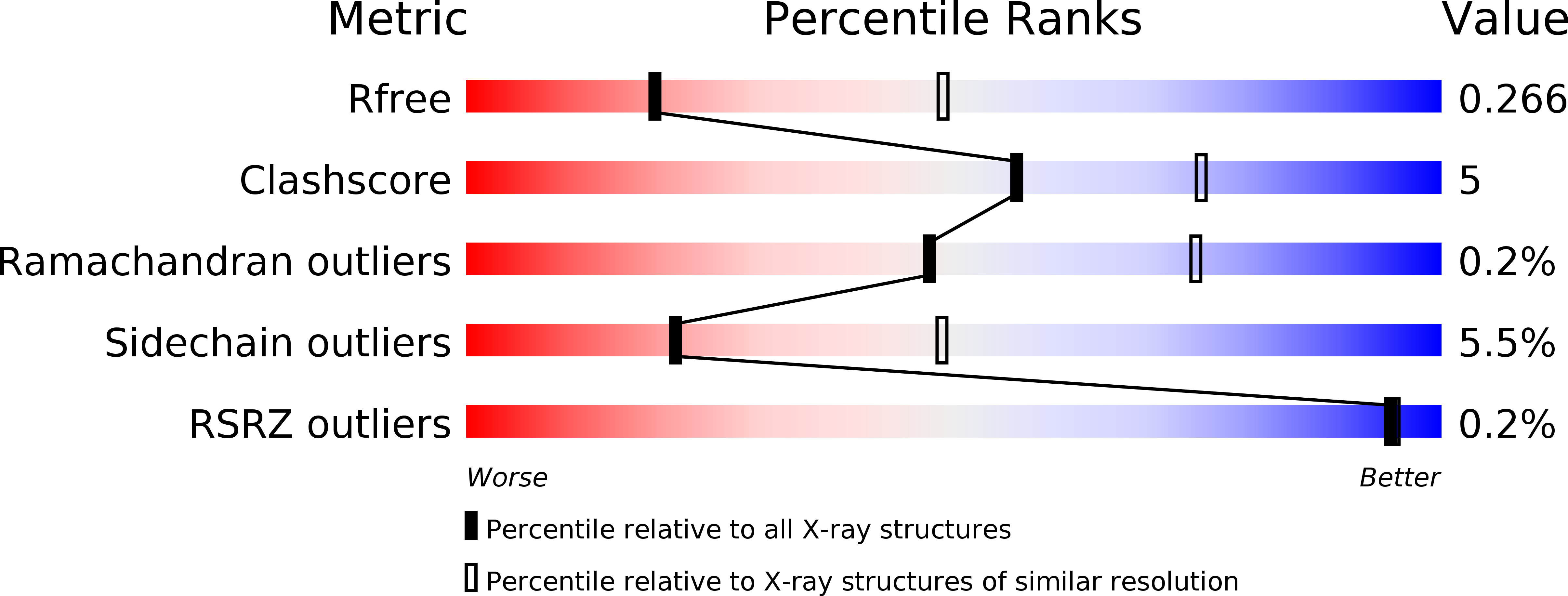
Macromolecular Entities
Polymer Type:polypeptide(L)
Molecule:Riboflavin synthase subunit alpha
Chain IDs:A, B, C
Chain Length:210
Number of Molecules:3
Biological Source:Brucella abortus
Ligand Molecules
Primary Citation
Crystallographic and kinetic study of riboflavin synthase from Brucella abortus, a chemotherapeutic target with an enhanced intrinsic flexibility.
Acta Crystallogr.,Sect.D 70 1419 1434 (2014)
PMID: 24816110 DOI: 10.1107/S1399004714005161

Abstact

Riboflavin synthase (RS) catalyzes the last step of riboflavin biosynthesis in microorganisms and plants, which corresponds to the dismutation of two molecules of 6,7-dimethyl-8-ribityllumazine to yield one molecule of riboflavin and one molecule of 5-amino-6-ribitylamino-2,4(1H,3H)-pyrimidinedione. Owing to the absence of this enzyme in animals and the fact that most pathogenic bacteria show a strict dependence on riboflavin biosynthesis, RS has been proposed as a potential target for antimicrobial drug development. Eubacterial, fungal and plant RSs assemble as homotrimers lacking C3 symmetry. Each monomer can bind two substrate molecules, yet there is only one active site for the whole enzyme, which is located at the interface between two neighbouring chains. This work reports the crystallographic structure of RS from the pathogenic bacterium Brucella abortus (the aetiological agent of the disease brucellosis) in its apo form, in complex with riboflavin and in complex with two different product analogues, being the first time that the structure of an intact RS trimer with bound ligands has been solved. These crystal models support the hypothesis of enhanced flexibility in the particle and also highlight the role of the ligands in assembling the unique active site. Kinetic and binding studies were also performed to complement these findings. The structural and biochemical information generated may be useful for the rational design of novel RS inhibitors with antimicrobial activity.

Legend

Protein

Chemical

Disease

Primary Citation of related structures
Feedback Form
Name
Email
Institute
Feedback