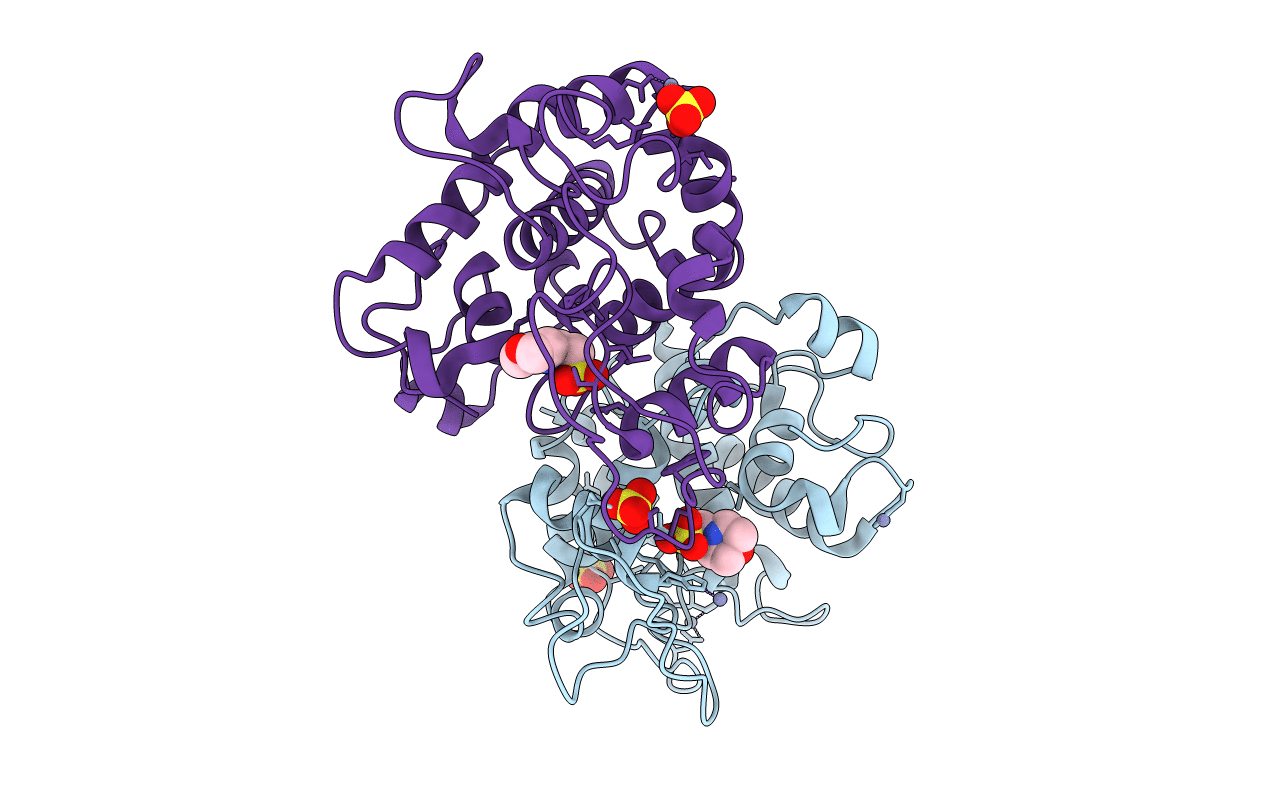
4DWX image
Deposition Date 2012-02-27
Release Date 2012-08-15
Last Version Date 2024-10-30
Entry Detail
PDB ID:
4DWX
Keywords:
Title:
Crystal Structure of a Family GH-19 Chitinase from rye seeds
Biological Source:
Source Organism:
Secale cereale (Taxon ID: 4550)
Host Organism:
Method Details:
Experimental Method:
Resolution:
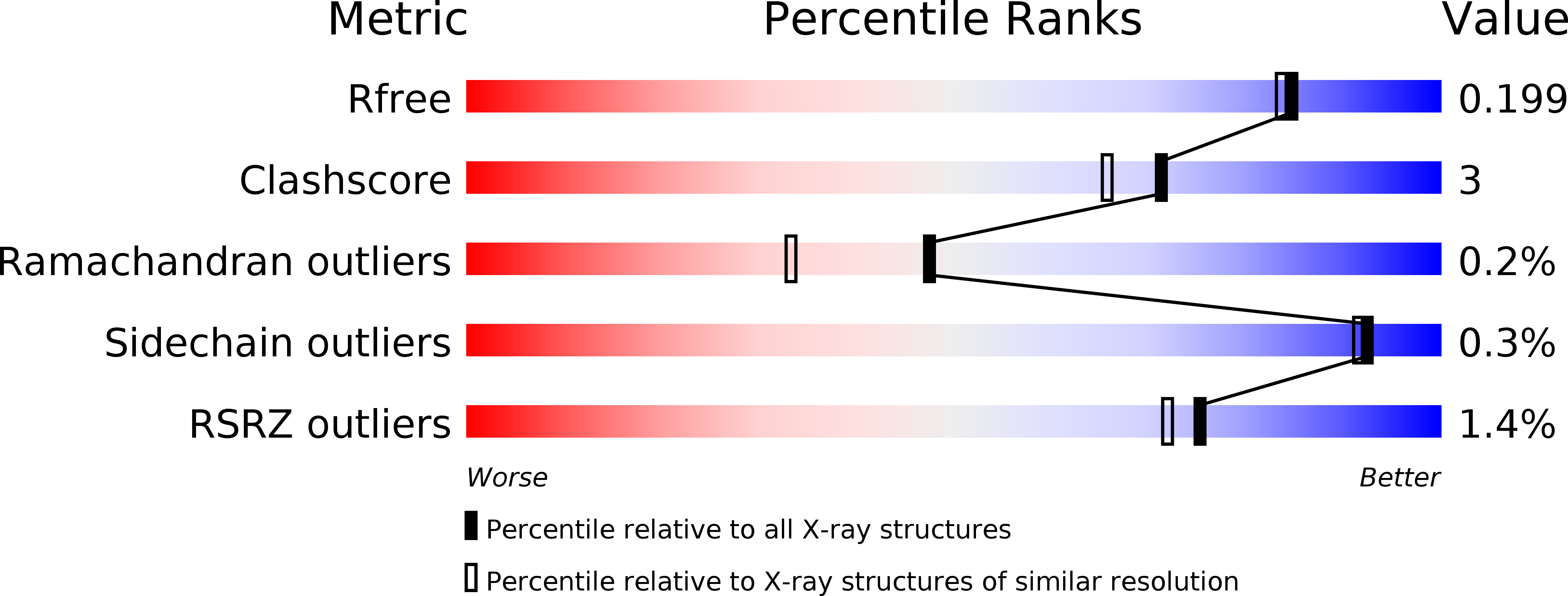
1.80 Å
R-Value Free:
0.20
R-Value Work:
0.17
R-Value Observed:
0.17
Space Group:
P 21 21 21
Macromolecular Entities
Structures with similar UniProt ID
Protein Blast
Polymer Type:polypeptide(L)
Molecule:Basic endochitinase C
Gene (Uniprot):rscc
Chain IDs:A, B
Chain Length:244
Number of Molecules:2
Biological Source:Secale cereale
Primary Citation
Crystal structure and chitin oligosaccharide-binding mode of a 'loopful' family GH19 chitinase from rye, Secale cereale, seeds
Febs J. 279 3639 3651 (2012)
PMID: 22831795 DOI: 10.1111/j.1742-4658.2012.08723.x

Abstact

The substrate-binding mode of a 26-kDa GH19 chitinase from rye, Secale cereale, seeds (RSC-c) was investigated by crystallography, site-directed mutagenesis and NMR spectroscopy. The crystal structure of RSC-c in a complex with an N-acetylglucosamine tetramer, (GlcNAc)(4) , was successfully solved, and revealed the binding mode of the tetramer to be an aglycon-binding site, subsites +1, +2, +3, and +4. These are the first crystallographic data showing the oligosaccharide-binding mode of a family GH19 chitinase. From HPLC analysis of the enzymatic reaction products, mutation of Trp72 to alanine was found to affect the product distribution obtained from the substrate, p-nitrophenyl penta-N-acetyl-β-chitopentaoside. Mutational experiments confirmed the crystallographic finding that the Trp72 side chain interacts with the +4 moiety of the bound substrate. To further confirm the crystallographic data, binding experiments were also conducted in solution using NMR spectroscopy. Several signals in the (1) H-(15) N HSQC spectrum of the stable isotope-labeled RSC-c were affected upon addition of (GlcNAc)(4) . Signal assignments revealed that most signals responsive to the addition of (GlcNAc)(4) are derived from amino acids located at the surface of the aglycon-binding site. The binding mode deduced from NMR binding experiments in solution was consistent with that from the crystal structure.

Legend

Protein

Chemical

Disease

Primary Citation of related structures
Feedback Form
Name
Email
Institute
Feedback