Maintenance Mode: Some services may turn out to be unavailable. We apologize for the inconvenience!

4DFY image
Deposition Date 2012-01-24
Release Date 2012-02-15
Last Version Date 2024-10-30
Entry Detail
PDB ID:
4DFY
Keywords:
Title:
Crystal structure of R194A mutant of cAMP-dependent protein kinase with unphosphorylated activation loop
Biological Source:
Source Organism(s):
Mus musculus (Taxon ID: 10090)
Expression System(s):
Method Details:
Experimental Method:
Resolution:
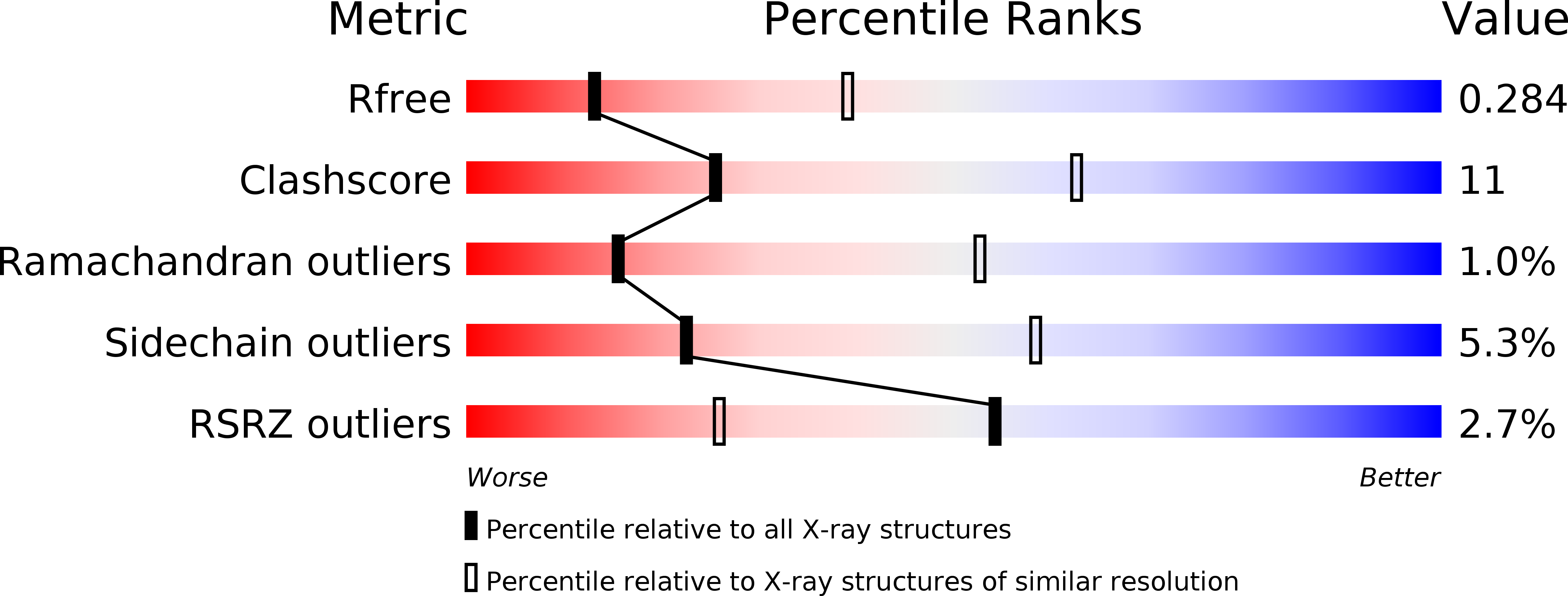
3.00 Å
R-Value Free:
0.28
R-Value Work:
0.25
R-Value Observed:
0.25
Space Group:
P 32 2 1
Macromolecular Entities
Structures with similar UniProt ID
Protein Blast
Polymer Type:polypeptide(L)
Molecule:cAMP-dependent protein kinase catalytic subunit alpha
Gene (Uniprot):Prkaca
Mutagens:R194A
Chain IDs:A, B (auth: E)
Chain Length:371
Number of Molecules:2
Biological Source:Mus musculus
Modified Residue
Compound ID Chain ID Parent Comp ID Details 2D Image
SEP A SER PHOSPHOSERINE
Primary Citation
Structural basis for the regulation of protein kinase a by activation loop phosphorylation.
J.Biol.Chem. 287 14672 14680 (2012)
PMID: 22334660 DOI: 10.1074/jbc.M111.335091

Abstact

The catalytic subunit of cAMP-dependent protein kinase (PKA) is a member of the AGC group of protein kinases. Whereas PKA has served as a structural model for the protein kinase superfamily, all previous structures of the catalytic subunit contain a phosphorylated activation loop. To understand the structural effects of activation loop phosphorylation at Thr-197 we used a PKA mutant that does not autophosphorylate at Thr-197. The enzyme crystallized in the apo-state, and the structure was solved to 3.0 Å. The N-lobe is rotated by 18° relative to the wild-type apoenzyme, which illustrates that the enzyme likely exists in a wide range of conformations in solution due to the uncoupling of the N- and C-lobes. Several regions of the protein including the activation loop are disordered in the structure, and there are alternate main chain conformations for the magnesium positioning loop and catalytic loop causing a complete loss of hydrogen bonding between these two active site structural elements. These alterations are reflected in a 20-fold decrease in the apparent phosphoryl transfer rate as measured by pre-steady-state kinetic methods.

Legend

Protein

Chemical

Disease

Primary Citation of related structures
Feedback Form
Name
Email
Institute
Feedback