4DCJ image
Deposition Date 2012-01-17
Release Date 2012-12-12
Last Version Date 2025-03-26
Entry Detail
PDB ID:
4DCJ
Title:
Crystal structure of caspase 3, L168D mutant
Biological Source:
Source Organism:
Homo sapiens (Taxon ID: 9606)
Host Organism:
Method Details:
Experimental Method:
Resolution:
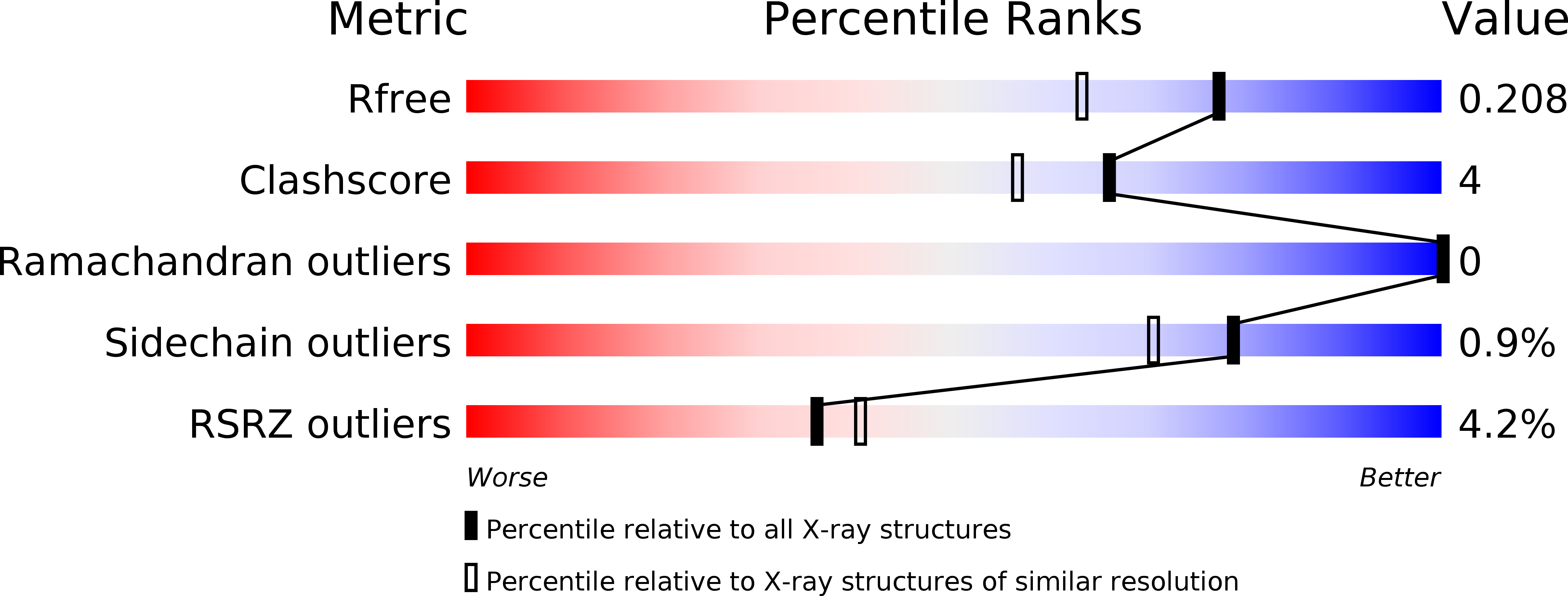
1.70 Å
R-Value Free:
0.21
R-Value Work:
0.19
R-Value Observed:
0.19
Space Group:
P 1 21 1
Macromolecular Entities
Structures with similar UniProt ID
Protein Blast
Polymer Type:polypeptide(L)
Molecule:Caspase-3 subunit p17
Gene (Uniprot):CASP3
Mutagens:L168D
Chain IDs:A, D
Chain Length:147
Number of Molecules:2
Biological Source:Homo sapiens
Structures with similar UniProt ID
Protein Blast
Polymer Type:polypeptide(L)
Molecule:Caspase-3 subunit p12
Gene (Uniprot):CASP3
Chain IDs:B, E
Chain Length:108
Number of Molecules:2
Biological Source:Homo sapiens
Peptide-like Molecules
PRD_000422
Primary Citation
Molecular insight into the role of the leucine residue on the L2 loop in the catalytic activity of caspases 3 and 7
Biosci.Rep. 32 305 313 (2012)
PMID: 22304005 DOI: 10.1042/BSR20120009

Abstact

Various apoptotic signals can activate caspases 3 and 7 by triggering the L2 loop cleavage of their proenzymes. These two enzymes have highly similar structures and functions, and serve as apoptotic executioners. The structures of caspase 7 and procaspase 7 differ significantly in the conformation of the loops constituting the active site, indicating that the enzyme undergoes a large structural change during activation. To define the role of the leucine residue on the L2 loop, which shows the largest movement during enzyme activation but has not yet been studied, Leu168 of caspase 3 and Leu191 of caspase 7 were mutated. Kinetic analysis indicated that the mutation of the leucine residues sometimes improved the Km but also greatly decreased the kcat, resulting in an overall decrease in enzyme activity. The tryptophan fluorescence change at excitation/emission = 280/350 nm upon L2-L2' loop cleavage was found to be higher in catalytically active mutants, including the corresponding wild-type caspase, than in the inactive mutants. The crystal structures of the caspase 3 mutants were solved and compared with that of wild-type. Significant alterations in the conformations of the L1 and L4 loops were found. These results indicate that the leucine residue on the L2 loop has an important role in maintaining the catalytic activity of caspases 3 and 7.

Legend

Protein

Chemical

Disease

Primary Citation of related structures
Feedback Form
Name
Email
Institute
Feedback