4CHX image
Deposition Date 2013-12-04
Release Date 2014-07-23
Last Version Date 2024-01-31
Entry Detail
PDB ID:
4CHX
Keywords:
Title:
Crystal structure of MltC in complex with disaccharide pentapeptide DHl89
Biological Source:
Source Organism:
Host Organism:
Method Details:
Experimental Method:
Resolution:
2.45 Å
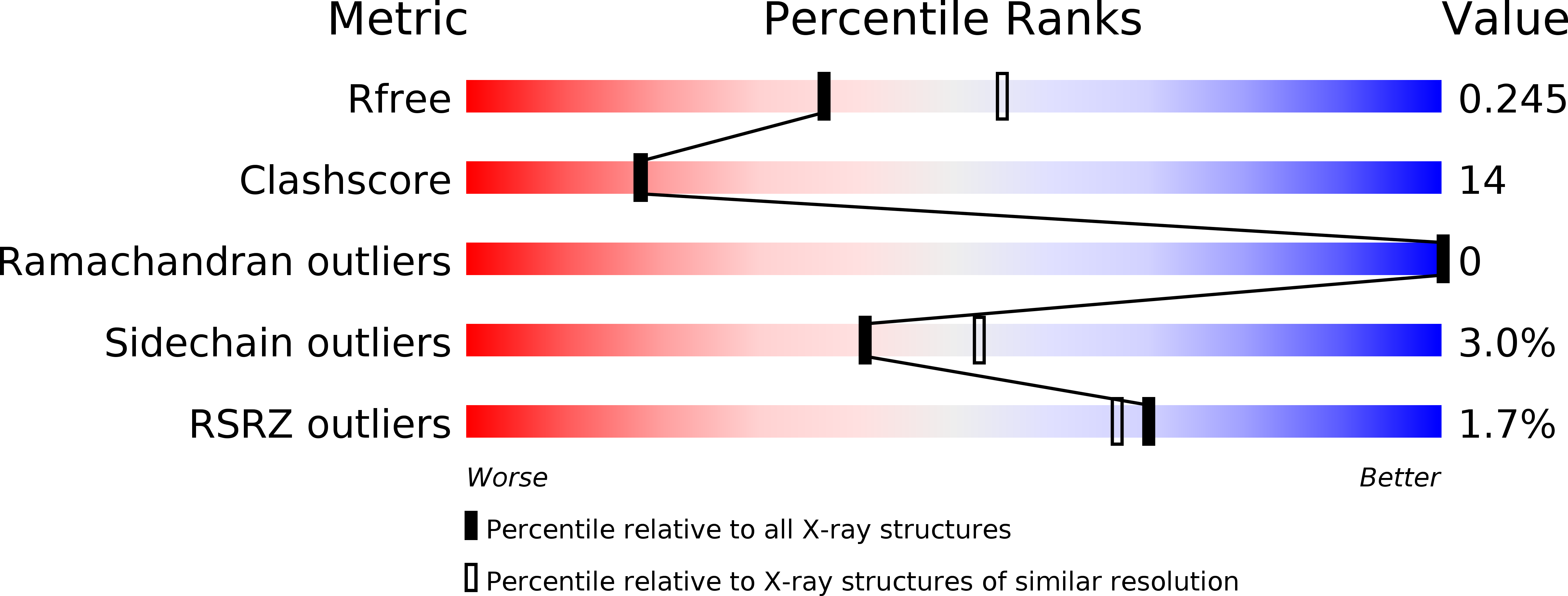
R-Value Free:
0.24
R-Value Work:
0.19
R-Value Observed:
0.19
Space Group:
P 1 21 1
Macromolecular Entities
Structures with similar UniProt ID
Protein Blast
Polymer Type:polypeptide(L)
Molecule:Membrane-bound lytic murein transglycosylase C
Gene (Uniprot):mltC
Mutagens:YES
Chain IDs:A, B
Chain Length:341
Number of Molecules:2
Biological Source:Escherichia coli
Polymer Type:polypeptide(L)
Molecule:NAG-ANHMUR-PENTAPEPTIDE
Chain IDs:C
Chain Length:5
Number of Molecules:1
Biological Source:SYNTHETIC CONSTRUCT
Modified Residue
Compound ID Chain ID Parent Comp ID Details 2D Image
API C LYS 2,6-DIAMINOPIMELIC ACID
Primary Citation
Structure and Cell Wall Cleavage by Modular Lytic Transglycosylase Mltc of Escherichia Coli.
Acs Chem.Biol. 9 2058 ? (2014)
PMID: 24988330 DOI: 10.1021/CB500439C

Abstact

The lytic transglycosylases are essential bacterial enzymes that catalyze the nonhydrolytic cleavage of the glycan strands of the bacterial cell wall. We describe here the structural and catalytic properties of MltC, one of the seven lytic transglycosylases found in the genome of the Gram-negative bacterium Escherichia coli. The 2.3 Å resolution X-ray structure of a soluble construct of MltC shows a unique, compared to known lytic transglycosylase structures, two-domain structure characterized by an expansive active site of 53 Å length extending through an interface between the domains. The structures of three complexes of MltC with cell wall analogues suggest the positioning of the peptidoglycan in the active site both as a substrate and as a product. One complex is suggested to correspond to an intermediate in the course of sequential and exolytic cleavage of the peptidoglycan. Moreover, MltC partitioned its reactive oxocarbenium-like intermediate between trapping by the C6-hydroxyl of the muramyl moiety (lytic transglycosylase activity, the major path) and by water (muramidase activity). Genomic analysis identifies the presence of an MltC homologue in no less than 791 bacterial genomes. While the role of MltC in cell wall assembly and maturation remains uncertain, we propose a functional role for this enzyme as befits the uniqueness of its two-domain structure.

Legend

Protein

Chemical

Disease

Primary Citation of related structures
Feedback Form
Name
Email
Institute
Feedback